

Saved Bookmarks
| 1. |
Explain the bond formation in ethylene and acetylene. |
|
Answer» Solution :Bonding in Ethylene. `C_(2)H_(4)`: (i) onding in ethylene can be explained by hybridisation concept. (ii) The valency of carbon is 4. The electronic CONFIGURATION of carbon is `ls^(2)" "2s^(2)" "2p_(x)^(1)" "2p_(y)^(1)" "2p_(z)^(0).` One electron from 2s orbital is promoted to `2p_(z)` orbital in the excited state to satisfy the valency of carbon. 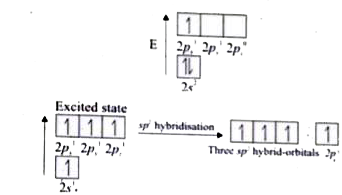 (iii) In ethylene both the carbon ATOMS undergo `sp^(2)` hybridisation involving `2s, 2p_(x) and 2p_(y)` orbitals resulting in 3 equivalent `sp^(2)` hybridised orbitals LYING in the XY plane at an angle of `120^(@)`other. The unhybridised `2p_(z)` orbital lies perpendicular to the xy plane. 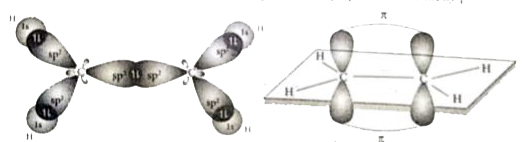 (iv) One of the `sp^(2)`hybridised orbitals of each carbon atoms lying along the X-axis linearly overlaps with each other resulting in the formation of C- C sigma bond. The other two `sp^(2)`hybridised orbitals of both carbon atom linearly OVERLAP with the four Is orbitals of four hydrogen atoms leading to the formation of two C-H sigma bonds on each carbon atom. (v) The unhybridised `2p_(z)` orbital of both carbon atoms can overlap only sideways as they are not in the molecular axis. This lateral overlap results in the formation of a pi bond between the two carbon atoms. Bonding in acetylene `(C_(2)H_(2))`: (i) The electronic configuration of valence shell of carbon atom in the ground state is `[He]2s^(2)" "2p_(x)^(1)" "2p_(z)^(0).`One electron from 2s orbital is promoted to `2p_(z)` orbital in the excited state to satisfy the valency of carbon. (ii) n acetylene molecule, both the carbon atoms are in sp hybridised state. I he 2s and `2p_(x)` Orbilals resulting in two equivalent sp hybridised orbitals are formed lying in a straigh: line along the X-axis. The unhybridised `2p_(y) and 2p_(z)`orbitals lie perpendicular to the X-axis. 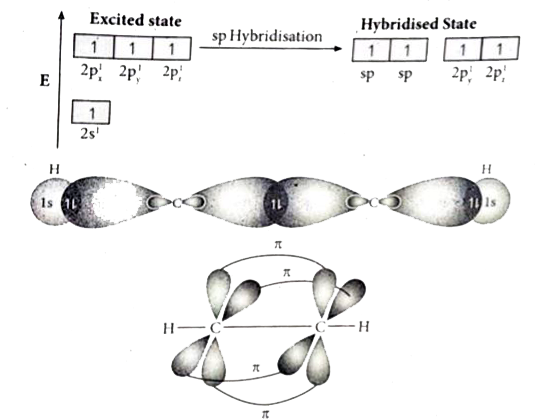 (iii) One of the two sp hybridised orbitals of each carbon atom linearly overlaps with each other resulting in the formation of a C-C sigma bond. The other sp hybridised orbital of both carbon atoms linearly overlap with the two Is orbitals of two hydrogen atoms leading to the formation of one C-H sigma bond on each carbon atom. (iv) The unhybridised `2p_(y) and 2p_(z)`orbitals of each carbon atom overlap sideways. This lateral overlap results in the formation of two pi bonds. `(p_(y) - p_(y)) and (p_(z) - p_(z))` between the two carbon atoms. |
|