

Saved Bookmarks
| 1. |
Explain the bond formation in SF_(4) and CCl_(4) usinghybridisation concept. |
|
Answer» Solution :In `SF_(4),` the central atom is `sp^(3)` d hybridised. he molecule `SF_(4)` will have a total 34 valence electron: 6 from sulpur, 7 each from four fluorine atoms. Sulphur atom will from 4 single bonds with fluorine atoms. These bonds account for the 8 electrons out of the 34 valence electrons. Each fluorine atom will have 3 1one pair of electrons in order to have a complete octet structure. These lone PAIRS will use up 24 valence electrons. So the total used valence electrons, are 32. The remaining 2 electrons will be placed on the sulphur atom as a lone pair. 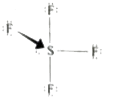 Sulphur atom GETS a total of 10 electrons 8 from the bonds and 2 as lone pair. This is quite possible for sulphur because it has easy access to its 3d orbital which means that it can expand its octet and accommodate more than 8 electrons. Sulphur FORMS 4 single bonds and has 1 lone pair which means that its steric number is equal to 5. In this case sulphur will use five hybrid orbitals, such as one 3s orbital three 3p orbitals and one 3d orbital. So the central atom is `sp^(3)`d hybridised. (ii) `C C1_(4)` It is not NECESSARY to invoke hybridisation especially in `C C1_(4).`It mustbe invoked for all tetrahedral bonds of carbon and other atoms. The electronic configuration of an isolated carbon atom in its ground state is `1s^(2)" "2s^(2)" "2p^(2)`. `C C1)(4)`is a tetrahedral molecule comprising of four single bonds known as `signa` bonds between the carbon atom and the chlorine atoms. In this type of bonding, the 2s orbital and three 2p orbitals of carbon atoms are mixed to produce four identical orbitals, a process known as `sp^(3)`hybridisation. 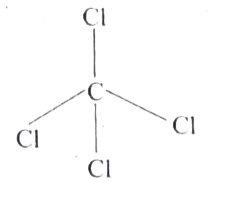
|
|