

Saved Bookmarks
| 1. |
Explain the following: (a) In sodium fusion test, why excess of sodium is taken? (b) acetals give positive test with 2,4 dinitrophenylhydrazine.. (c) A polyhydroxy alcohol has the molecualr weight of 168. On acetylation, the molecular weight increases to 294. Determine the number of (-OH) groups present in the alcohol. (d) Chlorobenzene when treated with enhanilic AhNO_3 does not give white precipate. |
Answer» Solution :`RCH(OR)_(2) + H_(2) O overset(H^(+))(to) underset("Gives positive result")(RCHO + 2ROH)` 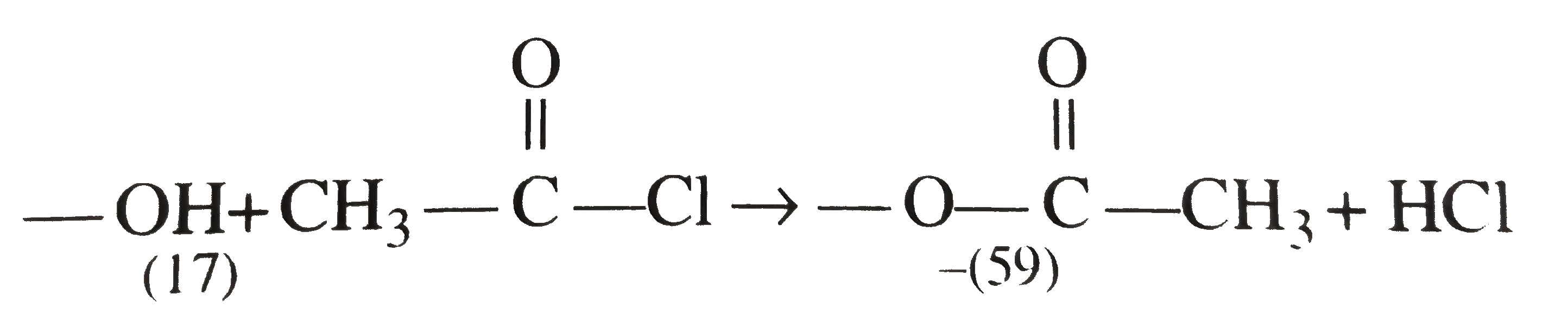 (a) IF sulphar and nitrogen both are present, sodium thiocynate `(NaCNS)` may be produced. This may GIVE a red colouration with `Fe^(3+)` but will not respond to tests for cyanide or sulphide ions. With EXCESS of sodium, the thiocynate, if formed, will be decomposed line this: `NaCNS+2NararrNaCN+Na_2S` (b) `2,4-` Dinitrophenylhydrizine reagent is prepared as follows. It is suspended in methanol and then conc. `H_2SO_4` is added. The mixture becomes warm and the solid usually dissolves completely. IF this reagent is added to acetals, the acetals get readily hydrolysed by acids, and give a positive with 2-4 DNP. (c) So when one (`-OH)` group is replaced by an ecetyl group, the molecular weight increases by `59-17=42`. Here the total increase in the molecular weight `=294-168=126` So the NUMBER of `(-OH)` groups present`=(126)/(42)=3` (d) Aromatic compounds in which halogen is attached directly to the aromatic nucleus (e.g., chlorobenzene do not react with ethanolic `AgNO_3` even on heating due to the high bond energy of the `(C---Cl)` bond which has partial double bond charactor. |
|