

Saved Bookmarks
| 1. |
Explain the formation of molecule orbital by LCAO method. |
|
Answer» Solution :Linear COMBINATION of atomic (LCAO): Molecular orbitals can be formed by the linear combination of atomic orbitals (LCAO). Let us consider the combination of two atomic orbitals of two hydbrogen atom. Each hydrogen atom 1s atomic orbitals containig one electrons `(1s^(1))`. Two atomic orbitals combine linearly in two ways i.e.,SYMMETRIC combination and asymmetric combination. During symmetric combination, the wave functions of the two stomijc orbitals are added. If `y_(A) and y_(B)` are the wave functions of the two atomic orbitals, `Psi_(A)+Psi_(AB)"".....(1)` Where YAB squaring the equation (1) on both sides, `(Psi_(A)+Psi_(B))^(2)= `Psi_(AB)^(2)` `Psi_(A)^(2)+Psi_(B)^(2)+2Psi_(A)Psi_(B)=Psi_(AB)^(2) or Psi_(AB)^(2) gt Psi_(A)^(2)+Psi_(B)^(2)` The above expression indicates that hte probablity of finding electrons between the nuclei is greaterthanthe probability electrons away from the NUCLIE. 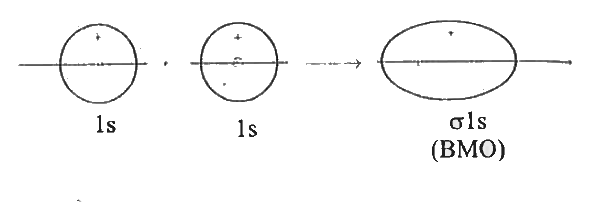 Such a molecular orbital has lower energy than the energy of the atomic orbitals. Hence it fevours the bond formationand this orbitals is called bonding molecuar orbital (s1s). The formation of bonding molecular orbitals orbitals s1s is represented in the fig. Asymmetric combination: During asyymetric combinatin of atomic orbitals, the wave FUNCTION are substrated. `Psi_(A)-Psi_(B)=Psi_(AB) ""....(2)` where `Psi_(AB)` is the wave of the molecular orbitals, formed by the asymmetric combination of atomic orbitals. By squring the equation (2) on both sides, `(Psi_(A)-Psi_(B))^(2)= Psi_(AB)^(+2)` or `Psi_(A)^(2)+Psi_(B)^(2)-2Psi_(A)Psi_(B)= Psi_(AB)^(+2) or Psi_(A)^(2)+Psi_(B)^(2) gt Psi_(AB)^(+2)`  Such a molecular orbitals has higher energy than the energy of the amotic orbitals. Hence it does nor favour the bond formation and this orbitals called anitbonding molecular orbitals `(S**1s)`. |
|