

Saved Bookmarks
| 1. |
Explain the relative velocity and its two cases. |
Answer» Solution :Case 1 TWO observes and one moving object : 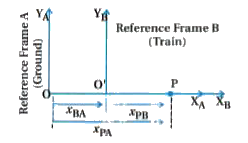 Let A be the frame of reference associated with person standing on the ground. B is the frame of reference associated with the train moving with UNIFORM velocity. Both these reference frames are inertial frames of reference. From the figure, `x_(PA)=x_(PB) +x_(BA)` Differentiating with respect to t, `(dx _(PA))/(dt) = (dx _(PB))/(dt )+ (dx _(BA))/(dt)` But ` (dx _(PA))/(dt) = v _(PA),( dx _(PB))/(dt)= v _(BA)` `THEREFORE v (PA) = v _(PB) + v _(BA)` `therefore v _(BA) = v _(PA) - v_({PB)` Where `v _(PA)=` Velocity of P with respect to reference frame A. `v _(PB)=` Velocity of P with respect ot reference frame B. `v _(BA)=` Velocity of reference frame B with respect to reference frame A. Case 2 One observer and two moving objects :  Suppose particales A andB motion in reference of frame O- XY O - YZ in ground. Suppose velocities of two particles A and B are respectively `vec(v _(A)) and vec(v_(B))` releative to a FARME of reference (suppose earth) then velocity `v _(AG) and v _(GB).` Then velocity of B relative to A is, `v _(BA)= v _(GA) - v _(GB)` `=- v _(GB) + v _(GB)` ` therefore v_(BA) =-v _(BG)-v_(AG)` `[because v_(BG) =- v _(GB) and v _(GA) =-v _(AG) ]` `=v _(B) -v_(A)` and velocity of A relative to B is `v_(AB) =v_(A) -v_(B)` `= v _(AG)-v_(BG)` |
|