

Saved Bookmarks
| 1. |
Give the structures of the compounds which on reductive ozonolysis give : (i)propane-1,3-dial(ii)glyoxal and formaldehyde (iii)acetaldehyde, formaldehyde and carbon dioxide. |
Answer» Solution :(i)Since reductive ozonolysis gives only one product i.e., propane-1,3-dial , therefore , the compound must be a cyclic alkene , i.e., cyclopropene, 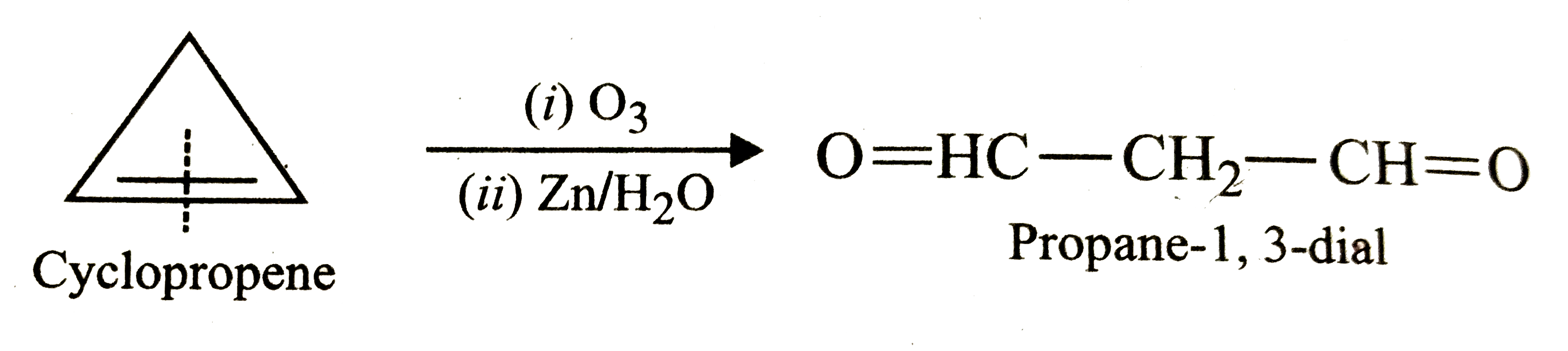 (ii)Since TWO products , i.e., glyoxal and formaldehyde are obtained , therefore , the compound must be acyclic. Further, since glyoxal (OCH-CHO) contains two aldehyde groups , therefore, on either side, there must a=`CH_2` group. Thus , the compound is 1,3-butadiene `underset"1,3-Butadiene"(CH_2=CH-CH=CH_2)underset((ii)Zn//H_2O)overset((i)O_3)to underset"Formaldehyde"(HCHO)+underset"Glyoxal"(OCH-CHO)+HCHO` (iii)Formation of `CO_2` indicates that on either side of this carbon, there is a DOUBLE BOND. Since `CH_3CHO` and HCHO are the two aldehyde obtained, therefore , this carbon is attached to `CH_3CH`= group on one side and `CH_2`=group on the other side. Therefore, the compound is 1,2-butadiene. `underset"1,2-Butadiene"(CH_3CH=C=CH_2)underset((ii)H_2O)overset((i)O_3)to underset"Glyoxal"(CH_3CHO)+O=C=O + underset"Formaldehyde""HCHO"` |
|