

Saved Bookmarks
| 1. |
(i) Explain-eletromeric effect. (ii) Give the example forbeta-elimination. |
|
Answer» Solution :(i) Electromeric effect. 1. The electromic eggect refers to the polarity produced in a multiple bonded compound when it is ATTACKED by a reagent when a double or triple bond is exposed to an attack by an electrophile the two `PI` electrons which from the `pi` bond are completely transferred to one atom or the other. 2. When a nucleophile approaches the carbonyl compound, the `pi`-electrons. between C and O is instantaneously shifed to the more wlwctrobegative oxygen, This make the carbon electron deficient and hus facilitating the formation of a new bond between the INCOMING nucleophile and the corbonyl carbon atom  . . 3. Wgen an electrophile such as `H^(+)` approacges an alkene molecule the `pi` electron are instantaneously shiftedto the electrophilr and a new bond is formed between carbon and hydrogen, This makes the other carbon electron deficient and hence it acquires a positive charge  4. This effect denotes as E-effect. (ii) ~beta~-elimination: Elimination reactions ibvolve the cleavage of a `sigma` bond and formation of a `pi` bond. A nicleophilic pair of electrons heads into a new `pi` bond as a leaving group departs. This process is called `beta`-elmination because the bond `beta` to the nuclwophilic pair of electrons BREAKS. Example: 1. n-propyl bromide on reaction with alcoholic KOH give propene. In this reaction hydrozen and Br are elimineted.  2. Acid-catalysed dehydration of alcohols 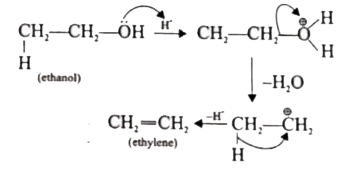 . .
|
|