

Saved Bookmarks
| 1. |
If a particle elastically collides obliquely with a particle of same mass at rest then show that they move perpendicular to each other after collision in two dimension. |
Answer» Solution :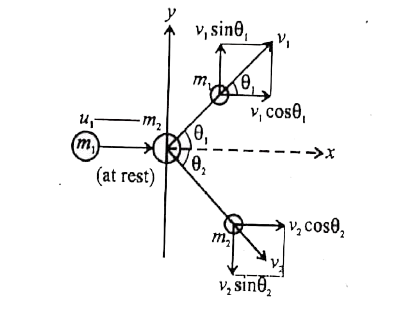 After the COLLISION, the rectangular components of the momentum of `m_(1)` are (i) `m_(1)v_(1)costheta`, along positive x axis (II) `m_(1)v_(1)sintheta`, along positive y axis After the collision, the rectangular components of themomentum of `m_(2)` are (i) `m_(2)v_(2)costheta`, along positive x axis `m_(2)v_(2)sintheta`, along positive y axis Applying the law of conservation of momentum along x axis we get, `m_(1)u_(1)=m_(1)v_(1)costheta_(1)+m_(2)v_(2)costheta_(2)""...(1)` The initial momentum of `m_(1)` or `m_(2)` along y axis is ZERO. Applying the principle of conservation of momentum along y axis we get, `0=m_(1)thetasintheta_(1)+m_(2)v_(2)sintheta_(2)....(2)` In this problem, a particle elastically collides OBLIQUELY with a particle of same mass at rest. So the two particles are identical. `therefore m_(1)=m_(2)=m` (say) By conservation of kinetic energy for elastic collision we get, `(1)/(2)m u_(1)^(2)=(1)/(2)mv_(1)^(2)+(1)/(2)mv_(2)^(2)[becauseu_(2)=0]` Dividing by `(1)/(2)m_(2)` we get `therefore u_(1)=v_(1)^(2)+v_(2)^(2)""...(3)` By conservation of linear momentum we get `mvecu_(1)=mvecv_(1)+mvecv_(2)` Dividing by m we get `vecu_(1)=vecv_(1)+vecv_(2)""...(4)` Then `vecu_(1).vecu_(1)=(vecv_(1)+vecv_(2))(vecv_(1)+vecv_(2))` `=vecv_(1).vecv_(1)+vecv_(1).vecv_(2)+vecv_(2).vecv_(1)+vecv_(2).vecv_(2)` or `u_(1)^(2)=v_(1)^(2)+v_(2)^(2)+2vecv_(1)vecv_(2)""...(5)` But from (3) `v_(1)^(2)+v_(2)^(2)=u_(1)^(2)` `therefore` Equation (5) becomes `u_(1)^(2)=u_(1)^(2)+2vecv_(1)vecv_(2)` `therefore vecv_(1)vecv_(2)=0` This shows that the angle between `vecv_(1) and vecv_(2)` is `90^(@)`. Hence two identical particles move perpendicular to each other after collision in two dimensions. |
|