

Saved Bookmarks
| 1. |
If all the glass capillaries have same internal radius, then in which of the capillary, water will ride to move height ? |
|
Answer» Solution :The height of water in the capillary `(h = (2T)/(rhogr)costheta)` doesn't depend on shapt of the capillary. So water will raise to same height in all the tubes. (However the LENGTH of water column in the tubes can be DIFFERENT) 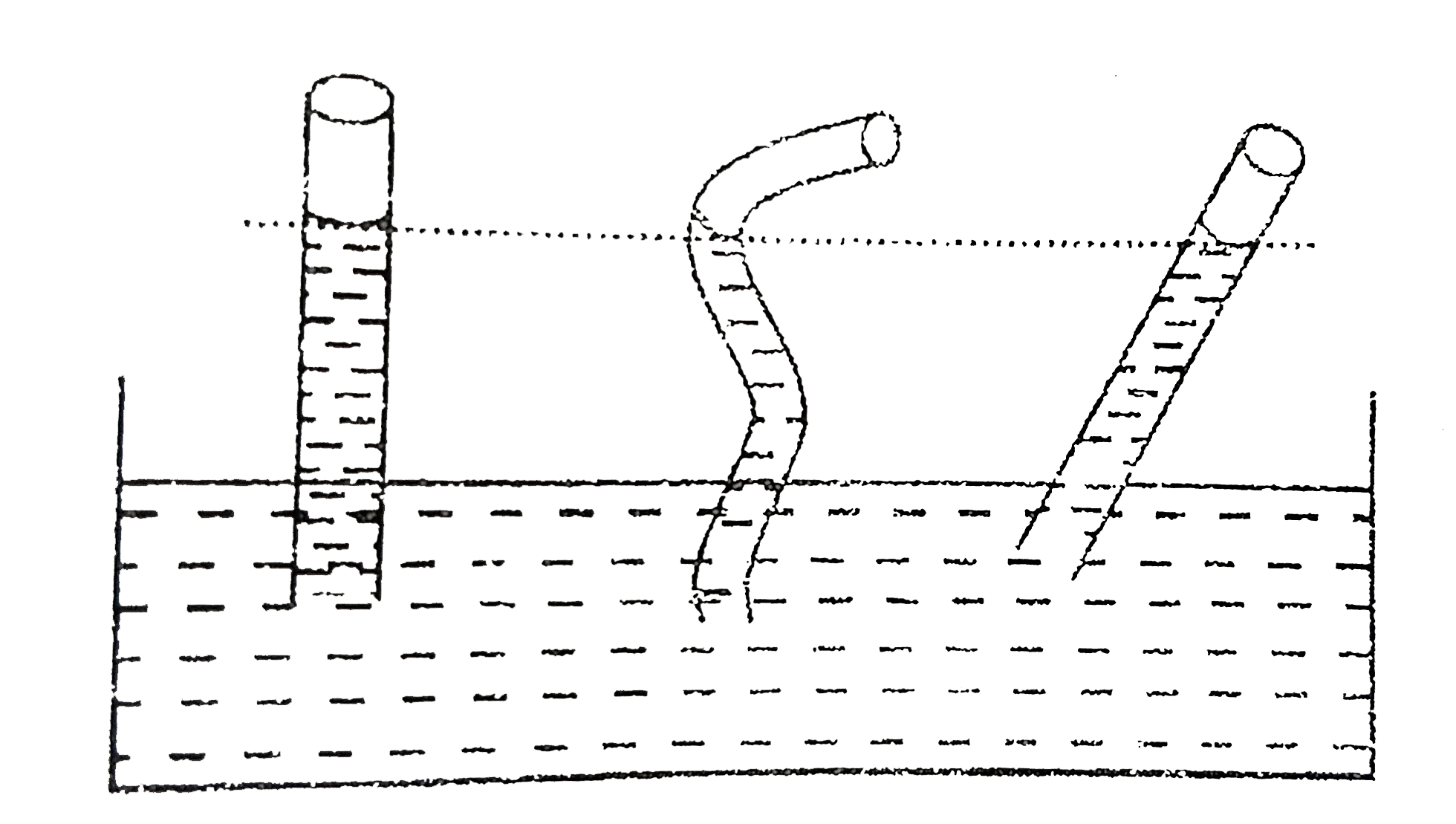 If capillary tube of insufficient length is used : Suppose a thin capillary tube of radius `0.35 mm` is dipped in water. `T_(water) = 70 xx 10^(-3) N//m, theta rarr 0`. In this case water will rise up to height `h = (2T)/(rhogR) costheta = (2 xx 70 xx 10^(-3))/(10^(3) xx 10 xx 0.35 xx 10^(-3)) = 4cm`  Now suppose we use the shorter capillarfy of smae radius. but its length is only `2 cm`. It is slightly dipped in the water. To balance the pressure, water level will ride up in the capillary, it will reach upto the upper END of the tube, and now the contact angle will CHANGE till the pressure at same horizontal level is balanced. Balancing pressure at point `A` (inside the capillry) and point `B` (outside) `P_(0) - (2T)/(R)costheta + rhogh = P_(0) rArr h = (2T)/(rhogR)costheta` `2 xx 10^(-2) = (2 xx 70 xx 10^(-3))/(10^(3) xx 10 xx 0.35 xx 10^(-3))cos theta` `costheta = (1)/(2) rArr theta = 60^(@)`. So water level will reach to the topmost point of the capillary `(= 2cm)` and now contact angle wil change to `60^(@)`, Water will not OVERFLOW out of upper end in the form of fountain. |
|