

Saved Bookmarks
| 1. |
if Sigma_(i=1)^(4)(x_(i)^(2)+y_(i)^(2))le 2x_1x_3+2x_2x_4+2y_2y_3+2y_1y_4, the points (x_1,y_1),(x_2,y_2),(x_3,y_3),(x_4,y_4) are |
|
Answer» the vertices of a rectangle Given `x_1^2+x_2^(2)+x_4^(2)+y_1^(2)+y_2^(2)+y_3^(2) +y_4^2-2x_1x_3-2x_(2)x_4-2y_(2)y_(3)-2y_(1)y_4le0` or `(x_1-x_3)^2+(x_2-x_4)^2+(y_2-y_3)^2+(y_2-y_3)^2+(y_1-y_4)^2le0` or `(x_1+x_2)/(2)=(x_3+x_4)/(2) and (y_1+y_2)/(2)=(y_4+y_3)/(2)` Hence AB and CD bisect each other. therefore, ACBD is a PARALLELOGRAM. Also, `AB^2=(x_1-x_2)^2+(y_1-y_2)^2` `=(x_3-x_4)^2+(y_4-y_3)^2` `=CD^2` 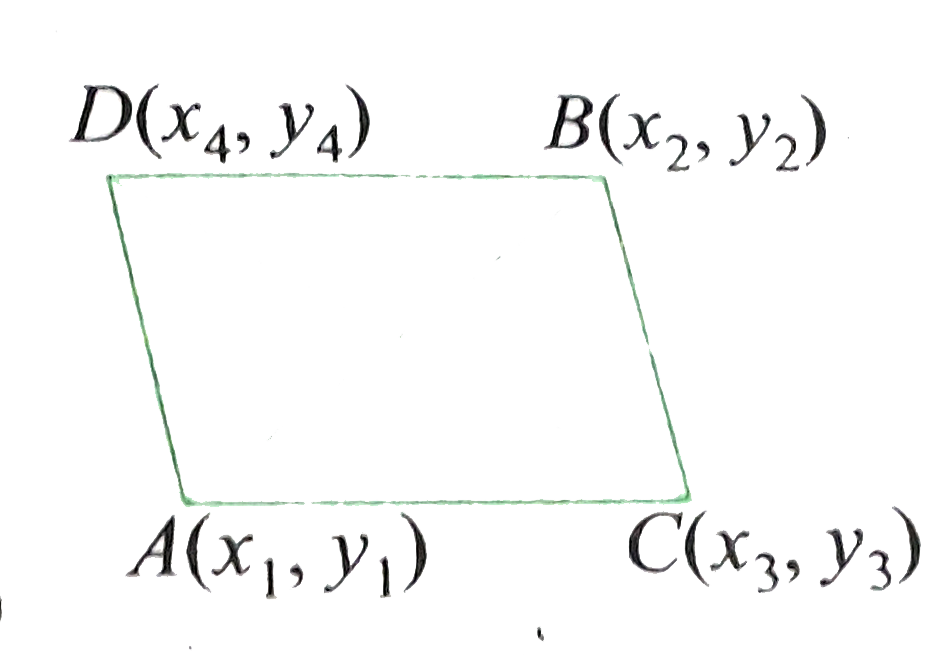
|
|