

Saved Bookmarks
| 1. |
If theta is tbe acute angle between the diagonals of a cube, then which one of the following is correct? |
|
Answer» `thetalt30^@` 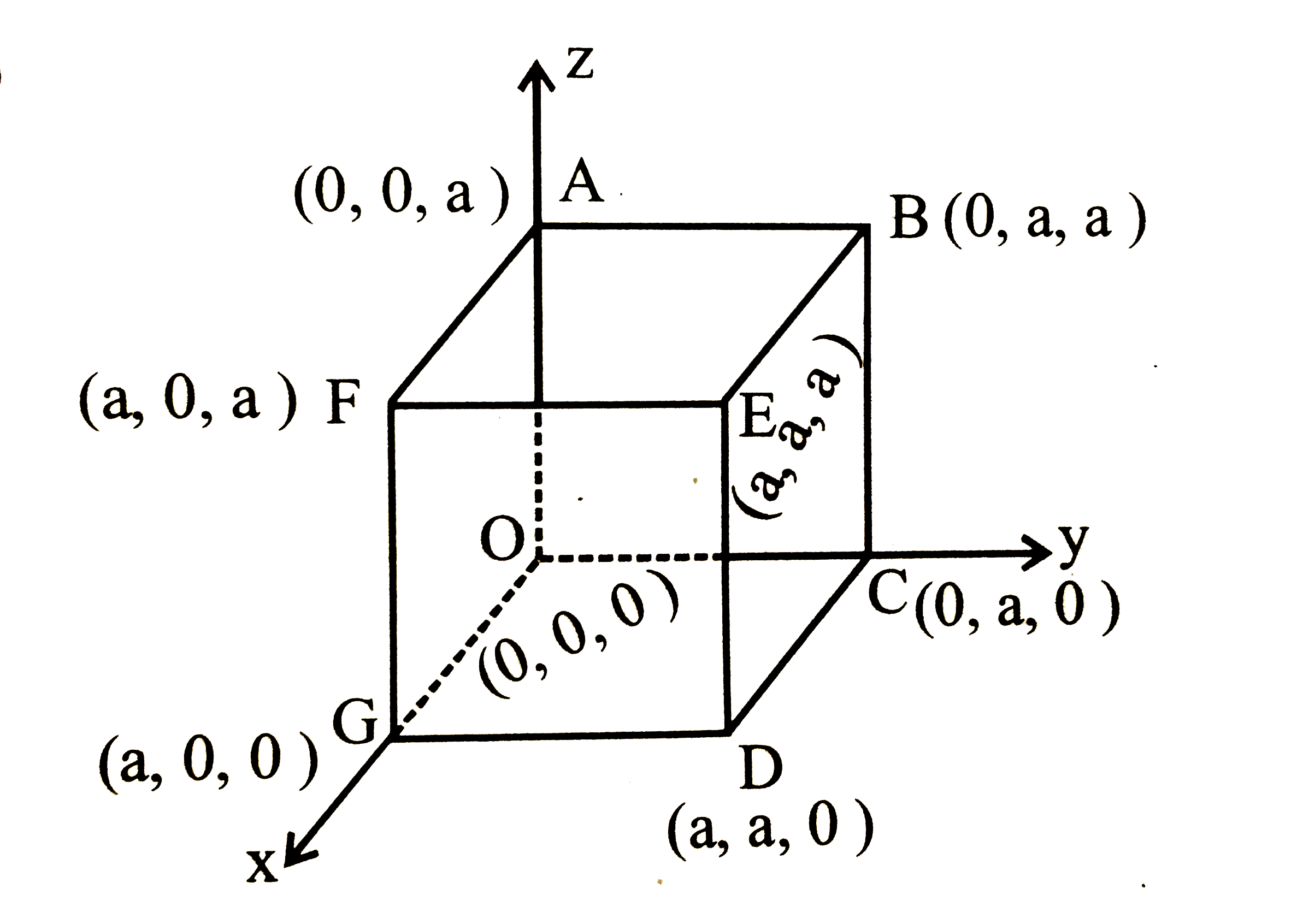 LET there be cube of side 'a'. Co-ordinates of its vertices O,A,B,C,D,E,F have be marked in the figure. Diagonals are OE, FC, GB and AD. Direction ratios `(dr_3)` of these diagonals are : `OE((a-0),(a-0),(a-0))=(a,a,a)FC((-a,a,-a),GB((-a,a,a))and AD((a,a,-a))` Their dcs are: `OE,{a/sqrt(a^2+a^2+a^2),a/sqrt(a^2+a^2+a^2),a/sqrt(a^2+a^2+a^2)}` `=(1/sqrt3,1/sqrt3,1/sqrt3)` `AD,(:a/sqrt(Sigmaa^2),a/sqrt(Sigmaa^2),(-a)/sqrt(Sigmaa^2),:)=(:1/sqrt3,1/sqrt3,(-1)/sqrt3:)` Angle ,`theta`, between AD and OE is given by `costheta=pm(1/sqrt3xx1/sqrt3+1/sqrt3xx1/sqrt3-1/sqrt3xx1/sqrt3)/sqrt({(1/sqrt3)^2+(1/sqrt3)^2+(1/sqrt3)^2}{(1/sqrt3)^2+(1/sqrt3)^2+(-1/sqrt3)^2})` `=(1/3)/(1xx1)=pm1/3` Since the cube is in positive OCTANT, we take `+1/3` So, `costheta=1/3rArrthetagt60` [Since value of `costheta` DECREASES as `theta` increases in 0 to `90^@.costheta=1" when "theta=0^@ and costheta=0" when "theta=90^@]` |
|