

Saved Bookmarks
| 1. |
In a process, 646 g of ammonia is allowed to react with 1.144 kg of CO_(2) to form urea.(i) If the entire quantity of all the reactants is not consumed in the reaction which is the limiting reagent ?(ii) Calculate the quantity of urea formed and unreacted quantity of the excess reagent. The balanced equation isunderset (H_(2)NCONH_(2) + H_(2)O)(2NH_(3) + CO_(2)) |
|
Answer» Solution :(i) The entire quantity of ammonia is CONSUMED in the reaction. So ammonia is the limiting reagent. Som,e quantity of `CO_(2)` remains unreacted, so `CO_(2)` is the excess reagent. (ii) Quantity of urea FORMED = number of moles of urea formed x MOLAR mass of urea = 19 moles `xx 60 g mol^(-1)` = 1140 g = 1.14kg Excess reagent leftover at the end of the reaction is carbon dioxide. Amount of carbon dioxide leftover = number of moles of CO, LEFT over x molar mass of `CO_(2)` = `7 "moles" xx 44 g mol^(-1)` = 308 g. 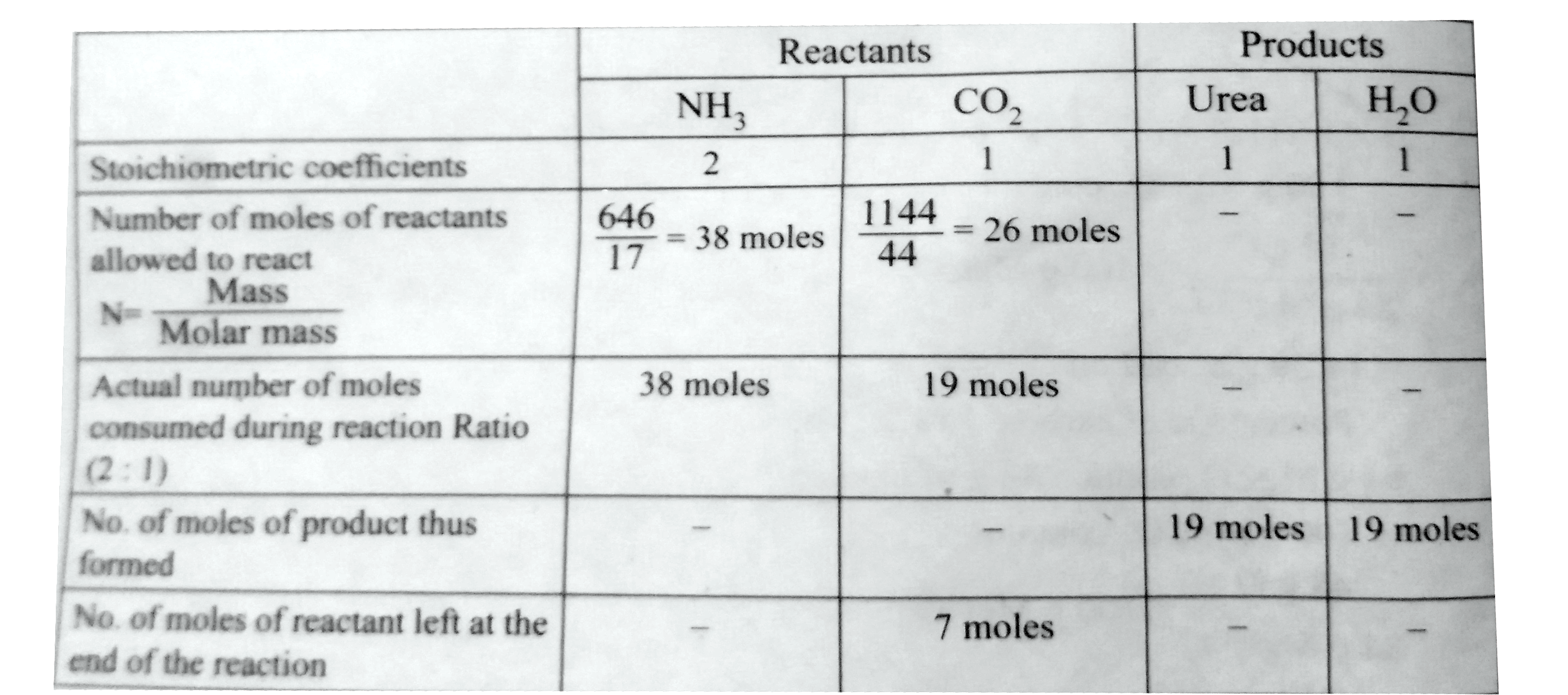
|
|