

Saved Bookmarks
| 1. |
In first case a srpings of ofrce constant K is fixed at one end a block of mass m is attahced to its other end and is placed on a horizontal frictionaless surface . In second case ,a similar springs with both ends free has a block of mass m attached to each of its ends. Each mass is streched by teh same force F in both the cases . If the mass in first released , then which of the following statement is true? |
|
Answer» The maximum extension of springs is equal in both cases .  The given situation is First case : 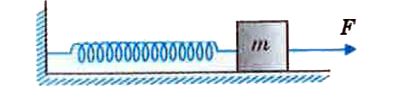 Second case : Maximum extension x produced in a spring is given by `F = kx` `rArr x = K//x` Time period of oscillation is `T = 2pisqrt((m)/(K))` In first case , one end is fixed to the wall. So, when force F is applied to block at FREE end in the direction shown, the spring is STRETCHED by exerting a force on the wall which is turn exerts ss equal and opposite reaction force no the spring. So, as a result, every coil of the spring is elongated, producing net extension x. In second case, both ends are free, so reaction force is absent. So, when force F is applied at each end in opposite directions, every coil of the spring is not elongated. 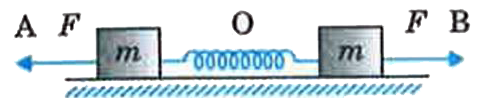 The mid point of coil is not elongated. This is equivalent to two springs, each of length l/2 are joined together at O. Now force applied at end A will produce an extension x//2 in OA and similarly force F applied at end B produces extension x/2 in part OA. `THEREFORE` The total extension in spring =`(x)/(2)+ (x)/(2) = x` so, in both first and second case, maximum extension produced is same. Option (a) is correct. For half spring OA or OB, force constant= 2K , `therefore` Time period, `T. = 2pisqrt((m)/(2K))` `rArr T = (T)/(sqrt(2))` |
|