

Saved Bookmarks
| 1. |
In nature, the failure of structural members usually result from large torque becuae of twisting or bending rather thendueto tensile or compressive strains. This process of structural breakdown is called bucking and in case of tell cylindrical structures like tress, the torque is caused by its own weight bending the structure. Thus the vertical through the centre of gravity does not fall within the base. The elastic torque caused because of this bending about the centralaxis of the tree is given by (Y pi r^4)/(4R). Y is the young's modulus, r is the radius of the trunk and R is the radius of curvature of the bent surface along the height of the tree containing the centre of gravity (the neutral surface). Estimate the critical height of a tree for a given radius of the trunk. |
Answer» Solution :The bending torque on the trunk of radius R of tree `= (Y PI r^4)/(4R)` Where R is the radius of curvature of the bent surface. LET h be the height of tree. If R gtgt h, then the centre of gravity of tree is at a height h/2 from the groung. 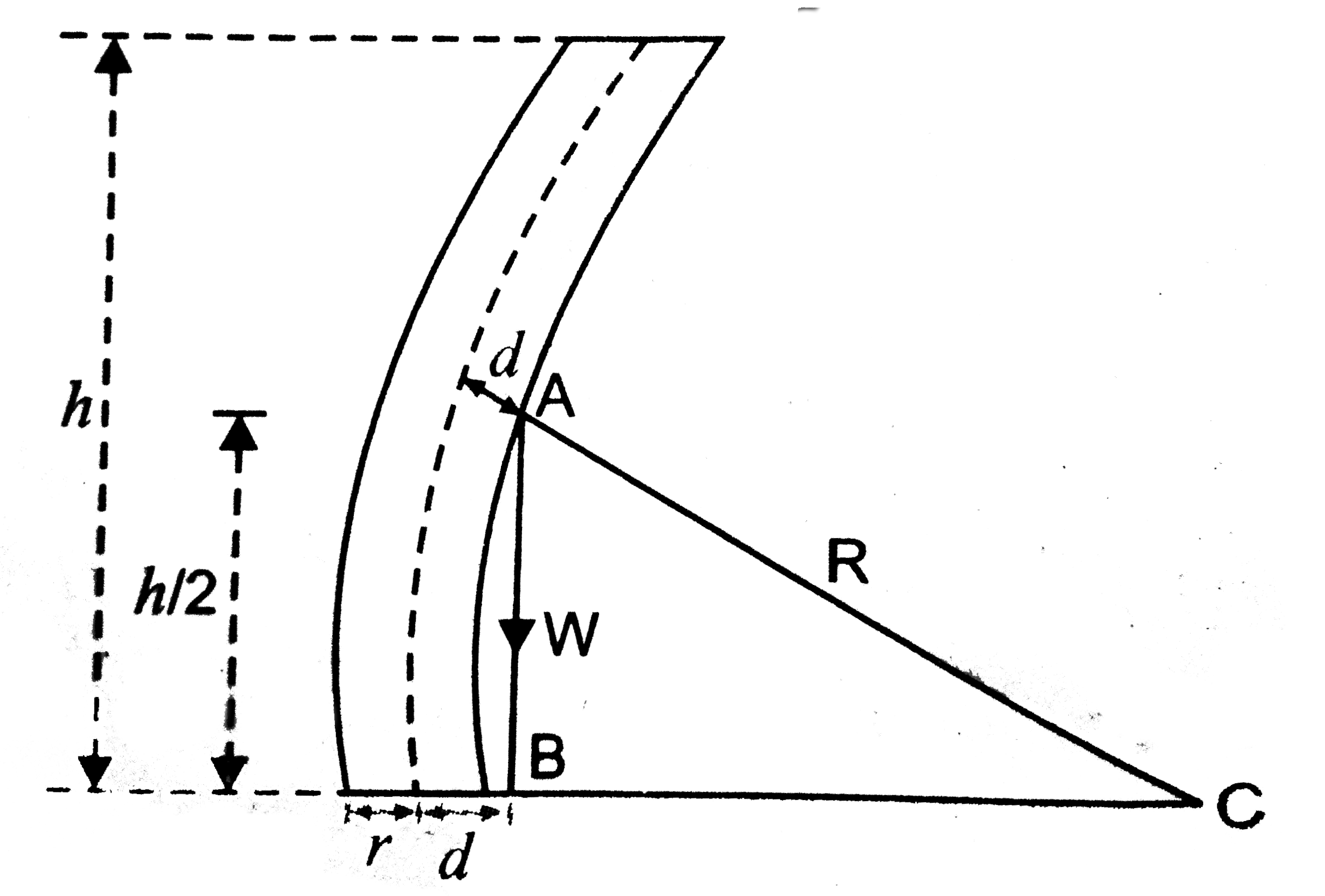 in `Delta ABC` Since d ltlt R, therefore the term `d^2` being very very small can be NEGLECTED. `:. R^2 = R^2 - 2 Rd + h^2 //4 or d = (h^2)/(8R) ..... (i)` If `W_0` is the weight per UNIT volume of the tree, then `(T pi r^4)/(4R) = W_0 (pi r^2 h)d = W_0 pi r^2 h xx((h^2)/(8R))` from (i) `:' h= ((2Y)/(W_0))^(1//3) r^(2//3)` |
|