

Saved Bookmarks
| 1. |
In the arrangement shown in fig. a wedge of mass m_(3) =3.45 kg is placed on a smooth horizontal surface. Small and light pulley is connected on its top edge, as shown. A light, flexible thread passes over the pulley. Two block having mass m_(1)=1.3kg and m_(2) =1.5 kg are connected at the ends of the thread. m_(1) is on smooth horizontal surface and m_(2) rests on inclined smooth surface of the wedge. the base length of wedge is 2m and inclination is 37^(@). m_(2) is initially near the top edge of the wedge. If the whole system is released from rest, calculate: (a) velocity of wedge when m_(2) reaches its bottom. (b) velocity of m_(2) at that instant. (g=10ms^(-2)). |
|
Answer» (a) `(a+b)` down the plane and (b) b leftwards. Hence, components of this resultant acceleration are (a) `[(a+b) cos 37^(@)-b]=((4a-b))/(5)` horizontal rightward, and (b) `(a+b) sin 37^(@)=3/5 (a+b)` vertically downward. Considering free body diagrams 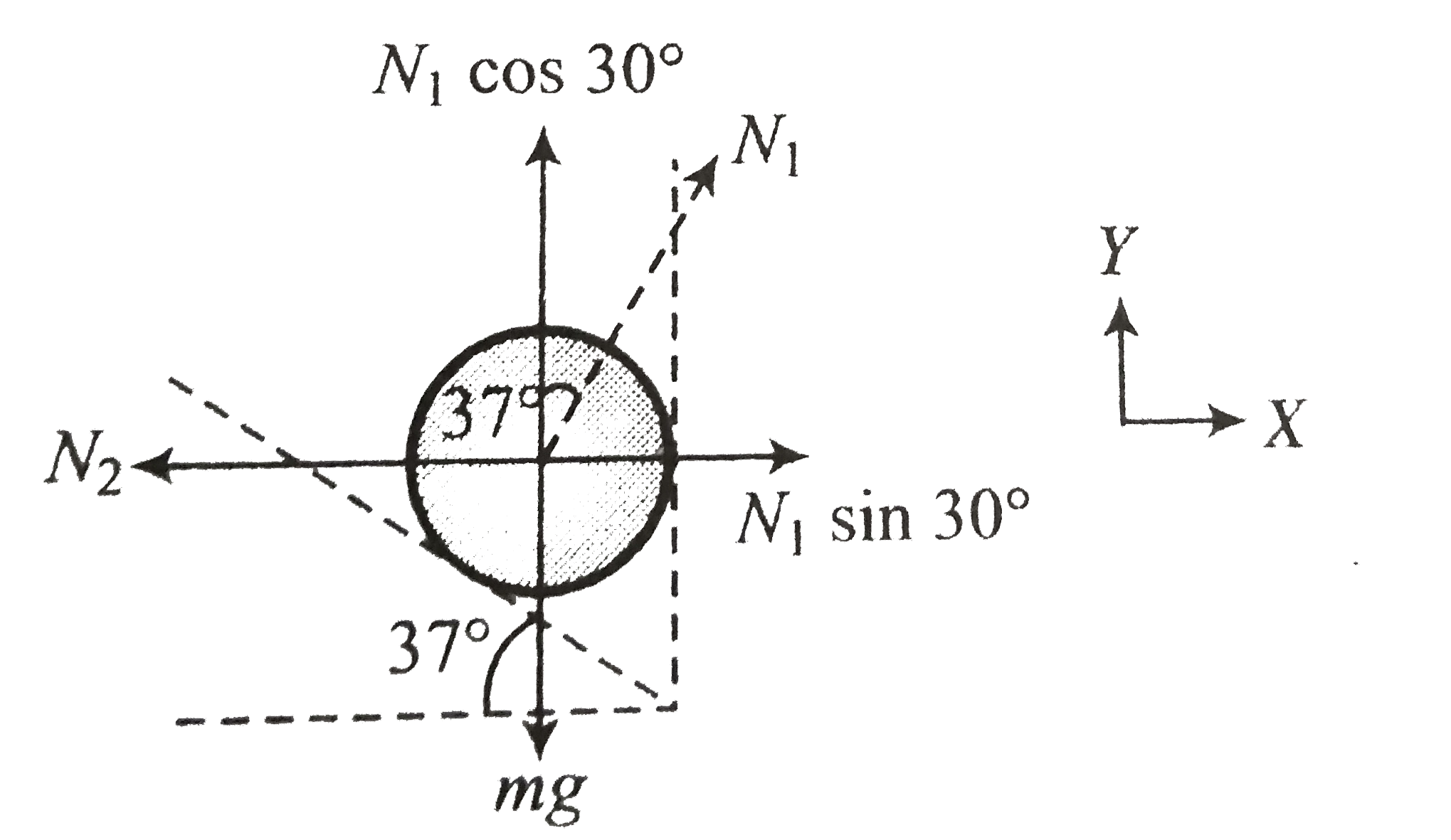 For horizontal FORCE on `m_(1), T=m_(1)a` ...(i) For horizontal force on wedge, `T-T cos 37^(@)+N_(2) sin 37^(@)=m_(3)b`...(ii) For horizontal force on `m_(2)` `N_(2). sin 37^(@)-T cos 37^(@)=m_(2)(0.8a-0.2)`...(III) For vertical force on `m_(2)` `m_(2)g-N_(2) cos 37^(@)-T sin 37^(@)=m_(2)(0.6 a + 0.6b)`...(iv) From above equations , `a=3ms^(-2), b=2ms^(-2)` SINCE base ANGLE and base length of wedge are `37^(@)` and 2m respectively, therefore, height of its vertical faces is `2tan 37^(@)=1.5m`. Now considering vertical motion of `m_(2)` from top of bottom of the wedge, `u=0`, acceleration =`(0.6a=0.6b)=3ms^(-2)` and displacement = `1.50m`. `t=1s` At this instant, horizontal component of velocity of `m_(2)` is `v_(2x)=(0.8a-0.2b)t=2ms^(-1)` and vertical component, `v_(2y)=(0.6a+0.6b)t=3ms^(1)` Vertical of `m_(2)` is `v_(2)=sqrt(v_(2x)^(2)+v_(2y)^(2))=sqrt(13)ms^(-1)` Velocity of wedge at this instant = `bt=2ms^(-1)`. |
|