

Saved Bookmarks
| 1. |
In the cubic crystal of CsCl (d=3.97 "g cm"^(-3)), the eight corners are occupied by Cl^- ions with a Cs^+ ion at the centre and vice-versa. Calculate the distance between the neighbouring Cs^+ and Cl^- ions . What is the radius ratio of the two ions ? |
|
Answer» Solution :In CsCl, `Cl^-` IONS per unit cell =`8xx1/8`=1 `Cs^+`ions per unit cell =1 Thus, the unit cell of CsCl contains one CsCl molecule, i.e., Z=1 `rho=(ZxxM)/(a^3xxN_0)` `THEREFORE 3.97 =(1xx168.36)/(a^3xx6.023xx10^23)`[Mol. MASS of CsCl=132.91+35.45 =168.36] or `a=4.13xx10^(-8)` CM or a=4.13 Å For a cube of side length (a) equal to 4.13 Å, body diagonal `AE=sqrt3a=sqrt3xx4.13Å`=7.15 Å As `Cl^-` ions A and E touch`Cs^+` ion, `therefore AE=2r_++2r_-` `therefore 2r_+ + 2r_(-)`=7.15 Å or `r_++ r_-` =3.57 Å i.e., Distance between neighbouring `Cs^+` and `Cl^-` =3.57 Å Assuming that the two `Cl^-` ions touch each other , length of the unit cell `=2r^(-)` =a=4.13 Å `thereforer_(-)` =2.06Å `therefore r_+` =3.57-2.06=1.51 Å `therefore r_+//r_-` =1.51/2.06=0.73 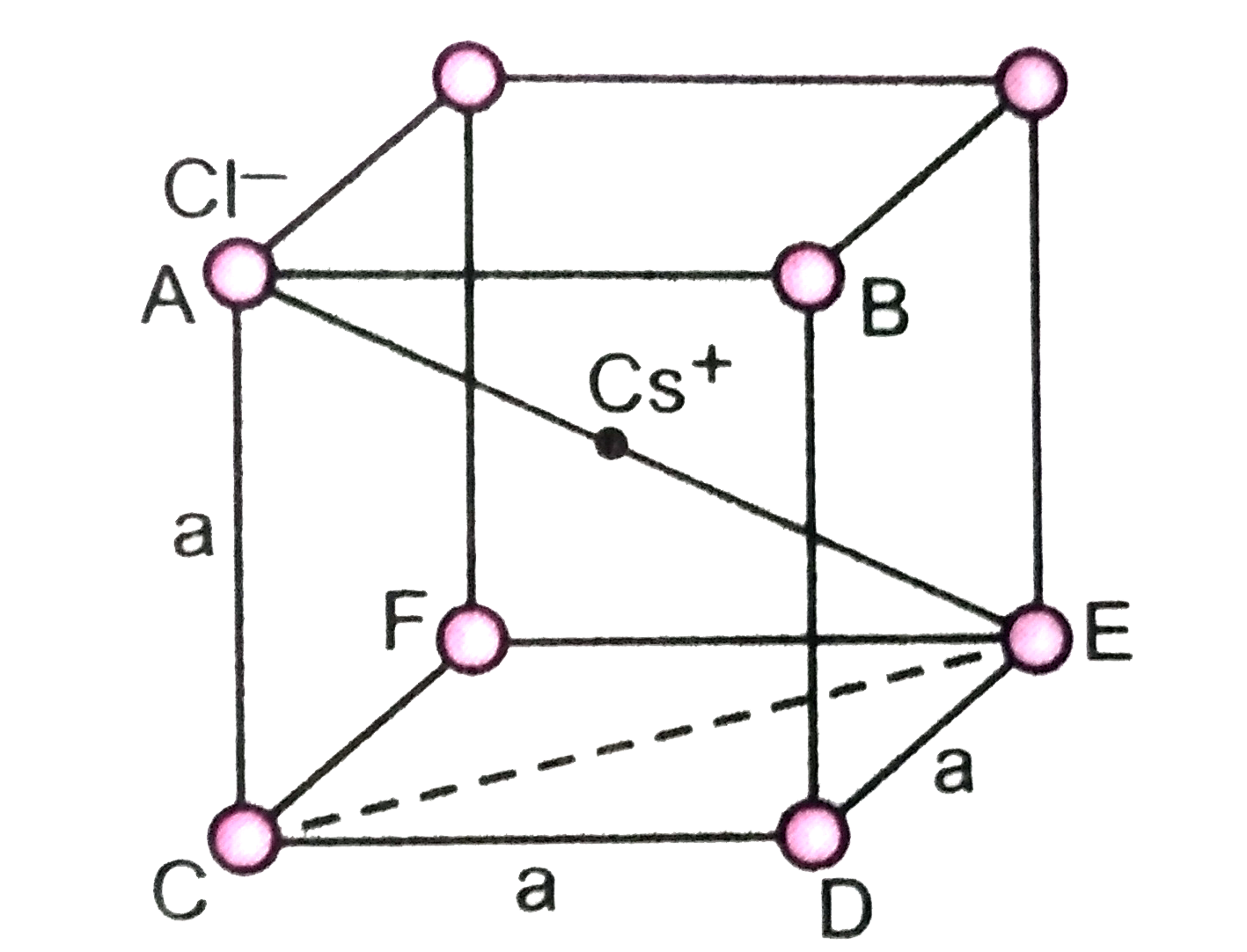
|
|