

Saved Bookmarks
| 1. |
Just as precise measuremnts are necessary in scienceit is equallyimportant to be able to make rough estimates of quantities using rudinmentary ideas and common observations. Think of ways by which you can estimatethe following (where an estimate is difficult to obtain, try to get an upper bound on the quantity): (a) the total mass of rain - bearing clouds over india during the Monsoon, (b) the mass of an elephant, (c ) the wind speed during a strom, (d) the number of strands of hair on your head, (e ) The number of air molecules in your class room. |
|
Answer» Solution :(a) The total mass of rain bearing clouds over india during the monsoon During the monsson,meterologist record about 100 cm of rain fall, i.e., h =100 cm =1m. Area of our conutry, A = 3.3 million square `km = 3.3xx10^6(10^3m)^2 = 3.3xx10^(12)m^2` :. volume of rain water,`V = Axxh = 3.3xx10^(12)xx1m^3` As density of water, `rho = 10^3 km//m^3` :. Mass of rain water `= V rho = 3.3xx10^(12)xx10^3 kg = 3.3xx10^(15)kg.` This must be the total mass of rainbering clouds over india. (b) Mass of and elephent To estimate the mass of an elephant, we take a boat of known base area A. Measure the depthe of boat in water. Let it be `x_1` Therefore, volume of water displaced by the boat, `V_1= A x_1` Move the elephen into this boat. The boat gets DEEPER into water. Meausre the depth of boat now into mater Let it be `x_2` :. Volume of water displaced by boat and elephant `V_2 = A x_2` :. volume of water displaced by the elephant `V = V_2 - V_1 = A(x_2 -x_1)` If `rho` is density of water, then mass of elephent= mass of water displaced by it =`V rho = A(x_2 -x_1)rho.` (c ) The wind speed during a storm can be estimated USING a gas filled ballon. in fig 1 (NCT).1 OA is normal position of a gas filled balloon, when there is no wind. As the wind blows to the RIGHT, the balloon drifts to position B in one second. The angle of drift `/_ AOB = theta` is MEASURED. If h is the height of the balloon, the `AB = d=h theta.,` This is the distance travelled by the balloon in one second. it must be the wind speed. (d) The NUMBEROF strands of hair on our head For this, we measure the area of the head the carries the hair. Let it be. A. Using a screw gauge, we measure thickness of hair. Let it be d. :. area of cross section of hair ` = pi//2` Assuming that the distribution of hair over the head is uniform, the number of starnds of hair ` =("total area")/("area fo cross secion of each hair") = (A)/(pid^2)` Calculation show that number of strands of hair on human head is of the order of one million. (e ) Number of air molecules in class room Measure the volmue fo room. We know that one mole of air at NTP occuopies a volume of 22.4 liters, `i.e. 22.4 xx10^(-3)m^3` :. Number of air molecules in `22.4xx10^(-3)m^36.023 xx10^(23)` Number of air molecules in volume V of room ` = (6.023xx10^(23))/(22.4xx10^(-03)) xxV = 2.96xx10^(25)V` 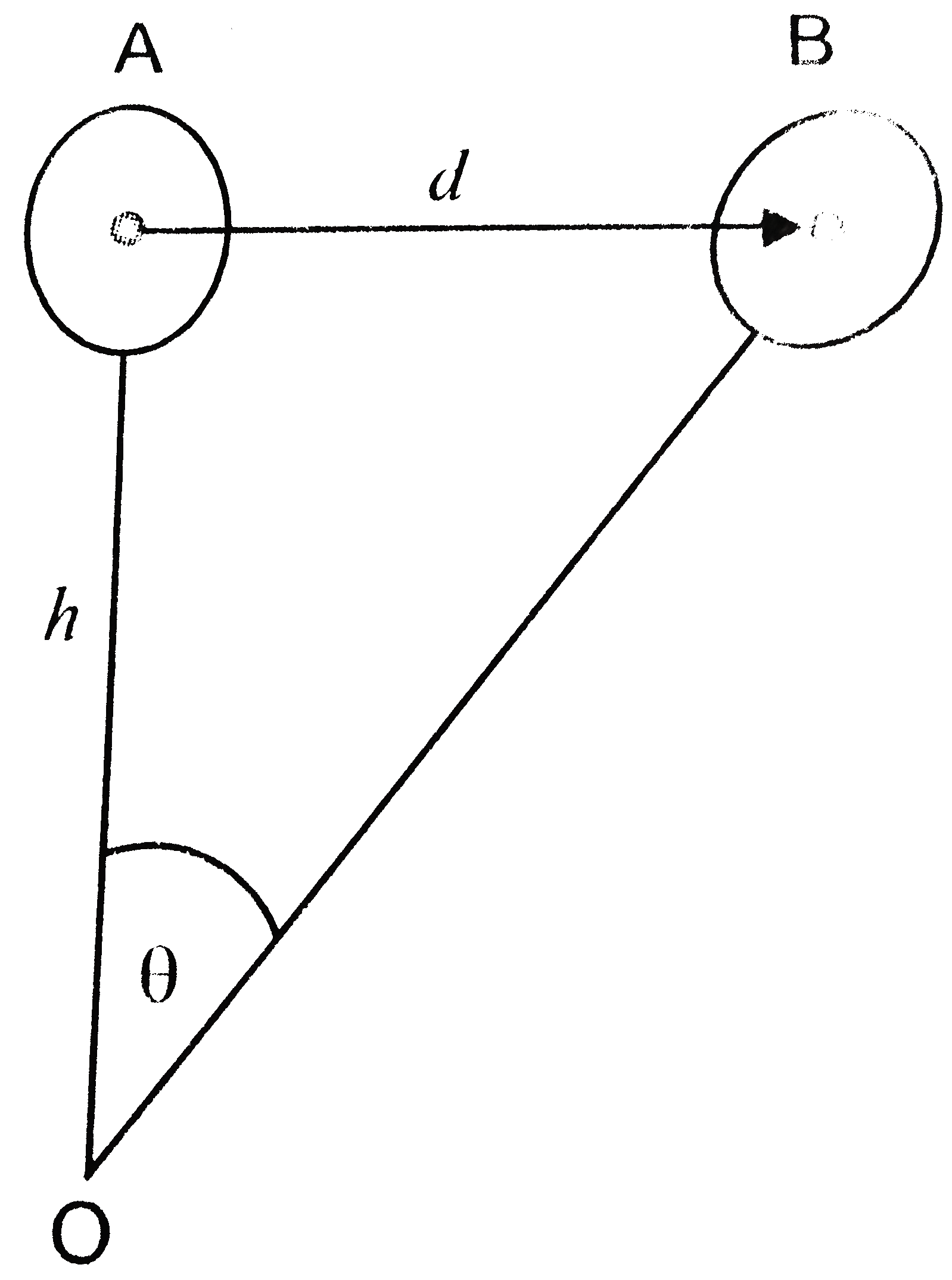
|
|