

Saved Bookmarks
| 1. |
Let f (x) =(sinpi)/(x^2),xgt 0 Let x_1lt x_2lt x_3lt..lt x_nlt...be all the poitns of local maximum of f and y_1lty_2lty_3lt.....lt y_nlt....... be all the poins of local minimum of f. Then which of the following opions is/are correct? |
|
Answer» `|x_n-y_n|gt 1` for EVERY n `impliesf(x)=(x^(2)picos(pix)-2xsin(pix))/(x^(4))` `=(2xcos(pix)[(xpi)/(2)-tan(pix)])/(x^(4))` `=(2cos(pix)[(xpi)/(2)-tan(pix)])/(x^(3))` Since, for maxima and minima of `f(x),f(x)=0` `impliescos(pix)=0` or `tan(pix)=(pix)/(2),` (as `xgt0`) `becausecos(pix)ne0impliestan(pix)=(pix)/(2)` `becausef'(P_(1)')lt0 and f'(P_(1)')lt0impliesx=P_(2)in(2,(5)/(2))` is point of local maximum. From the graph, for opition of maxima `x_(1),x_(2),x_(3)` . . . .it is clear that `(5)/(2)-x_(1) gt (9)/(2)-x_(2) gt (13)/(2)-x_3 gt (17)/(2)-x_(4)` . . . `impliex_(n+1)-x_(n) gt 2,AAn`. From the graph for point of minima `y_(1),y_(2),y_(3)`. . . , it is clear `|x_(n)-y_(n)|gtAAn and x_(1) gt (y_(1)+1)` And `x_(1)in(2,(5)/(2)),x_(2)in(4,(9)/(2)), x_(3)in(6,(13)/(2))` `impliesx_(n)in(2n,2n+(1)/(2)),AAn`. HENCE, options (a), (b) and (d) is correct 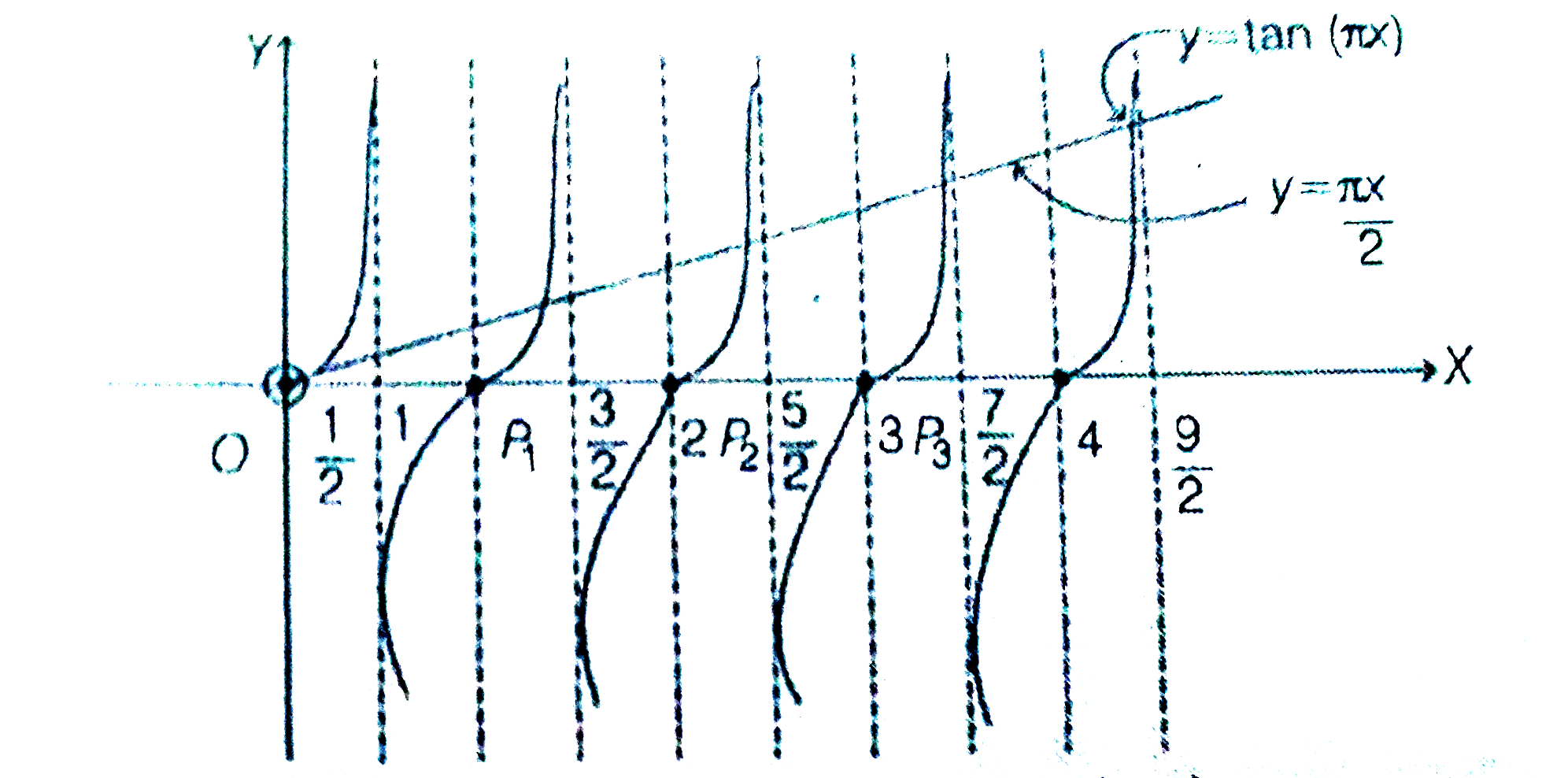
|
|