

Saved Bookmarks
| 1. |
Let f(x)=x^(3)-9x^(2)+24x+c=0 have three real and distinct roots alpha, beta and lambda. (i) Find the possible values of c. (ii) If [alpha]+[beta]+[lambda]=8, then find the values of c, where [*] represents the greatestinteger function. (ii) If [alpha]+[beta]+[lambda]=7, then find the values of c, where [*] represents thegreatest integer function.s |
|
Answer» Solution :We have `y=f(x)=x^(3)-9x^(2)+24x+c` `f'(x)=3x^(2)-18x+24=3(x-2)(x-4)` Sign scheme of `f'(x)` is as follows. 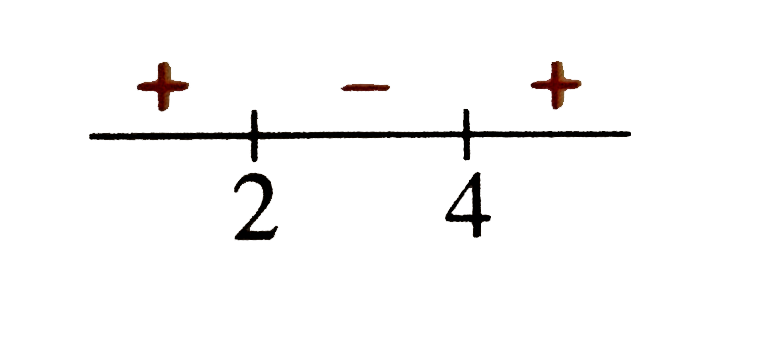 x=4 is the point of local minima and x = 2 is the point of local maxima. `f(2)=20, f(4)=16` `If c=0, " then " f(0)=0` So the graph of `y=f(x)` for `c=0` can be DRAWS as follows. 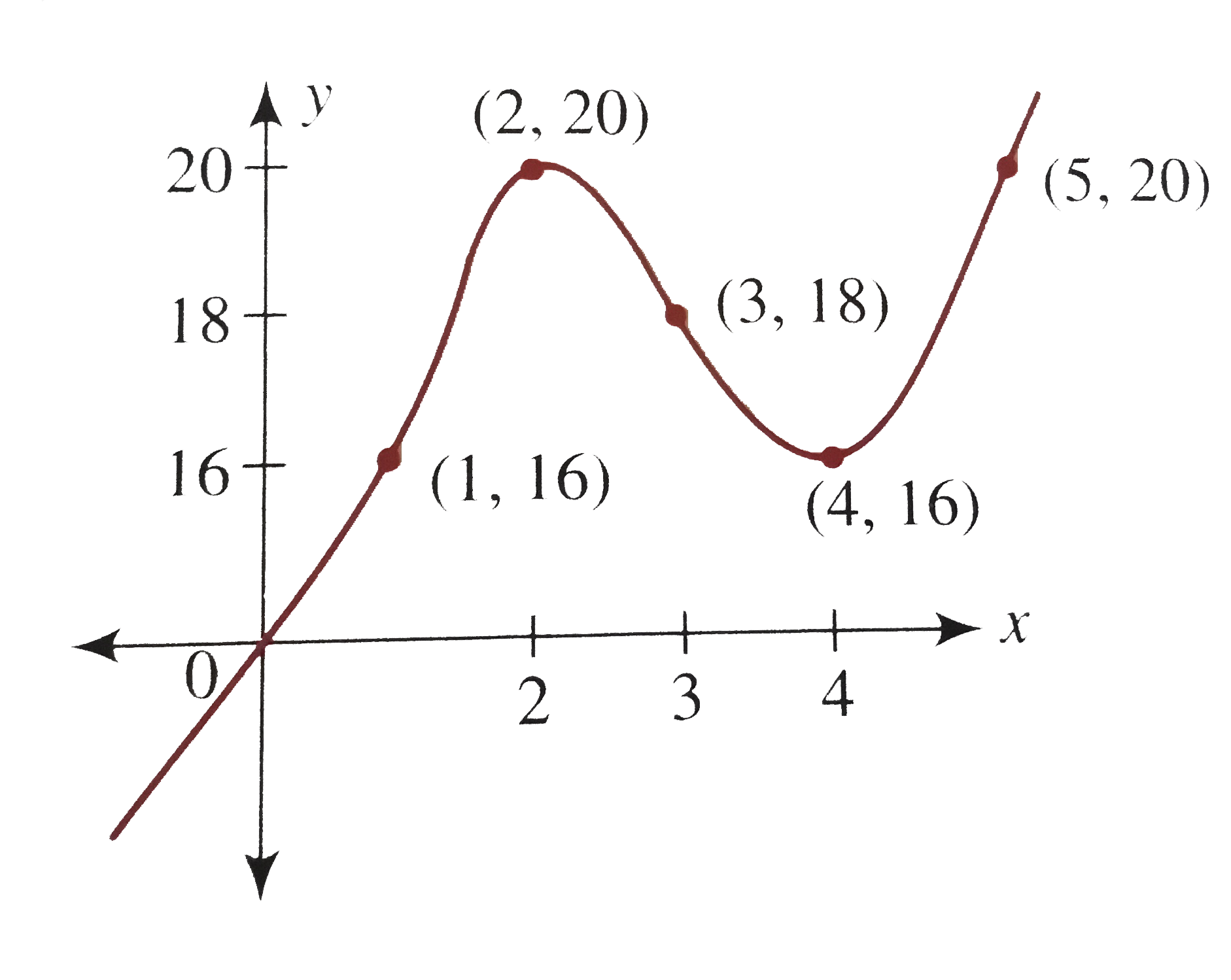 From the FIGURE, for three real roots of `f(x)=x^(3)-9x^(2)+24x+c=0`, c must lie in the interval `(-20, -16)`. `:. f(0)=c lt 0` `f(1)=1-9 +24+c=c+16 lt 0, AA c in (-20, -16)` `f(2)=8-36+48+c=c+20 gt 0, AA c in (-20, -16)` `:. alpha in (1,2) rArr [alpha]=1` `f(3)=27-81+72=18+c` `rArr f(3) gt 0 " if" c in (-20, -18) " or " f(3) lt 0 " if " c in (-18, -16)` or ` BETA in (2, 3) " if " c in (-18, -16)` and `beta in (3, 4) " if " c in (-20, -18)` Now `" " f(4)=64-144+96+c=16 +c lt0, AA c in (-20, -16)` `f(5) = 125 - 225 +120 +c = c+ 20 gt 0, AA c in (-20, -16)` ` :. LAMBDA in (4, 5) rArr [lambda] = 4` Thus `" " [alpha]+[beta]+[lambda]= {{:(1+3+4"," -20 lt c lt -18),(1+2+4"," -18 lt c lt -16):}` |
|