

Saved Bookmarks
| 1. |
Match list I with list II. Choose the correct matching codes from the choices given. {:(,"List I",,"List II"),(,"(Hydride)",,"(Type of hydride)"),(A.,BeH_(2),1.,"complex"),(B.,AsH_(3),2.,"Lewis acid"),(C.,B_(2)H_(6),3.,"Interstitial"),(D.,LaH_(3),4.,"Covalent"),(E.,LiAlH_(4),5.,"Intermediate"):} |
|
Answer» A-6, B-2, C-4, D-5, E-1 Complex : Addition compounds which do not give all their constituent ions when dissolved in water. Here, the individual properties of ions are e.g., `[Cu(NH_(3))_(4)]SO_(4), LiAlH_(4)`. Lewis acid : Electron DEFICIENT species which gain electrons while forming a bond with Lewis bases. 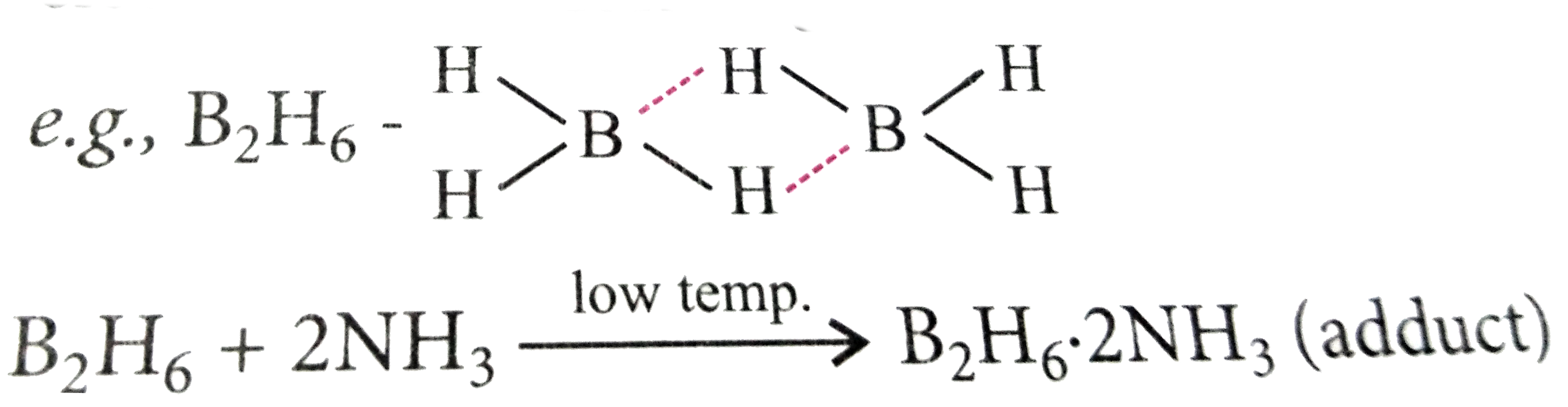 `B_(2)H_(6)+2NH_(3)overset("low temp.")rarr B_(2)H_(6).2NH_(3)` (adduct) Interstitial metallic hydrides : Many f-block hydrides are non-stoichimetric, e.g., `LaH_(n), TiH_(n)`, ETC. where the chemical composition is variable e.g., `LaH_(2.87), YbH_(2.5)`, etc. Such compounds are called interstitial compounds. `BeH_(2)` : Intermediate hydride and polymeric in nature. `AsH_(3)` : Covalent. |
|