

Saved Bookmarks
| 1. |
Obtain Carnot's theorem. |
|
Answer» Solution :Carnot theorem is divided into two parts: (a) No engine can have more efficiency than the reversible engine operating between the given temperature `T_1` and `T_2` of hot and cold reservoirs. (b) The efficiency of carnot engine is independent of the nature of the working substance. To prove the result (a), imagine a reversible carnot engine R and an irreversible engine I working between the same source and sink. 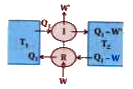 Let us couple the engines I and R in such a WAY so that I acts like a heat engine and R acts as a refrigerator. Suppose I absorb heat `Q_1` from the source, deliver work W. and release the heat `Q_1-W.` to the sink. Arrangement will made such that R returns the same heat `Q_1` to the source, taking heat `Q_2` from the sink and requiring work `W = Q_1 - Q_2` to be done on it. `therefore` Heat given to the sink `Q_2 = Q_1 - W`, necessary work will done. Heat given to the source `Q_1` is same as from R. Suppose `eta_R lt eta_I`, then engine R give less work than engine I. Hence for given `Q_1 W lt W.` With R acting like a refrigerator . `Q_2=Q_1-W gt Q_1 - W.` Thus , the coupled I-R system extracts heat `(Q_1-W)-(Q_1-W.)=(W. ~ W)` from the cold reservoir and delivers the same amount of work in one cycle. This is against the Kelvin Planck statement of the second LAW of thermodynamics. Hence `eta_I gteta_R`is wrong, means no engine can have efficiency greater then that of the carnot engine. A reversible engine with one particular substance cannot be more efficient than the one using another substance. The maximum efficiency of carnot engine `eta=1-T_2/T_1` independent of the nature of the system and hence in carnot engine an IDEAL gas is taken as a working substance, so the maximum efficiency will OBTAINED. From `eta=1-T_2/T_1` and `eta=1-Q_2/Q_1` `Q_2/Q_1=T_2/T_1 rArr Q_1/Q_2 =T_1/T_2` is independent of nature of the system . |
|