

Saved Bookmarks
| 1. |
Question : What is dark reaction in photosynthesis ? Describe C_(3) Pathway. |
|
Answer» Solution :DarkReaction : 1. This is the second phase of photosynthesis in which`CO_(2)` is fixed or reduced to glucose. It occurs in the stroma of chloroplast. 2. It is independent of light (does not require direct light) hence called dark reaction. 3. The products of light reaction namely, ATP and `"NADPH"_(2)` are used here. 4. The presence of dark reaction was first established by Blackman hence also called "Blackman's reaction". `6CO_(2)+12"NADPH"_(2)+12"H"_(2)"O"+18"ATP"toC_(6)H_(12)O_(6)+12"NADP"^(+)+18"ADP"+18" Pi"` Calvin Cycle (`C_(3)` Pathway): 1. Dr. MelvinCalvin in 1954 discovered the correct "path of carbon" in photosynthesis i.e.sequence of biochemical reactions of `CO_(2)` fixation into glucose. 2. He carried out experiments on unicellular green algae like Chlorella and Scenedesmus, and used radioactive ISOTOPE of carbon, `C^(14)` as a tracer. The biochemical reactions leading to synthesis of glucose take place in cyclic manner are final product, glucose is produced in 90 seconds. 4. The initial accepter is regeneratedso that it can accept `CO_(2)` again and keep the process going. 5. The first stable product is a 3-carbond compound, hence, Dr. Calvin called it `C_(3)` cycle, or `C_(3)` pathway, but it is more popularly known as Calvin cycle or Calvin-Benson cycle. 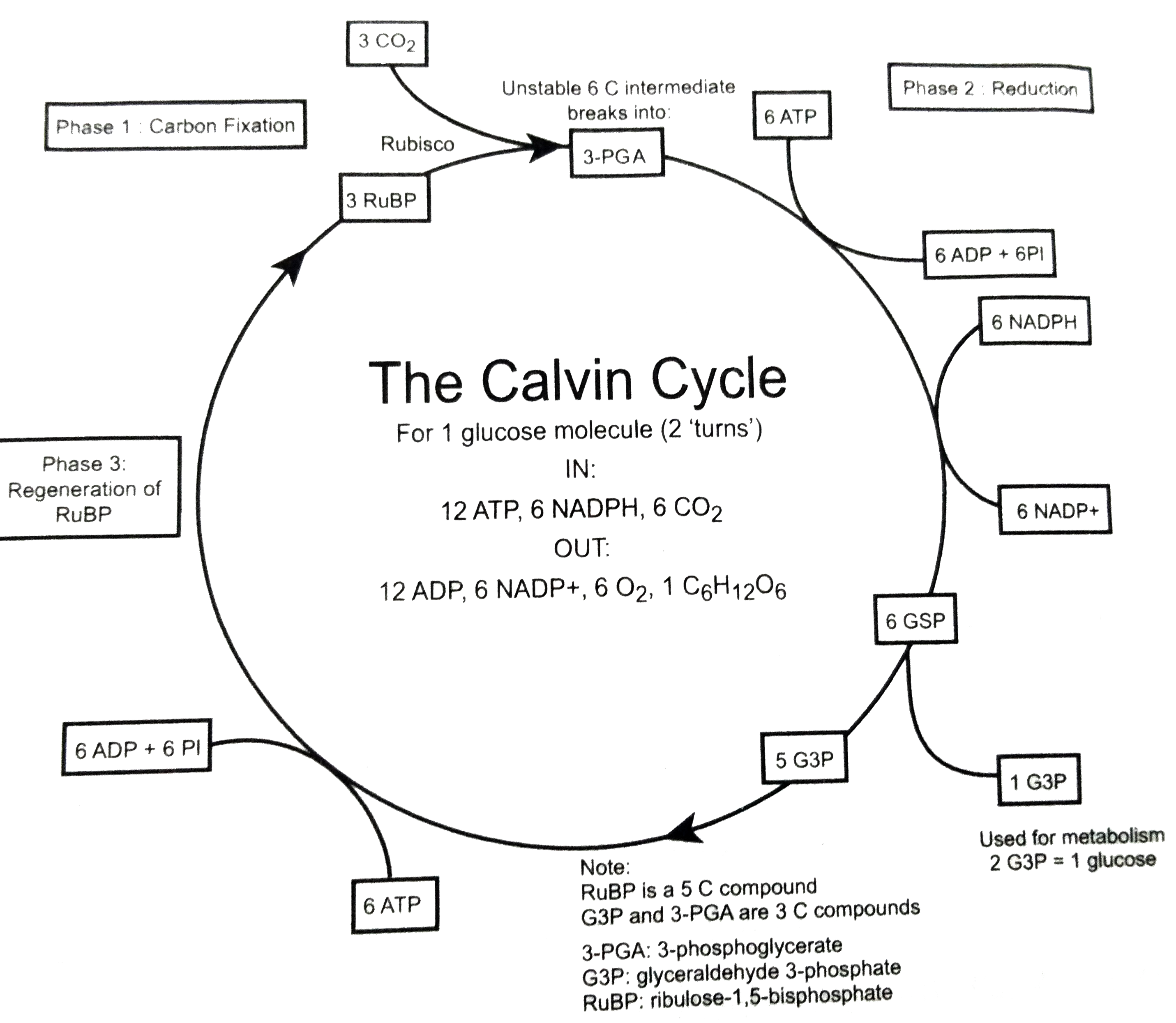 The cycle involves the following three main steps : 1. Carboxylation 2. Reduction. 3A. Synthesis 3B. REGENERATION. 1. Carboxylation : Atmospheric `CO_(2)` is accepted by a 5-carbon compound called Ribulose-1-5-di-phosphate (RuDP) or Ribulose-1-5 bisphosphate (RuBP) in presence of enzyme RuDP carboxylaseor RuBP carboxylase (RuBisCO) to from a 6-carbon unstable compound. Immediately it splitsbyhydrolysis into two molecules of 3-carbon compound called phosphoglyceric acid (PGA), in thepresenceof same enzyme. `underset((5C))(RuBP)+underset(("IC"))("CO"_(2))underset("RuBP Carboxylase")overset("MG"^(+))tounderset((6C))("unstable compound")` `underset((6C))("Unstable")" compound"+H_(2)Ounderset("RuBP Carboxylase")overset("Mg"^(++))tounderset((3C))(2,3"PGA")` 2. Reduction: (Utilisation of Assimilatory Power) The Phosphoglyceric acid molecules are first phosphorylated by using ATP to produce 1, 3 di-phosphoglyceric acid which is then reduced using `"NADPH"_(2)` to produce phospho-glyceraldehyde (PGAL) and inorganic phosphate is released. `3"PGA"+"ATP"to1,3" di-PGA"+"ADP"` `1,3" di-PGA"+"NADPH"_(2)to3"PGAL"+"NADP"+"iP"` Some part of 3PGAL is converted into its isomer Dihydroxyacetone phosphate (DHAP) in the presence of enzyme triose-phosphate isomerase. 3A. Synthesis: For the synthesis of one glucose molecule, six turns of Calvin cycle are required or six molecules of RUBP and six molecules of `CO_(2)` are required. `1//6` part of PGAL i.e. out of 12 molecules, 2 are used for synthesis of glucose. One moleculeof PGAL and one molecule of DHAP combine together to from one molecule of fructose 1, 6-dephosphate. `underset((3C))(3"PGAL")+underset((3C))("DHAP")tounderset((6C))("Fructose 1, 6-diphosphate.")` By dephosphorylation it producesfructose-6-phosphate which when isomerizes intoglucoss-6-phosphate. Glucose-6-phosphate loses a phosphate group (dephosphorylation) to produce glucose. Glucose is either utilized or stored as starch. 3B. Regeneration : (a) RUBP gets regenerated through several biochemical reactions. These reactions are called sugar phosphate interconversions. (b) All the compounds/intermediates formed are sugar phosphates, for example, erythrose-4-phosphate (4-C), xylulose-5-phosphate (5-C), ribose-5-phosphate (5-C) sedoheptulose-7-phosphate (7-C) etc. (c) 5/6 part PGAL, i.e., out of 12 molecules, remaining 10 molecules are used for regeneration of 6 molecules of ribulose mono-phosphate (RuMP). (d) RuMP is phosphorylated to RuBP using ATP. (e) For regeneration of 6 RuBP, 6 ATPs are required. (f) Thus the initial acceptor of `CO_(2)` gets regenerated and keeps the process going (`12"NADPH"_(2)` and 18 ATP are required for synthesis of one glucose molecule). `C_(3)` Plants : (g) Most of the plants fix `CO_(2)`through Calvincycle and are called `C_(3)` plants. (h) RuBisCO is thermolabile and requires higher concentration of `CO_(2)` for its activity. (i) At high temperature the stomata close partially so that availability of `CO_(2)` falls. (J) At high temperature and at low `CO_(2)` concentration, RUBPcarboxylase, (i.e., RuBisCO-Ribulose Bis-phosphate Carboxylase Oxygenase), functions as oxygenase and brings about oxidation of RuBP instead of carboxylation. (k) Due to this a considerable (approximately `25%`) part of photosynthetically fixed `CO_(2)` goes back to atmosphere. (l) This is called photorespiration. |
|