

Saved Bookmarks
| 1. |
Question : What is photorespiration? Explain it with diagrammatic representation. |
|
Answer» Solution :Photorespiration and its explanation: ( 1) Photorespiration : Respiration of chlorophyllous tissues in the presence of light is called photorespiration. (2) Explanation of photorespiration : (i) RUBISCO is an enzyme with active binding sites for both `CO_(2) and O_(2)` (II) At high temperature, high light intensity and low `CO_(2)` concen- TRATION it oxidises a 5-carbon RUBP into a molecule of 3-carbon PGA and a molecule of 2-carbon phosphoglycolate. (iii) PGA thus formed enters the Calvin cycle while phosphoglycolate undergoes dephosporylation to form glycolate in the chloroplast. (iv) The glycolate then diffuses into the peroxisomes where it is oxidized to glyoxylate. (v) The glyoxylate thus formed is finally converted into glycine, a 2-carbon amino acid. (vi) Glycine now enters the mitochondria where two molecules of glycine combine with each other forming one molecule of serine and one molecule of `CO_(2)` 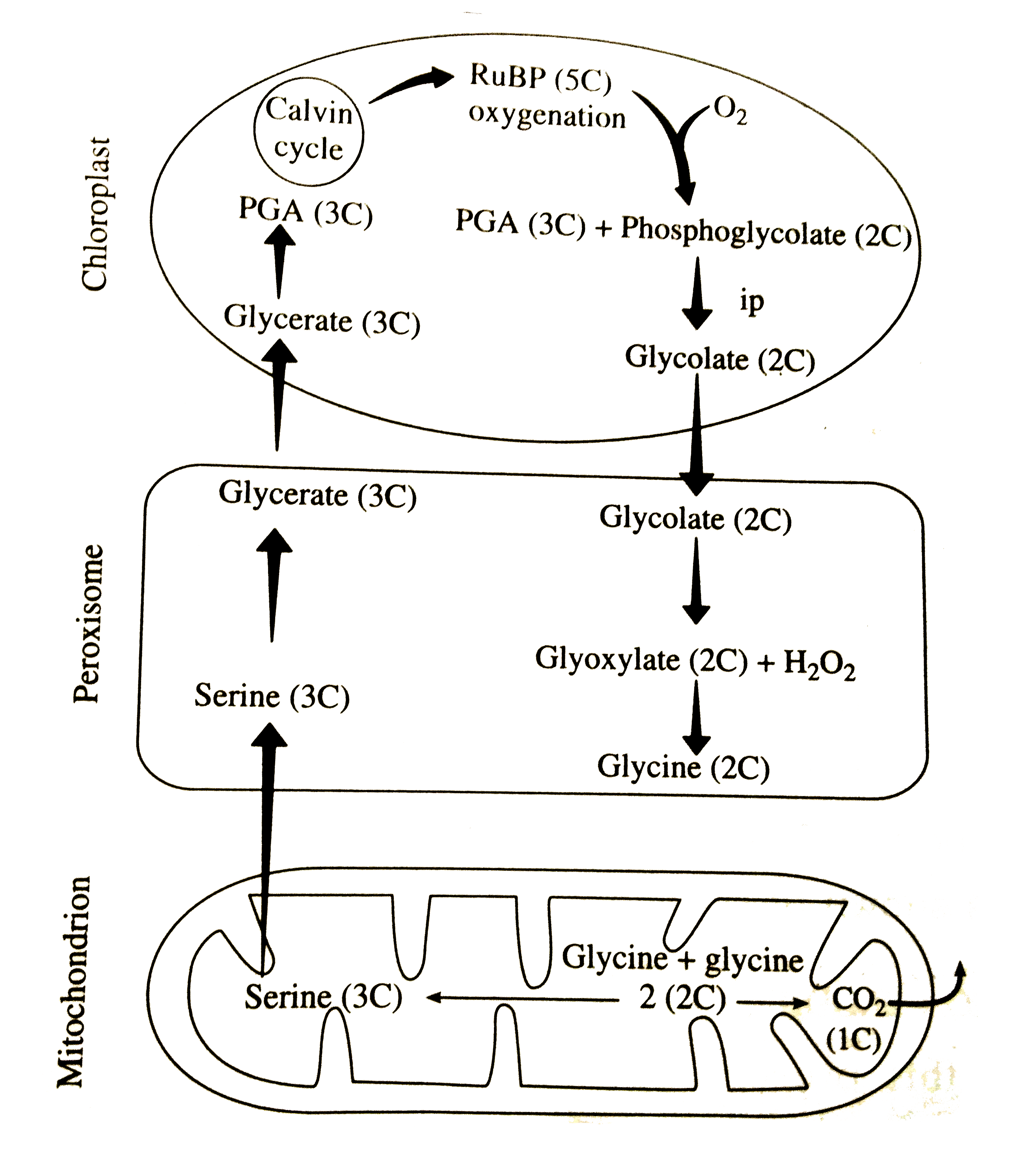 (vii) The serine is then taken to the peroxisome where it is converted into glycerate. (viii) The glycerate then enters the chloroplast where it is phosphorylated to form PGA which enters the Calvin cycle. (IX) Out of the total carbon LOST by oxygenation of RuBP, 75% is recovered and only 25% is lost as it is released as `CO_(2)` |
|