

Saved Bookmarks
| 1. |
Repeat example - 11 if source does not move along the line SO. |
|
Answer» Solution :The changed frequency `f'` is now, `f' = f ((upsilon)/(upsilon - upsilon_(s) cos theta))` This time `f'` is not constant but it is a function of `theta` , which is variable. But , at a far distance, `theta rarr 0^(@)` or `cos theta rarr 1` or `:. f'= f ((upsilon)/ (upsilon - upsilon _(s)))` and this is the MAXIMUM value of `f'` (say `f_(max)`) At point `P, theta = 90^(@)` `:. f' = f` During receding (to the right of `p`) `f' = f ((upsilon)/ (upsilon - upsilon _(s)costheta))` again, at large distance from `P`, `theta rarr^(@)` or `cos theta rarr 1` `f' = f ((upsilon)/ (upsilon + upsilon_(s)))` This time, this is the MINIMUM value of `f'` (say `f_(min)`). Hence, `f'` VARIES from `f _(max)` to `f _(min')` with `f' = f` at the time of CROSSING `p` . The correct `f'` versus `t` graph is as shows below. 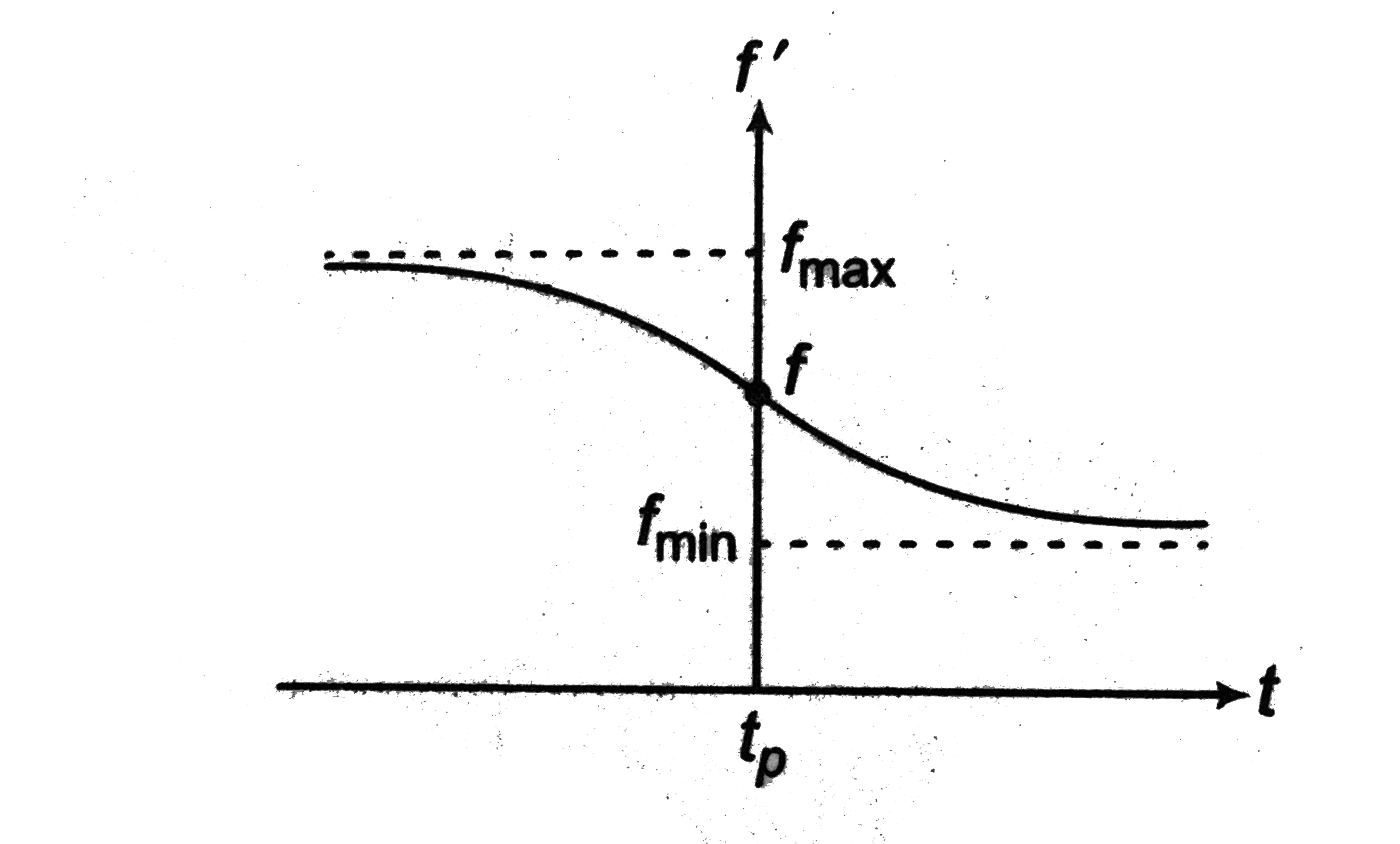
|
|