

Saved Bookmarks
| 1. |
Show that efficiency of Caront's ideal heat engine is eta=(1-(T_(2))/(T_(1))). |
|
Answer» Solution :Carnot.s ideal heat engine completes a sequence of isothermal and adiabatic expansion and isothermal and adiabatic COMPRESSION. The working SUBSTANCE returns to intial state. Heat absorbed by the system from the SOURECE at `T_(1)K` is `W_(1)=Q_(1)=muRT_(1)log_(e)((V_(2))/(V_(1)))."".......(1)` Total work done `W=W_(1)+W_(2)+W_(3)+W_(4)` Where `W_(1)&W_(3)` refres to isothermal process and `W_(2)&W_(4)` refers to adiabatic process. `W_(2)=(muRT)/((gamma-1))(T_(1)-T_(2))""` [adiabatic expansion] and `W_(4)=(-muRT)/((gamma-1))(T_(1)-T_(2))""` [adiabatic compression] So that `W_(2)+W_(4)=0` For an adiabatic expansion, `((T_(1))/(T_(2)))=((V_(3))/(V_(2)))^(gamma-1)"".......(2)` and adiabatic compression, `((T_(1))/(T_(2)))=((V_(4))/(V_(1)))^(gamma-1)"".......(3)` From (2) & (3) `(V_(3))/(V_(2))=(V_(4))/(V_(1))or(V_(3))/(V_(4))=(V_(2))/(V_(1))""............(4)` For isothermal expasion and compression, total work done `=W_(1)+W_(3)=muRT_(1)log_(e)((V_(2))/(V_(1)))-muRT_(2)log((V_(2))/(V_(4)))`. Applying (2) & (3) we get `W=muR(T_(1)-T_(2))log_(e)((V_(2))/(V_(1)))""............(5)` Hence efficiency `eta=(W)/(Q_(1))=((5))/((1))=(T_(1)-T_(2))/(T_(1))` i.e., `eta=1-(T_(2))/(T_(1))" also "eta=1-(Q_(2))/(Q_(1))" as "T_(2)propQ_(2)&T_(1)propQ_(1)`. 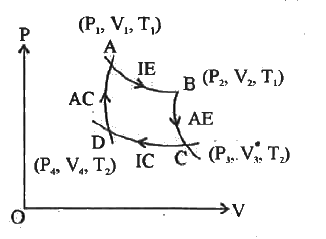
|
|