

Saved Bookmarks
| 1. |
shows (upsilon_(x) , t)and (upsilon_(x) , t) diagramsfor a body of unit mass Find the force as a funactionof time . |
|
Answer» Solution :As is clear from `{:(v_(X)=2t",","for",0 LT t lt 1s,|,v_(y)=t,"for",0 lt t lt 1s),(v_(x)=2(2-t)",","for",1 lt t lt 2s,v_(y)=1,"for",0 lt t,),(v_(x)=2(2-t)",","for",2 lt t,,,,):}` ` :. F_(x) = ma_(x) = m(d upsilon_(x))/(dt)""F_(y) = ma _(y) = m(dupsilon_(y))/(dt)` `{:(=1 xx 2,"for",0 lt t LT1 s,|,=1 xx 1,"for",0 lt t lt 1s),(=1(-2),"for",1 lt tlt 2s,=0,"for",1 lt t,),(=0,"for",2 lt t,,,,):}` Hence `VEC(F) = - 2 hati + hatj`for `0 lt t lt 1 s ` `vecF = - 2 hati` for `1 lt t lt2s` `vec(F) = vec(0)` for `2 lt t ` 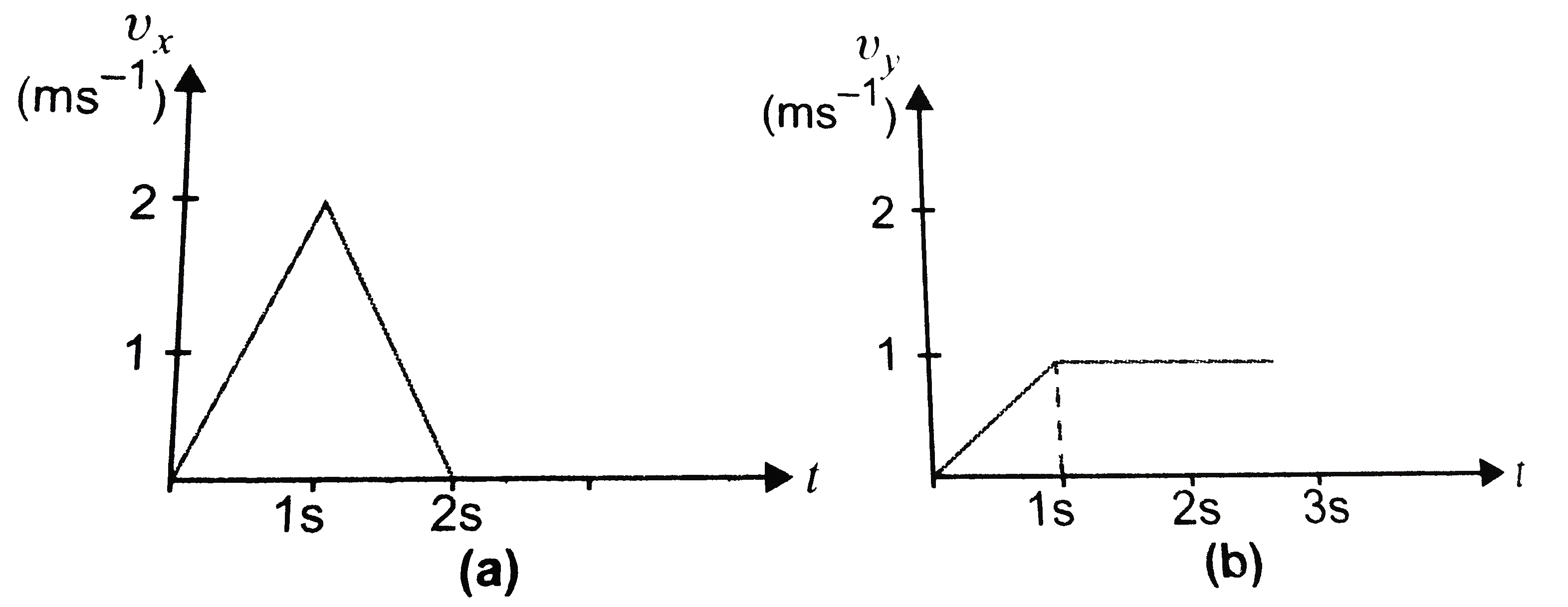 . .
|
|