

Saved Bookmarks
| 1. |
State and prove parallel axis theorem |
|
Answer» Solution :Parallel axis theorem: Parallel axis theorem STATES that the moment of inertia or a body about any axis is equal to the sum of its moment of inertia about a parallel axis through its center of mass and the PRODUCT of the mass of the body and the square of the perpendicular distance between the two axes. If `I_C`is the moment of incrliu oflhe body of mass M about an axis passing through the center of mass then the moment of inertia I about a parallel axis at a distance d from it is given by the relation ` I = I_C = md^2` `I=I_C + Md^2` Let us consider a rigid body as shown in figure. Its moment of inertia about an axis AB passing through the center of mass is `I_C` . DEis another axis parallel to AB at a perpendicular distance d from AB. The moment of inertia of the body about DE is I . We attempt to GET an expression for I in terms of `I_C`. For this, let us consider a point mass m on the body at position x from its center of mass The moment of inertia of the point mass about the axis DE is `m(x +d)^2` The moment of inertia I of the whole body about DE is the summation of the above expression. ` I = sum m (x+d)^2` This equation could further be written as, ` I sum m (x^2 + d^2 + 2xd)` `I = sum (mx^2 +md^2 + 2dmx)` `I = sum mx^2 + sum md^2 + 2d sum mx ` Here`sum mx^2` is the moment of inertia of the body aboutthe center of mass. Hence . `I_C = sum mx^2` The TERM `sum mx = 0`because, x can take positiveand negative values with respect to the axis AB. Thesummation `(sum mx)` will be zero . Thus `I=I_C + (sum mx)` will be zero . Thus`I = I_C + sum md^2 = I_C + (sum m)d^2` Here ` sum m ` is the entire mass M of the object `(sum m = m )` `I = I_C + Md^2` 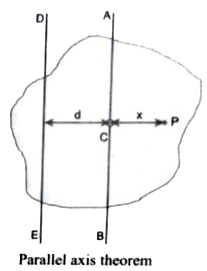
|
|