

Saved Bookmarks
| 1. |
The arrangement shown below consists of a uniform metre scale of length 1 m, balanced on a fixed hemisphere of radius 20 cm. when one end of the scale is slightly pressed and released, it performs S.H.M. Determine the angular frequency of oscillations. (Take g = 10 ms^(-2)) |
Answer» Solution :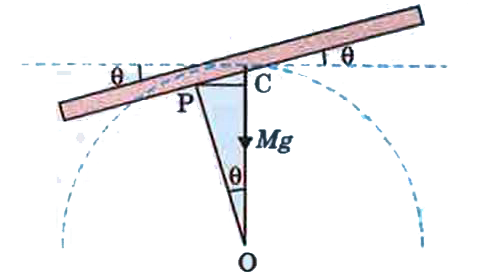 Let `theta` be the angle be which the rod is pressed. The restoring forc on the rod will be its weight, acting downwards at C. The MAGNITUDE of the restoring torque = force `xx` perpendicular DISTANCE ` = Mg xx CP = Mg xx OP sin theta = mg xx R sin theta` (where) OP = R = radius of sphere). Since `theta` is small so `sin theta = theta` where `theta` is in radains, IF I is the moment of inertia of the rod. then the equations of motion of the scale is `I(d^(2)theta)/(dt^(2)) = mgRtheta` or `(d^(2)theta)/(dt^(2)) = (-(mgR)/(I))theta`{negative sign due to restoring nature.} Thus, the motion is simple haromonic with angular frequency `omega^(2) = ((MgR)/(I))` `rArr omega = sqrt((MgR)/(I)) (because (ML^(2))/(12))` `therefore omega = sqrt((12gR)/(L^(2)))` Using the VALUES L = 1m, g = 10 `ms^(-2)` and R = 0.2 m, we get= 4.898 rad/s. |
|