

Saved Bookmarks
| 1. |
The maximum height attained by a projectile when thrown at an angle theta with the horizontal is found to be half the horizontal range.Then theta = |
|
Answer» Solution :Letus consider an object thrown with initial velocity `vec(u)`an angle`THETA`with the horizontal as in figure `vec(u) = u_(z) hat(i) +u_(y) hat(j)` The horizontal component of velocity`u_(x) = u cos theta`. Thevertical component of velocity`u_(y) = u sin theta`. Since the acceleration due to gravity is in the direction opposite to the direction of vertical component `u_(y)`this component will gradually reduce to zero at the maximum height of the projectile. At this maximum height, the same gravitational force will push the projectile to move downward . It falls to the ground.there isno acceleration along the x direction throughout the motion. Hence, the horizontal component of the velocity `(u_(x)=u cos theta)`remains the same till the object reaches the ground . Hence after the time t , the velocity along horizontal motion `v_(x) = u_(x) + a_(x) t`[ `:' u_(x) = u cos theta` ] The horizontal distance travelled by projectile in time t is`s_(x) = u_(x) t + (1)/(2) a_(x) t^(2)` Here, `s_(x) = x, u_(x)= u cos theta, a_(x)=0` Thus , x ` = u cos theta t or t = (x)/(u cos theta ) "". . . (1)` For the vertical motion `v_(y) = u_(y) + a_(y) t` Here `u_(y) = u sin theta, a_(y) = - g`(acceleration due to gravity acts opposite to the motion) . Thus `v_(y) = u sin theta - g t "". . . (2)` the vertical distance travelled by the projectile in the same time t is `s_(y) = u_(y) t + (1)/(2) a_(y) t^(2)` Here , `s_(y) = y, u_(y) = u sin theta , a_(x) = - g. `Then `y = u sin theta t - (1)/(2) g t^(2)"". . . (3)` Substitute the value of t from equation (1) in equation (3) , we have `y = u sin theta (x)/(u cos theta) - (1)/(2) g (x^(2))/(u^(2) cos^(2) theta)` `y = x tan theta -(1)/(2) g (x^(2))/(u^(2) cos^(2) theta) "". . . (4)` Thus the path followed by the projectile is an INVERTED parabola. Maximum height `(h_("max"))` : The maximum vertical distance travelled by the projectile during its JOURNEY is called maximum height For the vertical partof the motion, `v_(y)^(2) = u_(y)^(2) + 2a_(y^(s))` Here, `u_(y) = u sin theta, a = - g, s = h_("max")`, and at t he maximum height `v_(y) = 0` `:. (0) = u^(2) sin ^(2) theta = 2 gh_("max")` or`h_("max") = (u^(2) sin^(2) theta)/(2g)` Horinontal range (R) : The maximum horizontal distance between the point of projection and the point on the horizontal plane where the projectile hits the ground is called horizontal range (R) . It is found EASILY. Since the horizontal component of initial velocity remains the same.We can write `"Range R" = {{:("Horizontal component"),("of velocity" xx "time of flight"):}` `= u cos theta xx T_(f)` `R = u cos theta xx (2 u sin theta)/(g)` ` = (2 u^(2) sin theta cos theta)/(g)` `rArr :. R = (u^(2) sin 2 theta)/(g)` 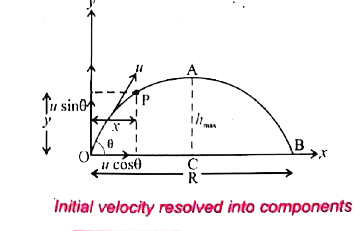
|
|