

Saved Bookmarks
| 1. |
The ring M_(1) and block M_(2) are held in the position shown in fig. Now the system is released. If M_(1) gt M_(2), find V_(1)//V_(2) wheb the ring m_(1) slides down along the smooth fixed vertical rod by the distance h. |
|
Answer» Solution :Method 1: Let ring has moved down a distance y. From fig., we have `y^(2)+l^(2)=s^(2)`…(i) Here l is the length of string which is constant. Differentiating (i) w.r.t. time, we get 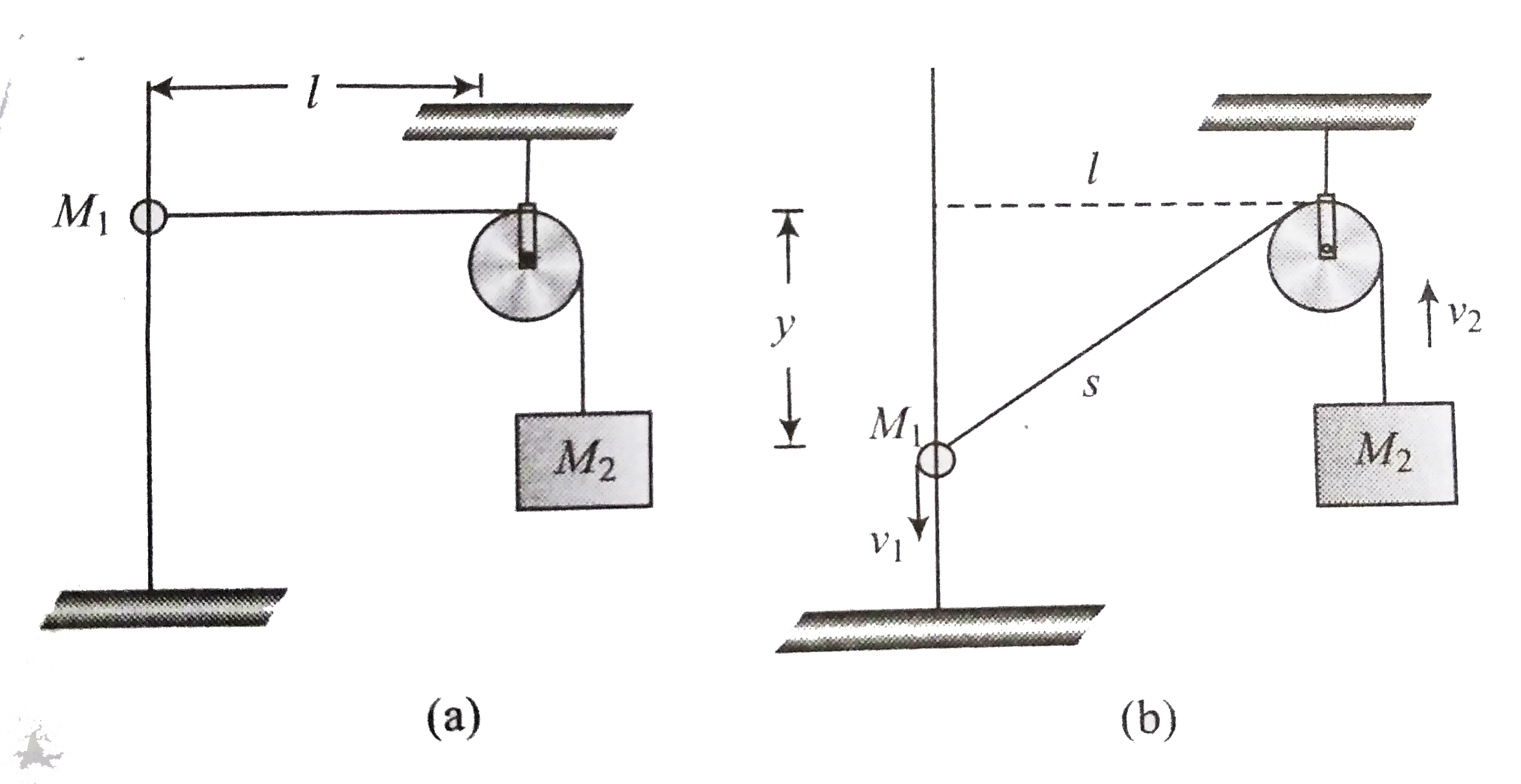 `2y(dy)/(DT)+0=2S(ds)/(dt) or (dy)/(dt)=(s)/(y)*(ds)/(dt)` ...(ii) Here `(dy)/(dt)=v_(1)` and `(ds)/(dt)=v_(2)`. For `y=h, s=sqrt(h^(2)+l^(2))` Therefore, Eq(ii) takes the from `v_(1)=(sqrt(h^(2)_l^(2)))/(h).v_(2) or (v_1)/(v_2)=(sqrt(h^(2)+l^(2)))/(h)` Method 2: Let in time t the ring falls to point A which is a distance h below the ring's initial position. 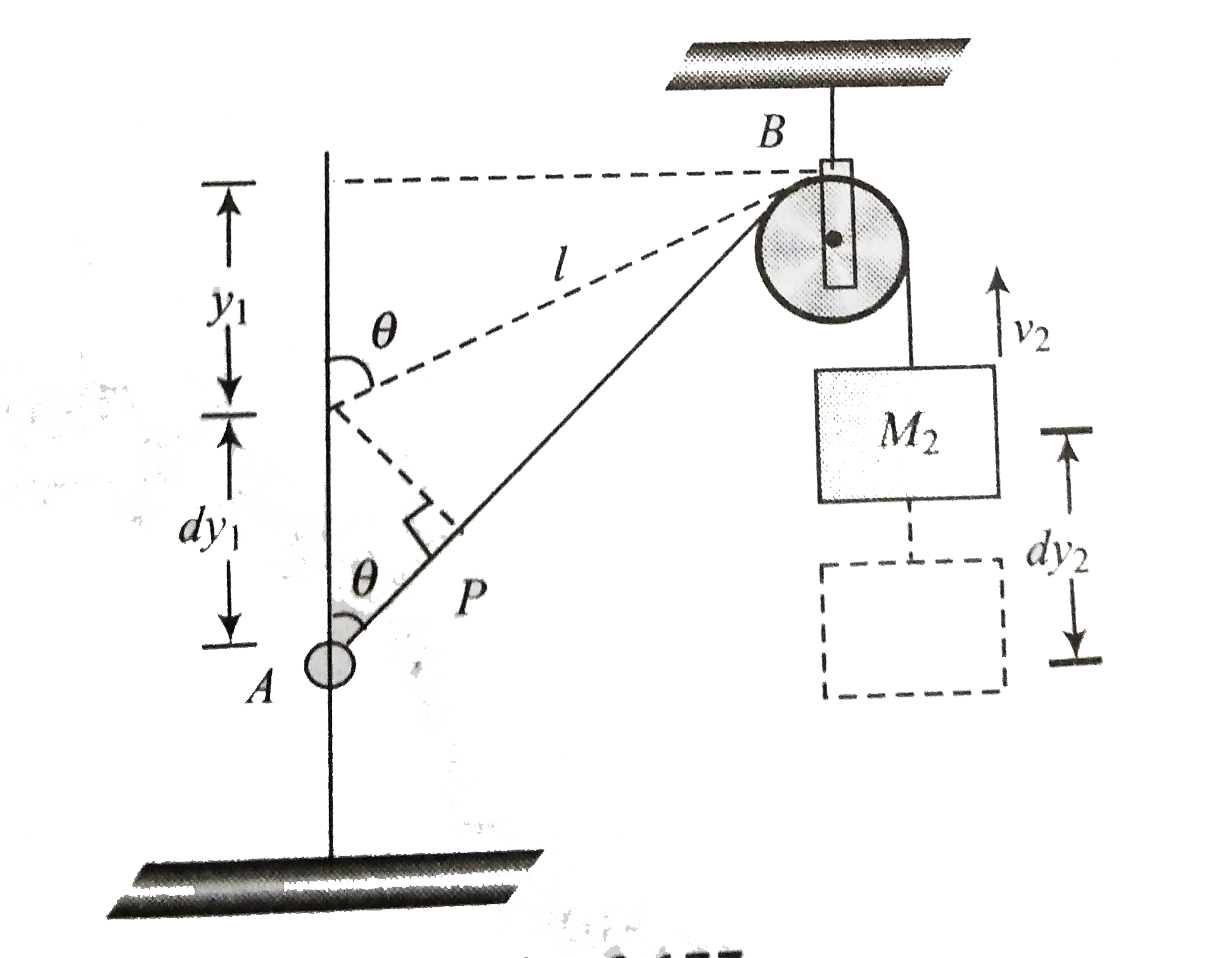 At this position, the string makes an angle `theta` with rod in small time interval dt, the ring moves down to A' and the block rises by `dy_(2)`. Let us DRAW a perpendicular AP from A to AB. As the length of the string is constant `:. A'P=dy_(2)` But `A'P=dy_(1) COS theta` `:. dy_(1) cos theta=dy_(2)` Dividing both sides by dt, we get `((dy_(1))/(dt)) cos theta =((dy_(2))/(dt))`. Here `(dy_(1))/(dt)=V_(1)`, the rate of change of position of ring with time and `(dy_(2))/(dt) =V_(2)`, the rate of change position of block with time. Thus, we have `V_(1) cos theta = V_(2)` or `(V_1)/(V_2)=(1)/(cos theta)=(1)/((h)/(sqrt(h^(2)+l^(2))))=(sqrt(h^(2)+l^(2)))/(h)`. |
|