

Saved Bookmarks
| 1. |
Two blocks of masses M and 3M are placed on a horizontal, frictionless surface. A light spring is attached to one of them and the blocks are pushed together with the spring between them. A cord initially holding the blocks together is burned, after that, the block of mass 3M moves to the right with a speed of 2.00 m//s. (a) What is the velocity of the block of mass M. (b) Find the system's original elastic potential energy, taking M = 0.350 kg. (c) Is the original energy in the spring or in the cord? Explain your answer. (d) Is momentum of the system conserved in the bursting apart process? How can it be with large forces acting? How can it be with no motion beforehand and plenty of motion afterward? |
|
Answer» <P> Solution :a. For the system of two blocks `/_\p=0`or `p_(i)=p_(F)` therefore `0=Mv_(M)+(3M)(2.00m//s)` 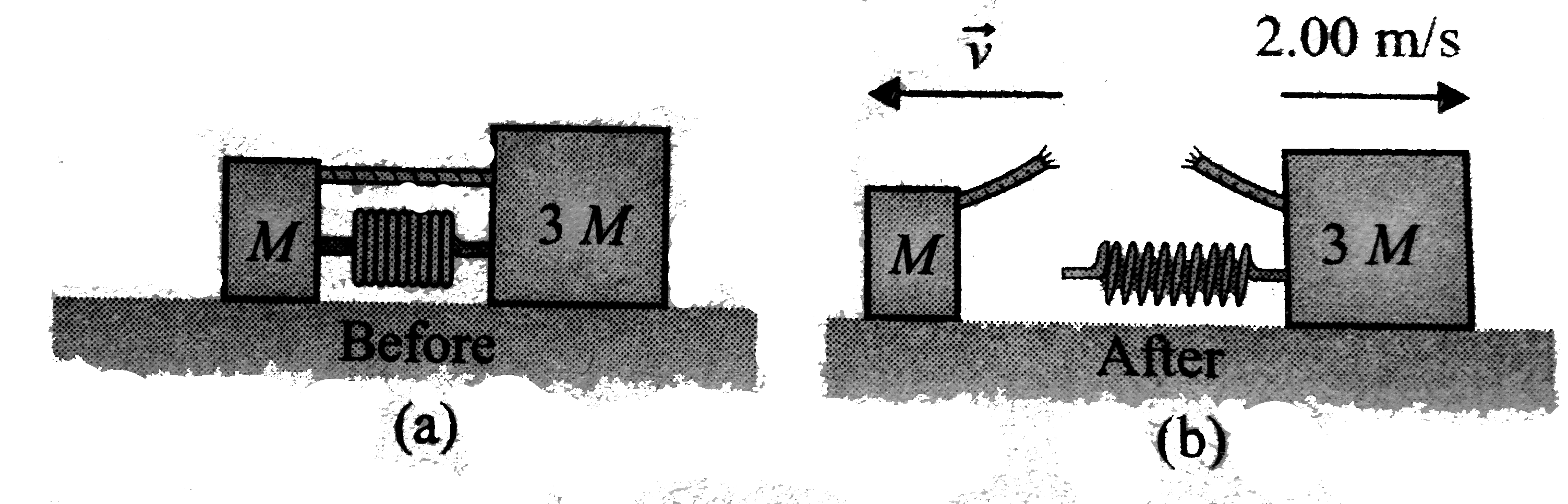 Solving `v_(M)=-6.00m//s` (motion toward the left) b. `1/2kx^(2)=1/2Mv_(M)^(2)+1/2(3M)v_(3M)^(2)=8.40J` c.The original energy is in the spring. A force had to be exerted over a distance to compress the spring, transferring energy into it by work. d. Momentum of the system is conserved with the value zero. The forces on the two blocks are of equal magnitude and opposite directions. Their impulses add to zero. The FINAL momenta of the two blocks of are of equal magnitude of nd OPOSITE directions. plenty of motion afterward is due to the fact that energy STORED in the spring converts into the kinetic energy of blocks. |
|