

Saved Bookmarks
| 1. |
"Two curves "C_(1)equiv[f(y)]^(2//3)+[f(x)]^(1//3)=0 and C_(2)equiv[f(y)]^(2//3)+[f(x)]^(2//3)=12," satisfying the relation "(x-y)f(x+y)-(x+y)f(x-y)=4xy(x^(2)-y^(2)) The area bounded by C_(1) and C_(2) is |
|
Answer» `2pi-sqrt(3)` SQ. units `(x-y)F(x+y)-(x+y)f(x-y)=4zy(x^(2)-y^(2))` `=(x^(2)-y^(2))[(x+y)^(2)-(x-y)^(2)]` `=(x-y)(x+y)^(3)-(x+y)(x-y)^(3)` `rArr""f(x+y)=(x+y)^(3)RARRF(x)=x^(3),f(y)=y^(3)` Now equations of given curves are `y^(2)+x=0"...(1)"` `x^(2)+y^(2)=12"...(2)"` 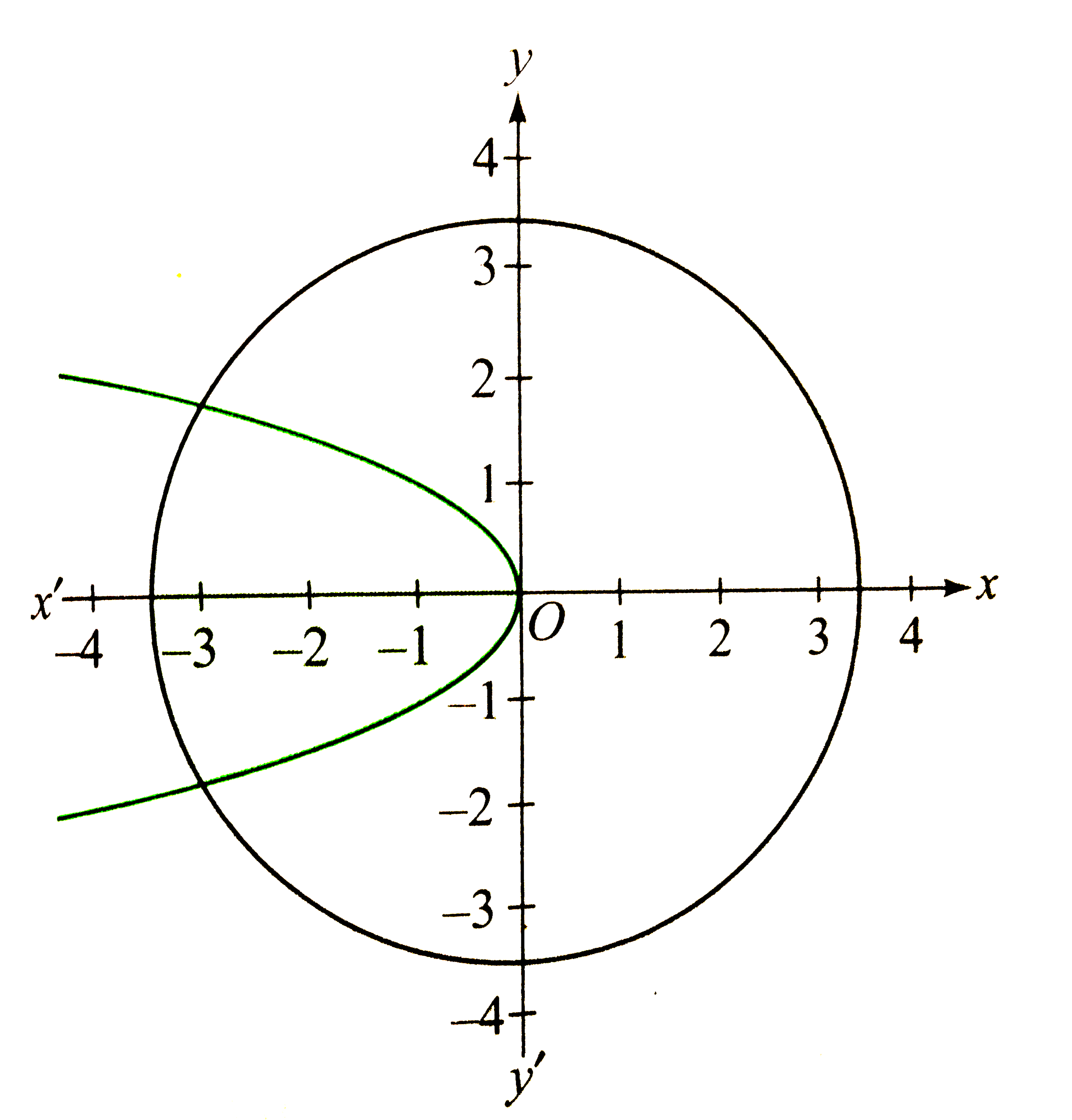 Solving equations (1) and (2), we get `x=-3,y = pm sqrt(3)` The area bounded by curves `A=2[|underset(-2sqrt(3))overset(-3)intdx|+|underset(-3)overset(0)intsqrt(-x)dx|]` `I_(1)=2overset(-3)underset(-2sqrt(3))intsqrt(12-x^(2))dx=2overset(-pi//3)underset(-pi//2)int12 cos ^(2) theta d""theta` `=12[overset(-pi//3)underset(-pi//2)INT(1+cos 2theta)d""theta]` `=12[theta+(SIN theta)/(2)]_(-pi//2)^(-pi//3)=12[-(pi)/(3)-(sqrt(3))/(4)+(pi)/(2)]` `=12[(pi)/(6)-(sqrt(3))/(4)]=2pi-3sqrt(3).` `I_(2)=2overset(0)underset(-3)intsqrt(-x)dx=(2[(-x)^(3//2)]_(-3)^(0))/(-3//2)=-(4)/(3)[10-3^(3//2)]=4sqrt(3).` `A=2pi-3sqrt(3)+4sqrt(3)=2pi+sqrt(3)` sq. units. |
|