

Saved Bookmarks
| 1. |
Two discs of moments of inertia I_(1) " and" I_(2) about their respective axes (normal to the disc and passing through the centre), and rotating with angular speeds omega_(1) " and" omega_(2) are brought into contact face to face with their axes of rotation coincident. (a) What is the angular speed of the two-disc system? (b) Show that the kinetic energy of the combined system is less than the sum of the initial kinetic energies of the two discs. How do you account for this loss in energy? Take omega_(1) ne omega_(2) |
|
Answer» Doesthe lawof conservationofangularmonentum apply to thesituation? Why ? letthe common angularvelocityof thesystemis `omega ` ( A)yes , thelaw of conservation of angularmomentumcan beapplied,Because , THEREIS nonetexternal TORQUE on thesystemof thetwodisc . EXTERNAL forces , gravition and normalreaction,act throughth axisofrotation, henceproduce notorque . 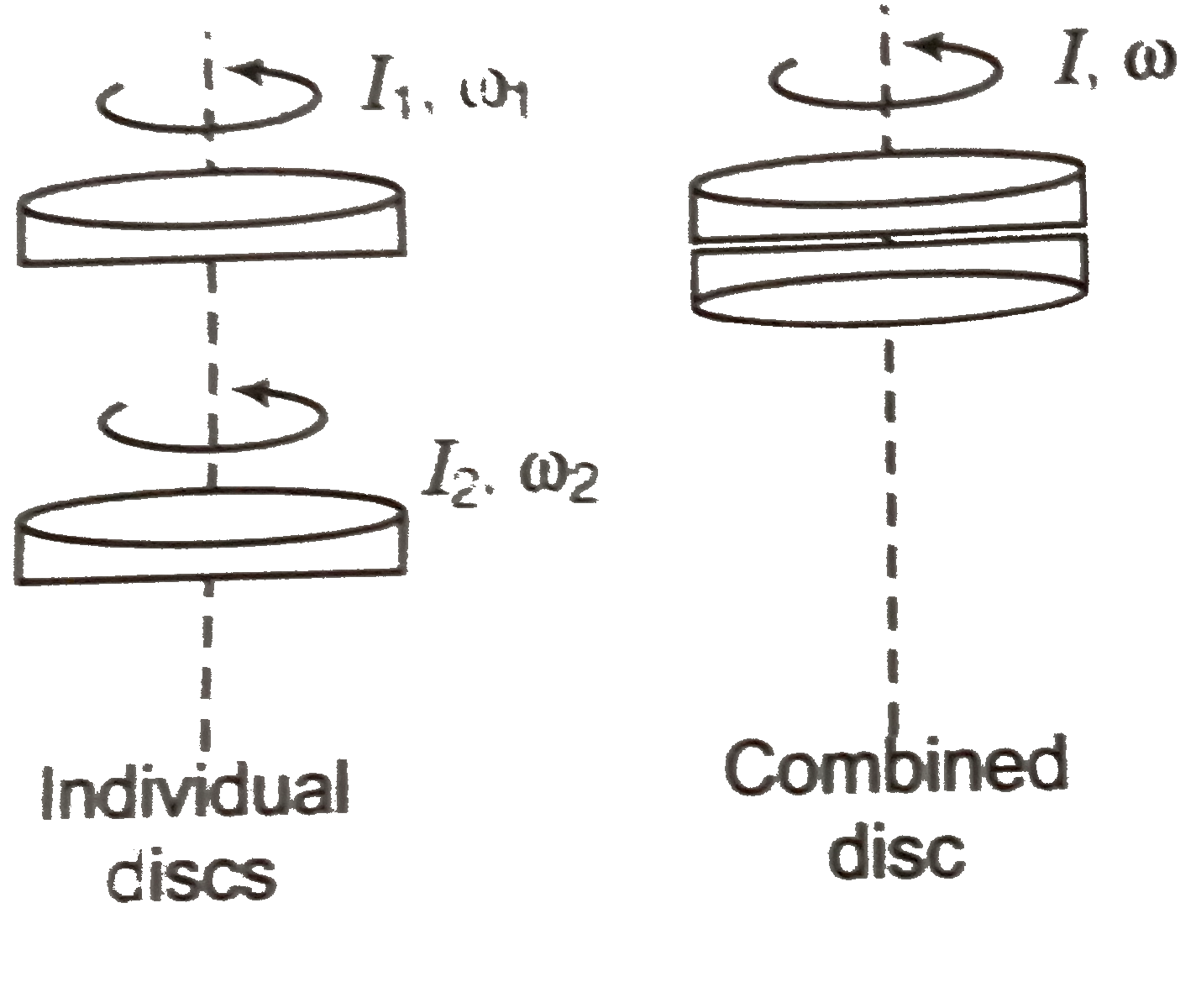 ( B) BYconservation of angularmomentum `L_(f)=L_(j)` `implies Iomega=Iomega_(1)+I_(2)omega_(2)` ` implies omega=(I_(1)+I_(2)omega_(2))/(I)=(I_(1)omega_(1)+I_(2)omega_(2))/(I_(1)+I_(2))""(:' I=I_(1)+I_(2))` `(C)K_(f)=(1)/(2)(I_(1)+I_(2))((I_(1)omega_(1)+I_(2)omega_(2)))/((I_(1)+I_(2)))=(1)/(2)((I_(1)omega_(1)+I_(2)omega_(2)))/((I_(1)+I_(2)))` `k_(f)=(1)/(2)(I_(1)omega_(1)^(2)+I_(2)omega_(2)^(2))` `DeltaK=K_(f)-K_(i)=-(I_(1)I_(2))/(2(I_(1)+I_(2)))(omega_(1)-omega_(2))^(2)lt0` (D)Hencethere is lossin KE of thelossin kinticenergyismainly dueto theworkagainst thefricationbetweenthe twodiscs. |
|