

Saved Bookmarks
| 1. |
Two metallic strings A and B of different materials are connected in series forming a joint . The strings have similar cross - sectional area .The length odA is l_(A) = 0.3 m and B is l_(B) = 0.75 m . One end of the combined string is tied with a support rigidly and the other end is loadedwith a block of mass m passing over a frictionless pulley . Transverse waves are set up in the combined string using an external source of variable frequency , calculate a. The lowest frequency for which standing waves are observed such that the joints is a node and b. The total number of antinodes at this frequency . The densitiesofA and B are 6.3 xx 10^(3) kg // m^(3) and 2.8 xx 10^(3) kg//m^(3) , respectively . |
|
Answer» Solution :Given that ` l_(A) = 0.3 m , l_(B) = 0.75 m , T = mg , A_(A) = A_(B) = A , d_(A) = 6.3 XX 10^(3) kg//m^(3)` `d_(B) = 2.8xx10^(3)` Let P = NUMBER of loops formed in stringA and q = number of loops formed in string B. a. Both `p and q` will be integer NUMBERS , as the one end is fixed rigidly , the other end is loaded and the joint `P` is a node. For string `A , n_(A) = (p)/( 2l_(A)) sqrt((A)/(A d_(A)))` For string `B , n_(B) = (q)/( 2l_(B)) = sqrt((T)/(Ad_(B)))` As both the strings are to be exerted by the same source of variable frequency , hence ` n_(A) = n_(B)`. `(p)/( 2 l_(A)) sqrt((T)/(Ad_(A))) = (q)/( 2 l_(B)) sqrt((T)/(A d_(B)))` `(p)/(q) = (l_(A))/(l_(B)) = sqrt((d_(A))/(d_(B))) = ( 0.3)/( 0.75) sqrt(( 6.3 xx 10^(3))/( 2.8 xx 10^(3))) = ( 2)/(5) sqrt((9)/(4)) = (2)/(5) xx (3)/(2) = (3)/( 5)` or ` (6)/( 10) or (9)/( 15)` As we have to determine the lowest frequency hence the mode of variation will be as shown in Fig . 7.46. `n_(min) = ( 3)/( 2l_(A)) sqrt((T)/( Ad_(A)))` ` = (3)/( 2 xx 0.3) sqrt (( m xx 10)/( A xx 6.3 xx 10^(3)))` `= (3)/( 2 xx 0.3 xx 10) sqrt ((m)/( 6.3 A)) = sqrt((m)/( 25.2 A))` b. The total number of antinodes at this frequency ` = 3 + 5 = 8` 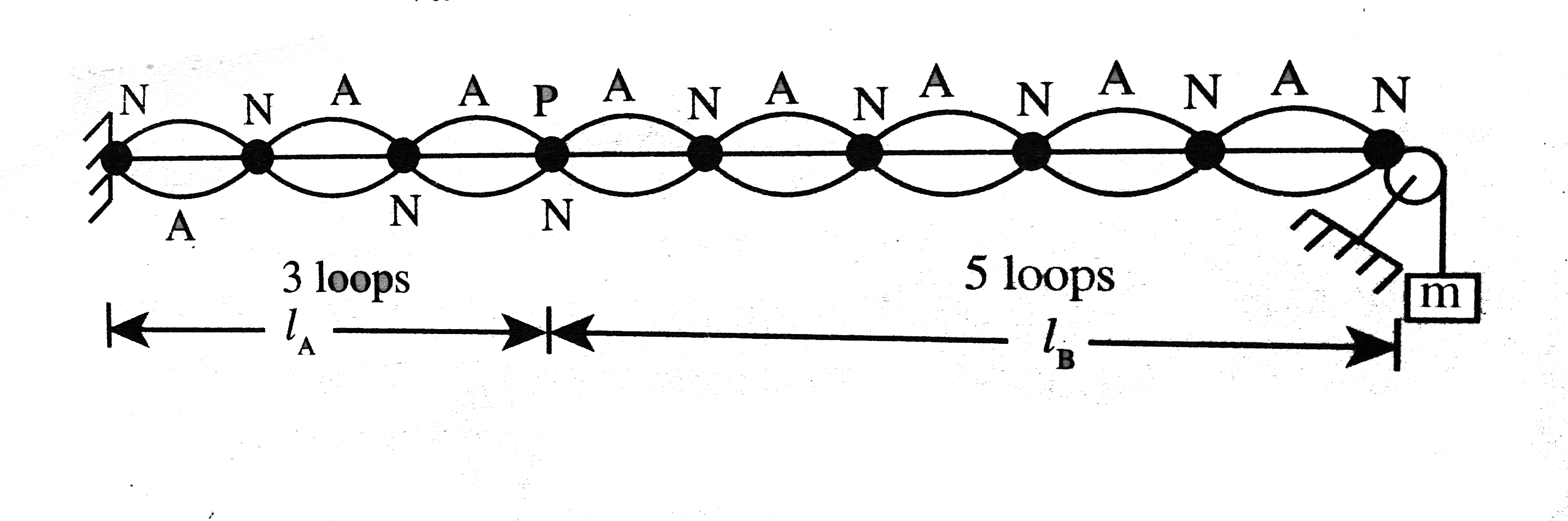
|
|