

Saved Bookmarks
| 1. |
Two narrow cylindrical pipes A and B have the same length . Pipe A is open at both ends and is filled with a monoatomic gas of molar mass M_(A). Pipe B is open at one end and closed at the other end and is filled with a diatomic gas of molar mass M_(B). Both gases are at the same temperature . a. If the frequency to the second harmonic of the fundamental mode in pipe A is equal to the frequency of the third harmonic of the fundamental mode in pipe B, determine the value of M_(A)//M_(B). b. Now the open end of pipe B is also closed ( so that pipe B is closed at both ends ). Find the ratio of the fundamental frequency in pipe A to that in pipe B. |
|
Answer» Solution :a. If `L` is the length of each pipe `A and B` , then fundamental FREQUENCY of pipe `A` ( open at both ENDS ) `n_(A) = (v_(A))/( 2L)`(i) Fundamental frequency of pipe `B` ( closed at one end) `n_(B) = (v_(B))/( 4L)`(ii) Given`2 n_(A) = 3 n_(B)` `2((v_(A))/(2L)) = 3((v_(B))/( 4L))` `rArr (v_(A))/(v_(B)) = (3)/(4)` But ` v_(A) = sqrt((gamma_(A) RT_(A))/( M_(A))) , v_(B) =sqrt((gamma_(B)RT_(B))/(M_(B)))` Given`T_(A) = T_(B)` For monoatomic get `gamma _(A) = (5)/(3)` For DIATOMIC get `gamma_(B) = (7)/(5)` `:. (v_(A))/(v_(B)) = sqrt({(gamma_(A))/(gamma_(B))) (M_(B))/(M_(A))}` `sqrt(((5//3)) /((7//5)) (M_(B))/(M_(A)))` ` = sqrt((25)/(21) (M_(B))/(M_(A)))` (i) From Eqs.(III) and (iv) `sqrt((25)/(21) (M_(B))/(M_(A))) = (3)/(4)` (ii) `(M_(A))/(M_(B)) = ((4)/(3))^(2) xx (25)/(21) = (400)/(189)` b. When pipe `B` is closed at both ends , fundamental frequency of pipe `B` becomes `n_(B) = (v_(B))/( 2L)`(v) Using Eqs. (i) ,(iii) and (v) , we get iii.`(n_(A))/(n_(B)) = (v_(A))/(v_(B)) = (3)/(4)` 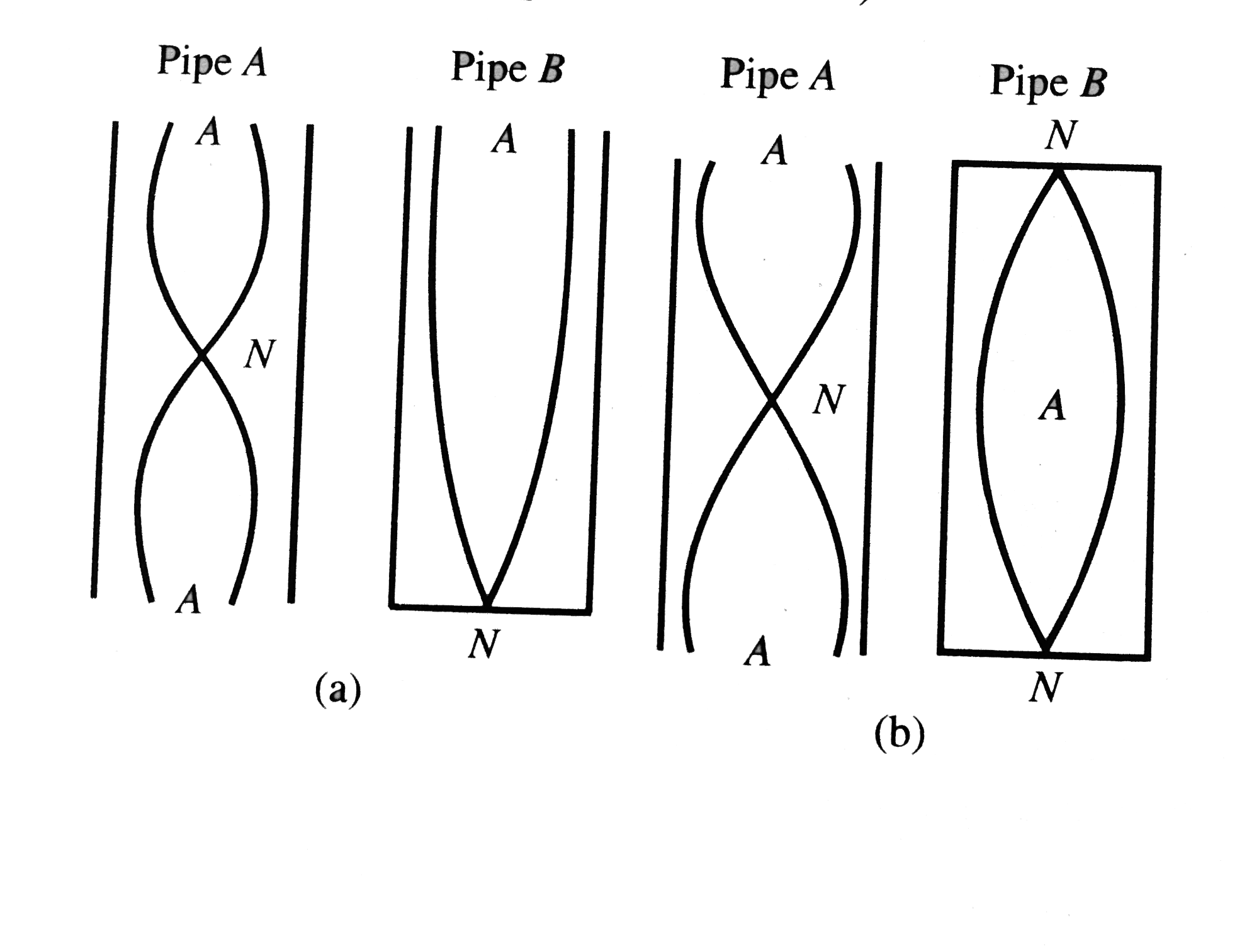
|
|