

Saved Bookmarks
| 1. |
Two particles of mass m_(1),m_(2) moving with initial velovity u_(1) and u_(2) collide head-on. Find minimum kinetic energy that system has during collision. Thus. Prove that maximum kinetic energy is lost in perfectly inelastic collision |
|
Answer» Solution :Particles moving with velocity `u_(1)` and `u_(2)` in the same direction. In C-frame initial KINETIC energy of system is `K_("sys")=K_(sys//c)+K_(c')` we get `K_(sys)=(muv_(rel)^(2))/(2)+(mv_c^(2))/(2)` `(1)/(2)mu(u_(2)-u_(1))^(2)+(mv_(c)^(2))/(2)` `mu=(m_(1)m_(2))/(m_(1)+m_(2))` ltbegt During collision, at the instant of maximum deformation. we get minimum kinetic energy in C-frame as particles attain same. velocity, thus relative velocity becomes zero. When an isolated system has minimum kinetic energy in C-frame, it will also have minimum kinetic energy in ground frame, as velocity of center of mass is constant. Thus minimum kinetic energy during collision is `(1)/(2)(m_(1)+m_(2))v_(c)^(2)` Where `v_(c)=((m_(1)u_(1)+m_(2)u_(2)))/(m_(1)+m_(2))` In perfectly inelastic collision, since both the particles move together, the relative velocity be- comes zero. Thus, final kinetic energy is `(1)/(2)(m_(1)+m_(2))v_(c)^(2)(m_(s)=m_(1)+m_(2))`, as velocity of center of mass is constant. This is the minimum possible kinetic energy that a system will have because in all other case there will be one more term adding in the kinetic energy of system because of particles having relative velocity. Two block of mass `m_(1)` and `m_(2)` connected by an ideal spring of spring constant `k` are kept on a SMOOTH horizontal surface. Find maximum extension of the spring when the block `m_(2)` is given an initial velocity of `v_(0)` towards right as shown in figure. 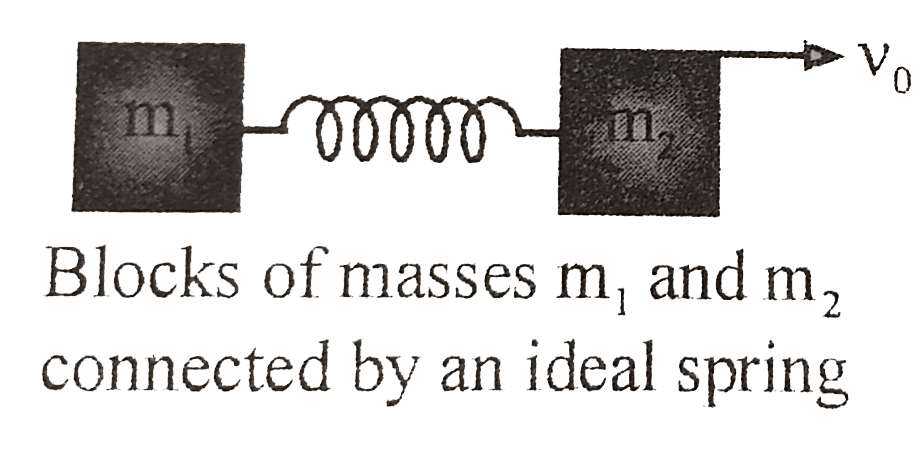 When a block of mass `m_(2)`is given an initial velocity of `v_(0)` towards right, the spring extends and pulls the block toward left and the same extended spring will pull the block `m1` towards right. Initially the force acting on `m_(2)` will reduce its speed and the force acting on `m_(1)` will increase its speed. Thus, we can see that initially the extension be increasing.If we consider the two blocks and spring as one system, then total mechanical energy must be CONSERVED as there is no dissipative force present. Also, momentum will be conserved as there is no external force present. Now there will be an instant when the block will have same velocity, that is, velocity of `m_(1)` has increased SUFFICIENTLY to become equal to the velocity of `m_(2)` which has been decreasing continuously. At this moment. The spring wil have the maximum extension`x_(xax')` as till this point distance between the blocks was continuously increasing because `m_(2)` had larger velocity. Now it will start decreasing as `m_(1)` will be moving faster than `m_(2)` and it will reduce the distance between the two blocks. Thus when `v_(1)=v_(2')` extension is maximum. This can also be understood alternatively by looking at `m_(1)` from reference frame attached to `m_(2)`. To an observer sitting on `m_(1)` the block `m_(2)` will be colsest or farthest when it is relative at rest. Since no external force is present, velocity of canter of mass is given as `v_("com")=((m_(2)v_(0)))/(m_(1)+m_(2))` From the reference frame of center of mass, the initial kinetic energy is given by `K=(1)/(2)mu(v_(2f)-v_(1f))^(2)=(1)/(2)(m_(1)m_(2))/(m_(1)+m_(2))(u)^(2)` From the reference frame of center of mass, the final kinetic energy is given by `K=(1)/(2)mu(v_(2f)-v_(1f))^(2)=0` Thus, equating initial and final energies in C-frame, we get `(1)/(2)(m_(1)m_(2))/(m_(1)+m_(2))(v_(0))^(2)=0+(1)/(2)kc_(max)^(2)` Thus, maximum extension `x_(max)=v_(0)sqrt((m_(1)m_(2))/(k(m_(1)+m_(2)))` This problem can be thought exactly as the opposite of the privious Illustration as here the maximum extension is occurrig the relative velocity is zero. |
|