

Saved Bookmarks
| 1. |
What is Young's modulus ? Explain. |
|
Answer» Solution :Experimental observation show that for a GIVEN material the magnitude of the strain PRODUCED is same whether the stress is tensile or compressive. The ratio of tensile (or compressive) stress `(sigma)` to the longitudinal strain `(epsi)` is difined as Young.s modulus and is denoted by the symbol Y. Young modulus = `("Tensile stress"(sigma))/("Longitudinal strain"(epsi))` `Y=(sigma)/(epsi)` `therefore Y = ((F//A))/((Delta L //L))= ((F xx L))/((A xx Delta L))` Here, strain is a dimensionless quantity, the UNIT of Young.s modulus is the same as that of stress. Mean `Nm^(-2)` or Pascal (Pa). Dimensional formula`:[M^(1) L^(-1) T ^(-2)].` Young.s MODULI, elastic limit and tensile strength of some materials are given below. 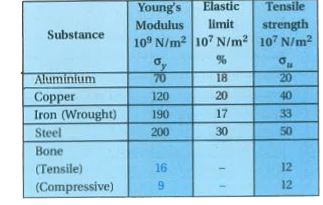 For metals Young.s moduli are large therefore these materials require a large force produce small change in length. Steel is more elastic than copper, brass and aluminium. It is for this reason that steel is preferred in heavy-duty machines and in structural designs. Wood, bone, concrete and glass have RATHER small Young.s moduli. |
|