

Saved Bookmarks
| 1. |
when benzyl chloride is boiled with aqueous KOH solution and the solution is acidified by a few drops of dilute HNO_(3) followed by AgNO_(3) solution, a white precipitate is formed. However, no such precipitate is noticed when the reaction is carried with chlorobenzene. explain. |
Answer» Solution :In case of `C_(6)H_(5)CH_(2)Cl`, the benzyl carbocation `(C_(6)H_(5) OVERSET(o+)(C)H_(2))` FORMED by releasing `Cl^(-)` ion is resonance stabilised. THEREFORE, the `C - Cl` bond can cleave to form `KCl`. HOWEVER, the phenyl carbocation `(C_(6)overset(o+)(H)_(5))` expected to be formed in case of chlorobenzene does not show any resonance. therefore, `C - Cl` bond does not cleave in case of chlorobenzene and no white precipitate is formed in this case. 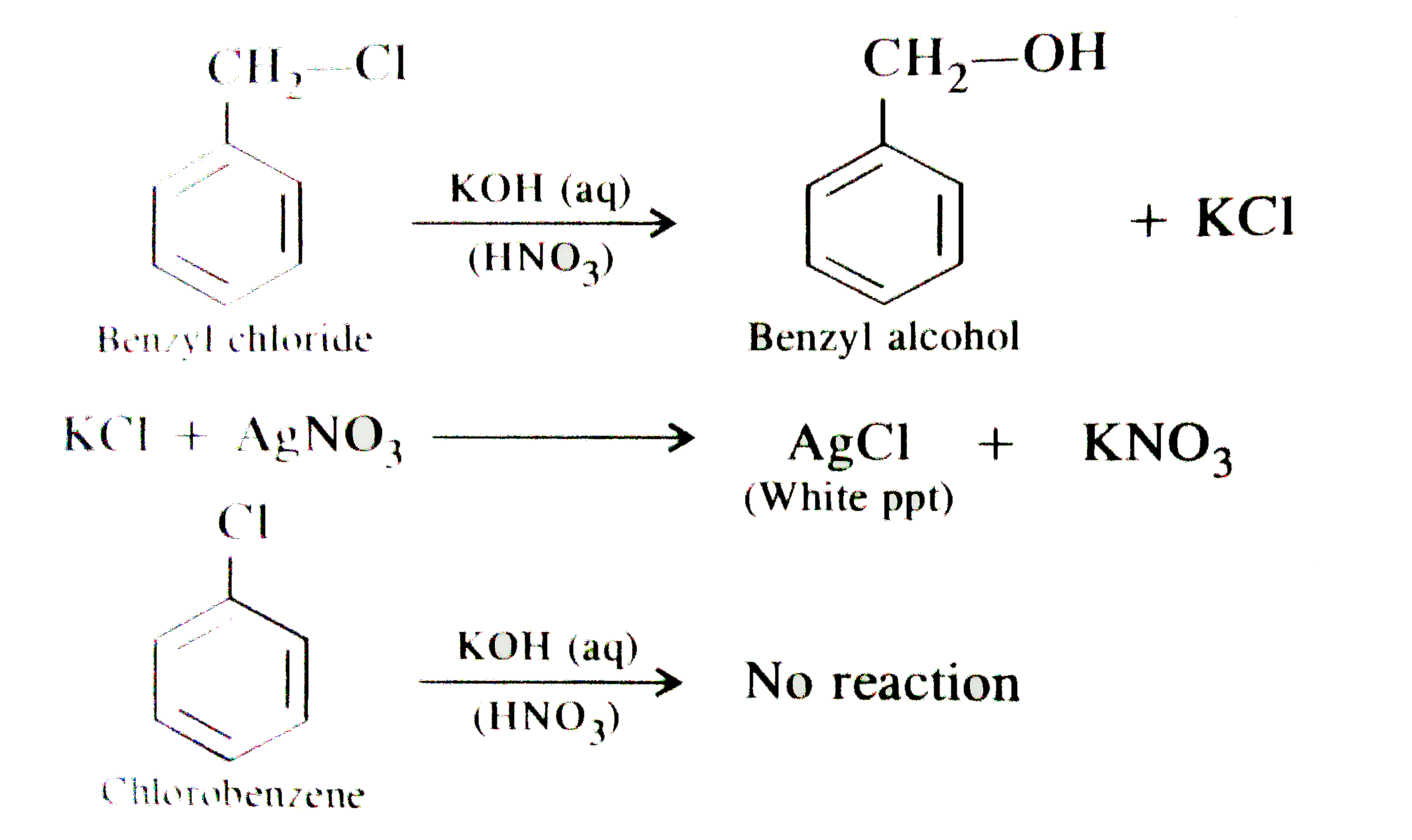
|
|