Saved Bookmarks
This section includes 7 InterviewSolutions, each offering curated multiple-choice questions to sharpen your Current Affairs knowledge and support exam preparation. Choose a topic below to get started.
| 1. |
Elements in the firsdt column of the periodic table are called alkali metals. These metals have: |
|
Answer» A single valency electron |
|
| 2. |
Elements havingthree incomplete outermostsubshellscalled ………. |
| Answer» SOLUTION :Inner-transitionelements | |
| 3. |
Elements havebeen classified as as s-,p-, d- and f-block elements of the basisof the types oforbital which receives the last electron. Are there any exceptions to thisgeneralization ? Comment. |
|
Answer» SOLUTION :Someexceptions are : (i) Zn, Cd, Hg and CN all receive the last ELECTRON in theirrespective s-orbitals but arecalledd-block ELEMENTS (ii)the receives the lastelectron in thed-orbitalbut is called f-blockelement. |
|
| 4. |
Elements belonging to which groups of the periodic table combinewith each other to form electrovalent compounds? |
| Answer» SOLUTION :Highly electropositive metals of groups-1 and 2 COMBINE with the electronegative ELEMENTS of groups-15, 16 and 17 to form electrovalent COMPOUNDS. | |
| 5. |
Elements capable of exhibiting photoelectric effect with 295nm radiation 1) |
|
Answer» LI, Na, K and MG |
|
| 6. |
Elements A ,B ,C,D and E have thefollowingelectronic configurations. A : 1 s^(2)2s^(2) 2p^(1) B : 1s^(2)n2s^(2) 2p^(6) 3 s^(2)3p^(1) C : 1 s^(2) 2 s^(2) 2p^(6) 3s^(2) 3p^(3) D : 1 s^(2) 2 s^(2) 2p^(6) 3s^(2) 3p^(5) E : 1 s^(2) 2 s^(2)2p^(6) 3 s^(2) 3p^(6)4s^(2) Whichamongthese will belongto thesame groupin theperiodictable ? |
|
Answer» <P> SOLUTION :We known that elements havingsimilarvalenceelectronic configuration belongto THESAME group of theperiodic table .Thereforeelements A and Bhavingthreeelectrons in thevalenceshell i.e., `2 s^(2)2 p^(1)` and`3 s^(2)3p^(1)` respectively belongto the samegroup ,i.e., group13 of theperiodic table |
|
| 7. |
Elements A, B, C and Dhaveatomicnumbers12, 19, 29and 36respectively . On thebasisof electronic configurationwriteto which group of theperiodictableeach element belongs. |
| Answer» Solution :A (Z= 12 ) = GROUP2 , B(Z= 19) = Group1 , C (Z = 29 )= Group11 ANDD (Z = 36 ) = GROUP18 ` | |
| 8. |
Elements A, B and C belong to the same period in the long form of the periodic table. The nature of the oxides of A, B and C is amphoteric basic and acidic respectively. The correct order of the atomic numbers of these elements is |
| Answer» Answer :C | |
| 9. |
{:("Element",Cr,Mn,Fe),(E^(underset(-)(o))(M^(2+)//M),-0.90V,-1.18V,-0.4V),(E^(underset(-)(o))(M^(3+)//M^(2+)),-0.41V,+1.57V,+0.8V):} ltbr. Use this data to comment upon (i) the stability of Fe^(3+) and Mn^(2+) in acid solutions, (ii) The ease with which iron can be oxidised as compared to the similar process for either Cr or Mn metals. |
|
Answer» SOLUTION :(i) `MN^(2+)` is more STABLE than `FE^(3+)` (ii) The ORDER of getitng oxidised is `Mn gt Cr gt Fe`. |
|
| 10. |
Element withvalenceshellelectronic configurationas (n-1)d^(5)ns^(1)is placedin whichof the followinggroupand blockof element ? |
| Answer» Solution :Group No. = (n-1)d+ ns electrons= 5 + 1=6 | |
| 11. |
Element with electronic arrangement [Ar]3d^24s^2 belongs to |
|
Answer» s-block |
|
| 13. |
Element with atomic number 56 belong to which block. |
|
Answer» s |
|
| 16. |
Element with atomic number 38, belongs to |
|
Answer» II A group and 5TH PERIOD |
|
| 17. |
Element with atomic number 15 and mass number 31 is present in |
|
Answer» GROUP 5 and PERIOD 4 |
|
| 18. |
Element that has the highest first ionisation energy among the following is |
| Answer» Answer :B | |
| 19. |
Element of group 14. (a) exhibit oxidation state of +4 only (a) exhibitoxidationstate of +4 only , (b) exhibitoxidationstate of +2 and +4 (c ) form M^(2-) and M^(4+) ion , (d) form M^(2+) and M^(4+) ions. |
| Answer» Solution :DUE toinertpaireffect, elementof group 14exhibit oxidationstates of `+2` and `+4`. Thus option (B) ISCORRECT. | |
| 20. |
Element showing the phenomenon of allotropy is |
|
Answer» aluminium |
|
| 21. |
Element M+N_(2) overset(Delta)to overset(H_(2)O)toNH_(3) element M belonging to group 13 can be |
|
Answer» B or Al |
|
| 22. |
Element E reacts with oxygen to produce EO_(2). Identify element E if 16.5 g of it react with excess oxygen to form 26.1 g of EO_(2) |
| Answer» Answer :A | |
| 23. |
Elements a,b,c and d have the following electronic configurations:a:1s^(2),2s^(2),2p^(6)b:1s^(2),2s^(2),2p^(6),3s^(2),3p^(1)c:1s^(2),2s^(2),2p^(6),3s^(2),3p^(6) d:1s^(2),2s^(2),2s^(1)Which elements among these will belong to the same group of periodic table. |
Answer» Solution :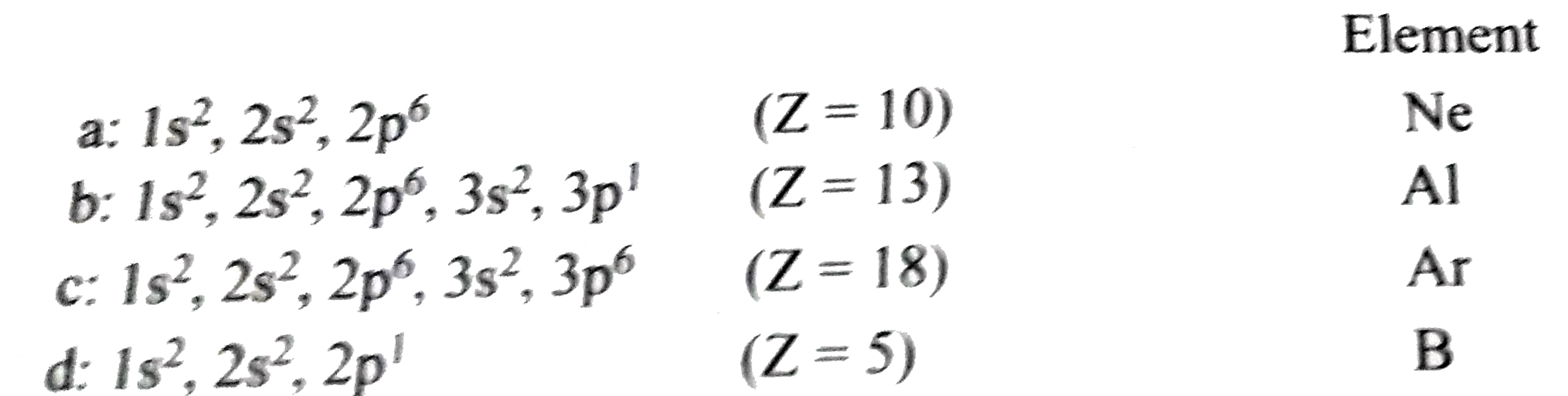 In the above elements, NE and Ar belong to same group (NOBLE gases - 18H group). Al and B belong to the same group (13H group). |
|
| 24. |
Element a reduces cation of element B but does not reduce the cation of element C will element C reduce the cation of elemnt B ? Explain |
|
Answer» Solution :since ELEMENT A reduces B therfore `E^(@)` of B is les ve than that of element A i.e element B lies above element A in theelectrochemical SERIES Furthr since A does not reduce `C^(+)` therefore `E^(@)` of C is more negative than that of element A i.e C lies BELOWA in the electrochemical series In the other owrds element B lies above element C in the electrochemical series and hence will reduce the cation of `B^(+)` i.e |
|
| 25. |
Element A will reduce the cation of element B (B^+) but will not reduce the cation of element C (C^+) Will element C reduce the cation of element B ? Explain . |
| Answer» Solution :Since A will reduce `B^+,B` has higher reduction POTENTIAL than A and THEREFORE, B LIES above A in the electrochemical series. Now, A will not reduce `C^+` , C has lower reduction potential than A and therefore , C lies below A in the electrochemical series . Therefore , C must be below B in the series and HENCE C will reduce `B^+`. | |
| 26. |
Elements 'A' and 'B' combine in the ratio of their |
|
Answer» ATOMIC WEIGHTS |
|
| 27. |
Elements of groupi are called alkali metals. Why? |
|
Answer» Solution :Alkali metals from basic oxides. `4M+O_(2)to2M_(2)O` These are soluble in water and form STRONG bases. Strong base is called alkali. HENCE GROUP 1elements are called alkali metals. |
|
| 29. |
Elektron is an alloy of zinc and…. |
|
Answer» barium Mg+Zn+Al+etc |
|
| 31. |
Electrophilies are electron seeking species. Which of the following groups contain only electrophilies? |
|
Answer» `BF_(3), NH_(3), H_(2)O` In (D), `C_(2)H_(5)^(-) and overset(.)C_(2) H_(5)` are not electrophiles. All electron in (B) and (C ) are ELECTROPHILIES. |
|
| 32. |
Electrophilies are electron seeking species. Which of the following groups contain only electrophiles ? |
|
Answer» `BF_(3), NH_(3), H_(2)O` |
|
| 33. |
Electrophilic substitutions are characteristic reaction of aromatic compounds. In this reaction hydrogen of the aromatic ring is replaced by an electophile because hydrogen in the form of HR is very good leaving group. -COOH and -SO_3H are also good leaving groups when they are present either atortho or at para to the highly activating groups like -NH_2 and -OH. Benzene sulphonic acid is converted into benzene by |
|
Answer» HEATING with DILUTE SULPHURIC acid |
|
| 34. |
Electrophilic substitutions are characteristic reaction of aromatic compounds. In this reaction hydrogen of the aromatic ring is replaced by an electophile because hydrogen in the form of HR is very good leaving group. -COOH and -SO_3H are also good leaving groups when they are present either atortho or at para to the highly activating groups like -NH_2 and -OH. Which one of the following compounds will be most unreactive towards electrophilic substitution reaction? |
|
Answer»

|
|
| 35. |
Electrophilic substitution reaction of benzene……… (i) overset(+)(N)O_(2) electrophile in nitration but SO_(3) in sulphonation. (ii) Cl is electrophile in chlorination. (iii) Br is electrophile in bromination (iv) R^(+) is electrophile in FC alkylation. |
|
Answer» |
|
| 36. |
Electrophilic substitution on mono substituted benzene is determined by electronic effects +1, -M groups are ortho, para directors, where as -1,-M groups are meta directions. When there is a competition between inductive and mesomeric effects, the latter wins over. Electrophilic substitution on disubstituted benzene is determined by the combined effect of both groups. Usually activating group wins over deactivating group. When one of the groups has a lone pair of electrons, that will determine the product formation. Usually a third group will not enter the position in between the two existing groups due to steric reasons. |
|
Answer»
|
|
| 37. |
Electrophilic substitution product of benzene is Hexa chloro benzene. Addition product of benzene is benzene Hexa chloride. The gram molecular wt. difference hetween these two compounds is________ grams. |
|
Answer» Hence 6 gms difference . |
|
| 38. |
Electrophilic substitution on mono substituted benzene is determined by electronic effects +1, -M groups are ortho, para directors, where as -1,-M groups are meta directions. When there is a competition between inductive and mesomeric effects, the latter wins over. Electrophilic substitution on disubstituted benzene is determined by the combined effect of both groups. Usually activating group wins over deactivating group. When one of the groups has a lone pair of electrons, that will determine the product formation. Usually a third group will not enter the position in between the two existing groups due to steric reasons. Identify the incorrect statement |
|
Answer» Solvolysis of cholorobenzene is DIFFICULT but 2,4,6-trinitrochlorobenzene can be EASILY solvolysed |
|
| 39. |
Electrophilic substitution on mono substituted benzene is determined by electronic effects +1, -M groups are ortho, para directors, where as -1,-M groups are meta directions. When there is a competition between inductive and mesomeric effects, the latter wins over. Electrophilic substitution on disubstituted benzene is determined by the combined effect of both groups. Usually activating group wins over deactivating group. When one of the groups has a lone pair of electrons, that will determine the product formation. Usually a third group will not enter the position in between the two existing groups due to steric reasons. Major products of nitration of acetanilide is: |
|
Answer»
 ORTHO, PARA DIRECTING GROUP ORTHO, PARA DIRECTING GROUP
|
|
| 40. |
Electrophilic substitution in phenol generally occurs at |
|
Answer» o-and p-POSITIONS |
|
| 41. |
Electrophilic addition reactions proceed in two steps. The first step involves the addition of an electrophile. Name of type of intermediate formed in the first step of the following addition reaction . CH_(3)-CH= CH_(2) + H^(+) rarr ? |
|
Answer» `2^(@)` -carbanion  According to Marecovnicove.s rule, the `2^(@)` carbocation is FORMED and COMPLETE ELECTROPHILIC addition REACTION. |
|
| 42. |
Electrophilic aromatic substitution can be seen in which of the following cases ? |
|
Answer»
|
|
| 43. |
Electrophilic addition reactions proceed in two steps. The first involves the addition of an electrophile. Name the type of intermediate formed in the first step of the following addition reaction. H_(3)C-HC = CH_(2) + H^(+) rarr ? |
|
Answer» `2^(@)` CARBANION 
|
|
| 44. |
Electrophilic addition reactions proceed in two steps. The first step involves the addition of an electrophile. Name the type of intermediate formed in the first step of the following addition reaction. H_(3)C -HC=CH_(2)+ H^(+)to? |
|
Answer» `2^(@)` carbanion 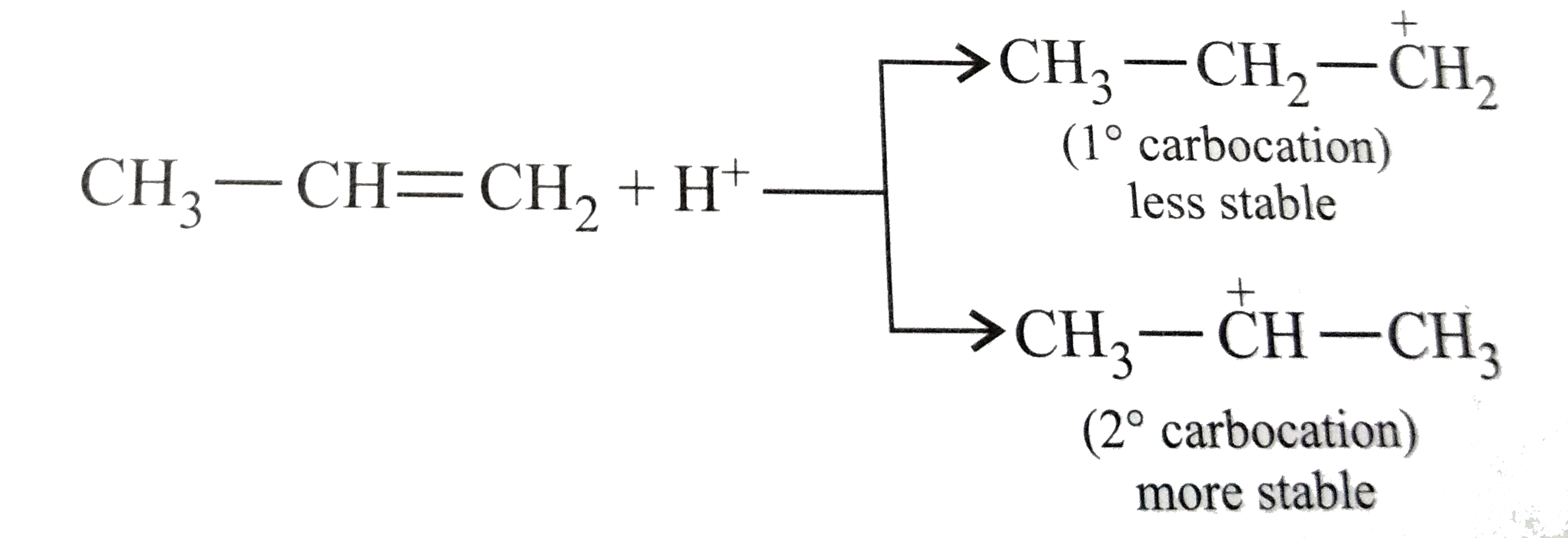 Thus, `2^(@)` CARBOCATIONS if FORMED. |
|
| 45. |
Electrophiles are electron seeking species. Which of the following groups contain only electrophiles ? |
|
Answer» `BF_(3), NH_(3), H_(2)O` In OPTION (a), `NH_(3)` and `H_(2)O` are nucleophiles whereas `BF_(3)` is an ELECTROPHILIC while in option (d) `C_(2)H_(5)^(-)` is a nucleophile while `overset(*)(C_(2))H_(5)` and `C_(2)H_(5)^(+)` are electrophiles. |
|
| 46. |
electrophiles are the species which attack the regions of............electron density |
|
Answer» |
|
| 47. |
Electrophiles are |
|
Answer» ELECTRON ATTRACTING SPECIES |
|
| 48. |
What are electrophiles ? Explain with two examples |
|
Answer» ELECTRON LOVING species |
|
| 49. |
Electrophile in the sulphonation of benzene is |
|
Answer» `Soverset(+)O_3H` |
|
| 50. |
Electrons with the highest penetrating power are |
|
Answer» p-electrons |
|