

Saved Bookmarks
This section includes 7 InterviewSolutions, each offering curated multiple-choice questions to sharpen your Current Affairs knowledge and support exam preparation. Choose a topic below to get started.
| 1. |
Justify that the following reactions are redox reactions : Fe_(2)O_(3)(s)+3CO(g)to2Fe(s)+3CO_(2)(g) |
|
Answer» Solution :`overset(+3)(Fe_(2))overset(-2)(O_(3))(s)+overset(+2-2)(3CO)(g)to2overset(0)Fe(s)+overset(+4-2)(3CO_(2))(g)` In this REACTION, `Fe_(2)O_(3)` is UNDERGOING reduction because the O.S. of Fe is decreasing from +3 ( in `Fe_(2)O_(3)` ) to 0 (in Fe), whereas CO is undergoing oxidation as the O.S. of carbon increases from +2 (in CO) to +4 ( in `CO_(2)` ). Hence, it is a REDOX reaction. |
|
| 2. |
Justify that the following reactions are redox reactions : CuO(s)+H_(2)(g)toCu(s)+H_(2)O(g) |
|
Answer» SOLUTION :`OVERSET(+2-2)(CUO(s))+overset(0)H_(2)(g)tooverset(0)(Cu)(s)+overset(+1-2)(H_(2)O)(g)` In this reaction, the O.S. of Cu is decreasing from +2 (in CuO) to 0 (in Cu) while that of hydrogen is increasing from O ( in `H_(2)` ) to +1 (in `H_(2)O` ). Thus, the reaction involves the REDUCTION of Cuo and OXIDATION of hydrogen. HENCE, it is a redox reaction, |
|
| 3. |
Justify that the following reactions are redox reactions : 4NH_(3)(g)+5O_(2)(g)to4NO(g)+6H_(2)O(g) |
|
Answer» Solution :`overset(-3)(4N)overset(+1)(H_(3))(g)+5overset(0)O_(2)(g)to4overset(+2-2)(4NO)(g)+overset(+1)(6H_(2))overset(-2)(O)(g)` In this reaction, `NH_(3)` is undergoing OXIDATION as the O.S. of N increases from -3 (in `NH_(3)` ) to +2 (in NO), whereas `O_(2)` is undergoing reduction as its O.S. decreases from 0 to -2 (in `H_(2)O` ). HENCE, it is a redox reaction. |
|
| 4. |
Justify that the following reactions are redox reactions : 4BCl_(3)(g)+3LiAlH_(4)(s)to2B_(2)H_(6)(g)+3LiCl(s)+3AlCl_(3)(s) |
|
Answer» Solution :`overset(+3)(Fe_(2))overset(-2)(O_(3))(s)+overset(+2-2)(3CO)(g)to2overset(0)(Fe)(s)+overset(+4-2)(3CO_(2))(g)` `overset(+3)(4B)overset(-1)(Cl_(3))(g)+overset(+1)(3Li)overset(+3)(Al)overset(-1)(H_(4))(s)to2overset(-3)(B_(2))overset(+1)(H_(6))(g)+overset(+1)(3Li)overset(-1)(Cl)(s)+3overset(+3)(Al)overset(-1)(Cl_(3))(s)` In this reaction, `BCl_(3)` is undergoing reduction because the O.S. of B decreases from +3 ( in `BCl_(3)` ) to -3 ( in `B_(2)H_(6)` ). Further, `LiAlH_(4)` is undergoing OXIDATION because the O.S. of Hincreases from -1 (in `LiAlH_(4)` ) to +1 ( in `B_(2)H_(6)` ).Therefore, it is a REDOX reaction. |
|
| 5. |
Justify that the following reactions are redox reactions : 2K(s)+F_(2)(g)to2K^(+)F^(-)(s) |
|
Answer» SOLUTION :`2Koverset(0)((s))+F_(2)overset(0)((g))to2overset(+1)(K^(+))overset(-1)(F^(-))(s)` In this reaction, K is UNDERGOING oxidation as its O.S. increases from 0 to +1, whereas `F_(2)` is undergoing reduction because its O.S. decreases from 0 to - 1. Hence, it is a redox reaction. |
|
| 6. |
Justify that the fifth period of the periodic table should have 18elements on the basis of quantum numbers. |
|
Answer» Solution :Fifth period of the PERIODIC table have 18 ELEMENTS. 5th period starts from Rb to Xe (18 elements), 5th period starts with PRINCIPAL quantum number n-5 and 1 = 0, 1, 2, 3 and 4 When n=5, the number of orbitals 1 for 5s 5 for 4d 3 for 5pTotal number of orbitals -9. `:.`Total number of electrons that can be accommodated in 9 orbitals = `9xx2` = 18. Hence the number of elements in 5th period is 18. |
|
| 7. |
Justify that reaction : 2Na(s) +H_2(g) rarr 2NaH(s) is redox reactions. |
|
Answer» Solution :Sodium hydride is an IONIC compound and it EXISTS as `Na^(+)H^(-)`. `2Na +H_2 rarr 2Na^(+)H^(-)(s)` The REACTION may be split up into two half REACTIONS. `{:(""Na(s)rarrNa^(+)+e^(-)"]"xx2" OXIDATION"),(H_2(g)+2e^(-)rarr2H^(-)"Reduction"),(bar(2Na(s)+H_2(g)rarr2NaH"")):}` In this reaciton , Na is oxidised to `Na^(+)` to `2H^(-)` ion. Therefore , it is a redox reaction. |
|
| 8. |
Justify giving reaction that among halogens, fluorine is the best oxidant and among hydrohalic compounds, hydroiodicacid in the best reductant. |
|
Answer» Solution :The standard redox potentials for (or standard reductionpotentials) of the redox couples formed by halgoens are - A redox couple consists of reduced from and an oxidised form .Larger the value of `E^(0)`for a redox couple ,greater is the tendency of its oxidised from to get reduced and smaller is the tendency of its reduced from to ger oxidised .The reverse is true when the value of `E^(0)` for a redox couple is small .Conbining this idea with standard ELECTRODE potentials of the redox couples given we can infer that the tendency of oxidised forms (i.e.,`F_(2),CI_(2),Br_(2)andI_(2))`to get reduced or the strength of oxidising power of the oxidised forms follows the order: `F_(2)ltCI_(2)ltBr_(2)ltI_(2)` and the tendency of reduced froms (i.,e`F^(-)CI^(-)Br^(-)andI^(-)`to get oxidised or the strength of reducing power of the reduced forms follows the order : `I^(-)ltBr^(-)ltCI^(-)ltF^(-)`As the oxidising power of `F_(2)` is highest among the halongs ,it is capable of oxidising other halides to the corresponding halogensn No other halogen except `F_(2)` has this ability. `F_(2)(g)2CI^(-)(aq)to2F^(-)(aq)+CI_(2)(g)` `F_(2)(g)2Br^(-)(aq)to2F^(-)(aq)+Br_(2)(l)` `F_(2)(g)+2I^(-)(aq)to2I^(-)(aq) to2F^(-)(aq)+I_(2)(s)` `CI_(2)(g)+2Br^(-)(aq)to2CI^(-)(aq)+br_(2)(l)` `CI_(2)(g)+2I^(-)(aq)to+2CI^(-)(aq)+I_(2)(s)` `Br_(2)(g)+3I^(-)(aq)to+2Br^(-)(aq)+I_(2)(s)` Therefore ,`F_(2)` has the strongest oxidising power among the halogens . The oxidation of a hydrohalic acid to get oxidised or the reducing power of a hydrohalic acid is high when the halide ion of the hydrohalic acid exhibits greater tendency of getting oxidised .As the tendency of halide ions to get oxidised follows the order `I^(-)ltBr^(-)ltCI^(-)ltF^(-)`, the reducing powet of hydrohallic ACIDS will follow the order `HIltHBrltHCIltHF`. This is confirmed from the following reactions : HI or HBr can reduce `H_(2)SO_(4)`to `SO_(2)`,but HCI or HIE cannot reduce . `2HI+H_(2)SO_(4)toI_(2)+SO_(2)+2H_(2)O` `2HBr+H_(2)SO_(4)toBr_(2)+SO_(2)+2H_(2)O` `I(-)` can reduce `Cu^(2+)` to `Cu^(+)` but `Br^(-)` cannot `2Cu^(2+)(aq)+4I^(-)(aq)toCU_()I_(2)+I_(2)(s)` `Cu^(2+)(aq)+2br^(-)(aq) to No reaction` Therefore ,we can conclude that Hi is the stongest reducing AGENT among the hydrohalic acids. 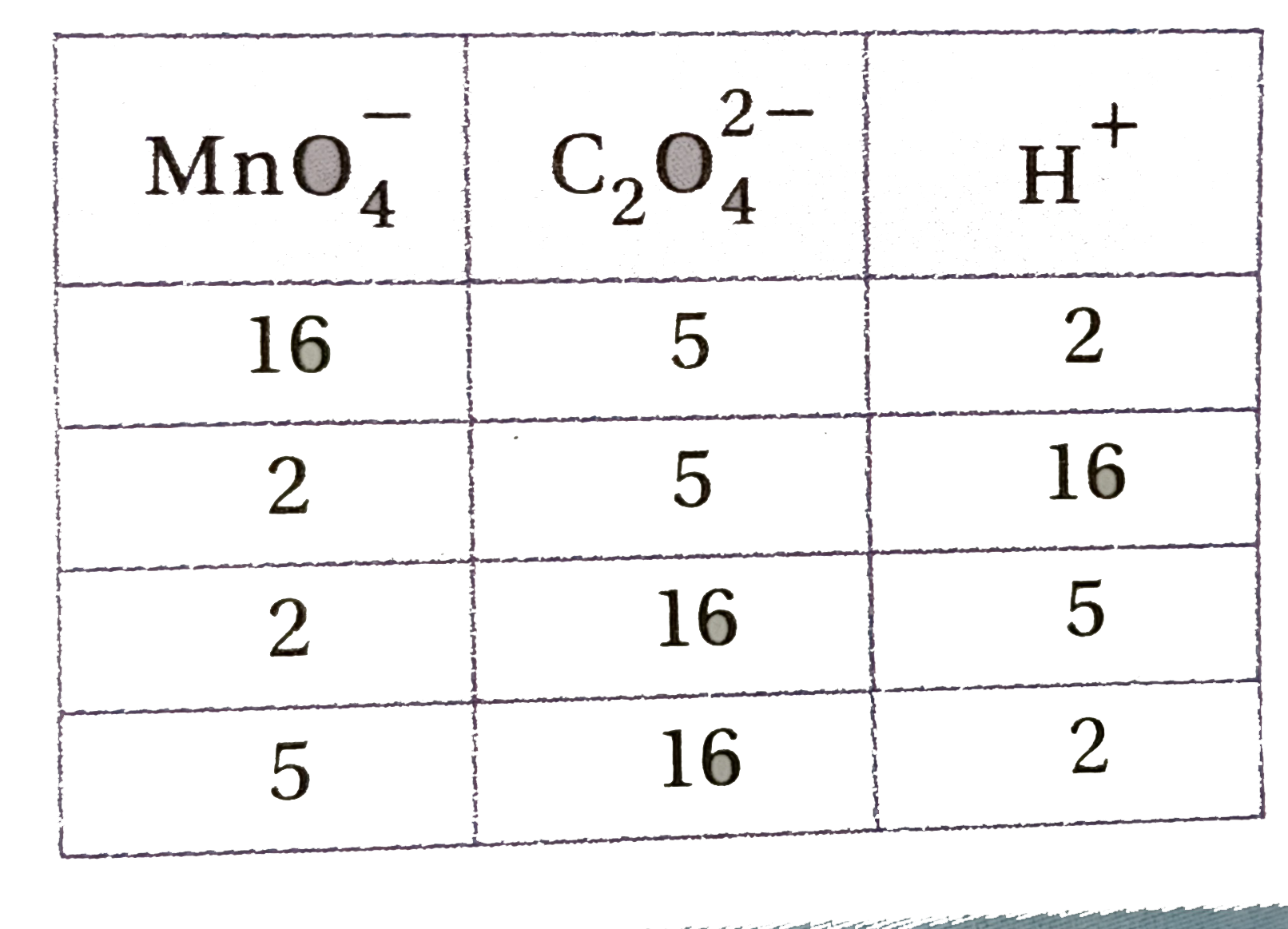
|
|
| 9. |
Justify giving reactions that among halogens, fluorine is the best oxidant and among hydrohalic compounds, hydroiodic acid is the best reductant. |
|
Answer» Solution :The oxidising POWER of halogens DECREASES in the order `F_(2)gtCl_(2)gtBr_(2)gtl_(2).F_(2)` being the strongest OXIDANT can oxidise `Cl^(-),Br^(-)` and `l^(-)` ions. `Cl_(2)` oxidises `Br^(-)` and `l^(-)` ions, whereas `Br_(2)` can oxidise only `l^(-)` ions. `l_(2)` is unable to oxidise none of these. The reactions are as follows: Oxidising reactions of `F_(2)` : `{:(F_(2)(g)+2Cl^(-)(aq)to2F^(-)(aq)+Cl_(2)(g)),(F_(2)(g)+2Br^(-)(aq)to2F^(-)(aq)+Br_(2)(l)),(F_(2)(g)+2l^(-)(aq)to2F^(-)(aq)+l_(2)(s)):}}` Oxidising reactions of `Cl_(2)` : `{:(Cl_(2)(g)+2Br^(-)(aq)to2Cl^(-)(aq)+Br_(2)(l)),(Cl_(2)(g)+2l^(-)(aq)to2Cl^(-)(aq)+l_(2)(g)):}}` Oxidising reaction of `l_(2)` : `Br_(2)(l)+2l^(-)(aq)to2Br^(-)(aq)+l_(2)(s)}` Thus, fluorine is the BEST oxidant. The reducing power of hydrohalic acids decreases in the order `HlgtHBrgtHClgtHF.HI` and HBr reduce `H_(2)SO_(4)` to `SO_(2)` while HCl and HF are unable to do so. `2HBr+H_(2)SO_(4)toSO_(2)+2H_(2)O+Br_(2)` `2HI+H_(2)SO_(4)toSO_(2)+2H_(2)O+l_(2)` HCl reduces `MnO_(2)` to `Mn^(2+)` but HF is unable to do so. This indicates that HCl is a stronger reducing agentd than HF. `MnO_(2)+4HCl toMnCl_(2)+Cl_(2)+2H_(2)O` `MnO_(2)+4HFto` No reaction Thus, HI is the best reductant among hydrohalic compounds. |
|
| 10. |
Justify giving reaction that among halogens fluorine is the best oxidant and among hydrohalic compounds hydriodic acid is the best reductant |
|
Answer» SOLUTION :Halogens have a strong tendency to accept electrons therefore they are strong oxidising agents theirrelative oxidising power is however measured in terms of their electrode potential since the eletrode potential of halogens decrease in the order `F_(2)(+2.87 v) CI_(2)(+1.36 v) gt Br_(2)(+1.09 v)gtI_(2)(+0.54v)` therefore their oxidising power decrease in the same order This is evident from the observation that `F_(2)` oxidises `CI^(-)` to `CI_(2) Br^(-)` to `Br_(2) I^(-)` to `I_(2),CI_(2)` oxidises `Br^(-)` to `Br_(2)` and `I^(-)` to `I_(2)` but not `F^(-)` to `F_(2). Br_(2)` howver oxidises `I^(-)` to `I_(2)` but not `F^(-)` to `F_(2)` and `CI^(-)` to `CI_(2)` `F_(2)(g)+2CI^(-)(aq)rarr2F^(-)(aq)+CI_(2)(g),F_(2)(g)+2 Br^(-)(aq)rarr2F^(-)(aq)+Br_(2)(l)` `F_(2)(g)+2CI^(-)(aq)rarr2F^(-)(aq)+I_(2)(a),CI_(2)(g)+2Br^(-)(aq)rarr2CI^(-)(aq)+Br_(2)(l)` `CI_(2)(g)+2I^(-)(aq)rarr2cI^(-)(aq)+I_(2)(s)` and `Br_(2)(l)+2I^(-)rarr 2Br^(-)(aq)+I_(2)(s)` THUS `F_(2)` is the best oxidant conversely halide IONS have a tendency to lose electrons and hence can ACT as reducing agent since the electrode potentials of hlide ions decrease in the order therefore the reducing power of the halide ions or their corresponding hydrohalic acids decrease in the same order `HIGT HBrgt HCIgtHF` thus hydroidic acid is the best reductant this is supported by the following reaction for example HI and HBrreduce `H_(2)SO_(4)` to `SO_(2)` while HCI and HF do no Thus HI is a stronger reductant than HBr further among HCI and HF ,HCI is a stronger reducing agent than HF because HCIreduces `MnO_(2)` to `Mn^(2+)` but HF does not `MltnO_(2)(s)+4 HCI(aq)rarrMnCI(2)(aq)+CI_(2)(g)+2H_(2)O` `MnO_(2)(s)+4Hf (l)rarrF_(2)` is not formed Thus the reducing character of hydrohalic acids decrease in the order `HI gt HBr HCI gt HF` |
|
| 11. |
Just as Bohr.s model of atom was developed on the basis of planck.s quantum theory, wave mechanical model of atom has been developed on the basis of quantum mechanics. The herat of quantum mechanism is Schrodinger wave equation which in turn is based on Heisenberg.s uncetainity principle and de broglie concept of dual nature ofmatter and radiation. Bohr model could explain the main lines of hydrogen or hydrogenic spectra but could not explain their fine structure. To explain this, it was suggested that each level consists of a number of sublevels, it was suggested that each level consists of a number of sublevels, the transitions between which gave rise to closely spaced lines. The numbers representing the main energy level are called Princiapl Quantum Number (n) while those representing sublevels are called Azimuthal Quantum numbers (l) and these determine the angular momentum of the electron. The orbital angular Number (m) which is just like a further split of a sublevel into finer sublevels. Lastly the electron may rotate or spin about its own axis given rise to Spin Quantum number (s) which determines the angular momentum of the electron. The electron spin magnetic moment of Fe^(2+) ion in FeSO_(4) in Bohr magnetons (B.M) is |
|
Answer» 5.92 |
|
| 12. |
Just as Bohr.s model of atom was developed on the basis of planck.s quantum theory, wave mechanical model of atom has been developed on the basis of quantum mechanics. The herat of quantum mechanism is Schrodinger wave equation which in turn is based on Heisenberg.s uncetainity principle and de broglie concept of dual nature ofmatter and radiation. Bohr model could explain the main lines of hydrogen or hydrogenic spectra but could not explain their fine structure. To explain this, it was suggested that each level consists of a number of sublevels, it was suggested that each level consists of a number of sublevels, the transitions between which gave rise to closely spaced lines. The numbers representing the main energy level are called Princiapl Quantum Number (n) while those representing sublevels are called Azimuthal Quantum numbers (l) and these determine the angular momentum of the electron. The orbital angular Number (m) which is just like a further split of a sublevel into finer sublevels. Lastly the electron may rotate or spin about its own axis given rise to Spin Quantum number (s) which determines the angular momentum of the electron. Total number of ndoes 4d_(xy) orbital is |
|
Answer» 1 |
|
| 13. |
Just as Bohr.s model of atom was developed on the basis of planck.s quantum theory, wave mechanical model of atom has been developed on the basis of quantum mechanics. The herat of quantum mechanism is Schrodinger wave equation which in turn is based on Heisenberg.s uncetainity principle and de broglie concept of dual nature ofmatter and radiation. Bohr model could explain the main lines of hydrogen or hydrogenic spectra but could not explain their fine structure. To explain this, it was suggested that each level consists of a number of sublevels, it was suggested that each level consists of a number of sublevels, the transitions between which gave rise to closely spaced lines. The numbers representing the main energy level are called Princiapl Quantum Number (n) while those representing sublevels are called Azimuthal Quantum numbers (l) and these determine the angular momentum of the electron. The orbital angular Number (m) which is just like a further split of a sublevel into finer sublevels. Lastly the electron may rotate or spin about its own axis given rise to Spin Quantum number (s) which determines the angular momentum of the electron. The orbital angular momentum of 2p electron is |
| Answer» Answer :C | |
| 14. |
Just as Bohr.s model of atom was developed on the basis of planck.s quantum theory, wave mechanical model of atom has been developed on the basis of quantum mechanics. The herat of quantum mechanism is Schrodinger wave equation which in turn is based on Heisenberg.s uncetainity principle and de broglie concept of dual nature ofmatter and radiation. Bohr model could explain the main lines of hydrogen or hydrogenic spectra but could not explain their fine structure. To explain this, it was suggested that each level consists of a number of sublevels, it was suggested that each level consists of a number of sublevels, the transitions between which gave rise to closely spaced lines. The numbers representing the main energy level are called Princiapl Quantum Number (n) while those representing sublevels are called Azimuthal Quantum numbers (l) and these determine the angular momentum of the electron. The orbital angular Number (m) which is just like a further split of a sublevel into finer sublevels. Lastly the electron may rotate or spin about its own axis given rise to Spin Quantum number (s) which determines the angular momentum of the electron. The de Broglie wavelength (lambda) of the electron subjected to an accelerating potential of V volts is given by |
|
Answer» `(eh)/(SQRT(2MV))` |
|
| 15. |
Just as Bohr.s model of atom was developed on the basis of planck.s quantum theory, wave mechanical model of atom has been developed on the basis of quantum mechanics. The herat of quantum mechanism is Schrodinger wave equation which in turn is based on Heisenberg.s uncetainity principle and de broglie concept of dual nature ofmatter and radiation. Bohr model could explain the main lines of hydrogen or hydrogenic spectra but could not explain their fine structure. To explain this, it was suggested that each level consists of a number of sublevels, it was suggested that each level consists of a number of sublevels, the transitions between which gave rise to closely spaced lines. The numbers representing the main energy level are called Princiapl Quantum Number (n) while those representing sublevels are called Azimuthal Quantum numbers (l) and these determine the angular momentum of the electron. The orbital angular Number (m) which is just like a further split of a sublevel into finer sublevels. Lastly the electron may rotate or spin about its own axis given rise to Spin Quantum number (s) which determines the angular momentum of the electron. The quantum number not obtained from the solution of Schrodinger wave equation is |
|
Answer» PRINCIPAL QUANTUM no. |
|
| 16. |
Joule-Thomson coefficient is zero at: |
|
Answer» CRITICAL temperature |
|
| 17. |
Joule K^(-1) gm^(-1) is the unit of …. |
|
Answer» Entropy |
|
| 18. |
J.J Thomson's cathode ray experiment revealed that atoms consists of |
| Answer» Answer :A | |
| 19. |
(ix) Zn +HNO_3 to Zn (NO_3)_2 +NH_(4)NO_3+H_2O . |
|
Answer» Solution :`Zn+HNO_3 to Zn(NO_3)_2 +NH_4NO_3+H_2O` `Zn^(0) to ZN^(2+)+2e^(-)` ……………(1) `N^(+5)+8e^(-) to N^(-3)` ……………(2) Multiply Equation (1) by 4 to balance the electorns `4Zn^(0) to 4Zn^(2+)+2e^(-)` ……………(3) ADD equation (3) and (2) `4Zn^(0)to 4Zn^(2+)+ cancel(8e^(1))` `N5+cancel(8e^1)to N^(3-)`. `4Zn^(0)+N^(5+)to 4Zn^(2+)+N^(2)` . Overall equation . `4Zn+10HNO_3 to 4Zn(NO_3)_2 +NH_4NO_3+H_2O` Balance all the ATOMS except O and H `4Zn +10HNO_(3)to 4Zn (NO_3)_2+ NH_4NO_3+H_2O` Balance oxygen atom by adding `H_2O` on the side FALLING short of oxygen atom . `4Zn+10HNO_3 to 4Zn(NO_3)_2 +NH_4NO_3+3H_2O` . |
|
| 20. |
(i)What mass of hydrogen peroxide will be present in 2 L of a 5 molar solution ? (ii) Calculate the mass of oxygen which will be liberated by the decomposition of 200 ml of this solution. |
|
Answer» Solution :(i)Mol mass of `H_2O_2=34 "g mol"^(-1)` `therefore` 1L of 5 M solution of `H_2O_2` will CONTAIN 34 x 5 g `H_2O_2` 2L of 5 M solution of `H_2O_2` will contain 34 x 2 x 5=340 g `H_2O_2` (II) 0.2 L or 200 ML of 5 M solution will contain `H_2O_2` `=(340xx0.2)/2`=34 g `H_2O_2` Now, `{:(2H_2O_2 to , 2H_2O + O_2),(2 XX 34 = 68 gm , 2 xx 16 =32 gm):}` Now, 68 g of `H_2O_2` on decomposition will give `O_2` =32 g 34 g of `H_2O_2` on decomposition will give `=(32xx34)/68`=16 g `O_2`. |
|
| 21. |
(i)What is meant by the term 'coordination number' ? (ii)What is the coordination number of atoms (a) in a cubic close packed structure? , (b) in a body-centred cubic structure ? |
|
Answer» Solution :(i)The coordination NUMBER of a constituent particle (atom, ion or molecule) in a crystal is the number of constituent particles which are the immediate neighbours of that particle in the crystal LA IONIC crystals, coordination number of an ion in the crystal is the number of oppositely charged is surrounding that particular ion. (II) (a) 12 (B) 8 |
|
| 22. |
(i)What are heterogenous equillibrium ? Givean example.v (ii) The atmospheric oxidation of NO,2NO_(g)+O_(2(g))hArr2NO_(2(g)) was studied with initial pressure of 1-atm of NO and 1-atm of O_2 At equillibrium partial pressure of oxygen is 0.52 atm. Calculate K_p of the reaction. |
|
Answer» SOLUTION :(i) Heterogeneous EQUILLIBRIUM: If the REACTANT and PRODUCT of a reaction in equilibrium arein different phase, then it is called as heterogeneous equilibrium. `CaCO_(3)(s)hArrCaO(s)+CO_(2)(g)` (ii) `2NO(g)+O_2(g)hArr2NO_(2)(g)` 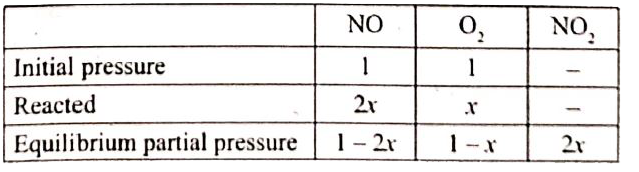
|
|
| 23. |
The following reaction is classified as: CH_2CH_2l+ KOH(aq) toCH_3CH_2OH+ KI |
|
Answer» |
|
| 24. |
(iv) Sb^(3+) + MnO_(4)^(-) to Sb^(5+)+Mn^(2+). |
Answer» Solution : Eqalise the INCREASE / decrease in Oxidation NUMBER by multiplying with SUITABLE numbers. `5Sb^(3+)+2MnO_(4)^(-)to Sb^(5+)+Mn^(2+)` Balance all other atoms except O and H `5Sb^(3+)+2MnO_(4)^(-)to 5Sb^(5+)+2MN^(2+)` Balance Oxygen atom by adding `H_2O` on the side falling short of oxygen. `5Sb^(3+)+2MnO_(4)^(-)to 5Sb^(5+)+2Mn^(2+)+8H_(2)O` Balance hydrogen atom by adding `H^(+)` on the side falling short of hydrogen atoms. `5Sb^(3+)+2MnO_(4)^(-) to 5Sb^(5+)+2Mn^(2+)+8H_(2)O+16H^(+)`. |
|
| 25. |
IUPAC names of CH_(2) = CH- CH_(2) - and CH_(3) - CH= CH- groups respectively are |
|
Answer» 2-propenyl and 1-propenyl |
|
| 26. |
IUPAC name of the given compound is CH_(3) - oversetoverset(CH_(3))(|)C = oversetoverset(H)(|)C - COOH |
|
Answer» 2-methylbut-2-enoci ACID |
|
| 27. |
IUPAC name of the following compound is CH_(3)-underset(C_(6)H_(5))underset(|)overset(H)overset(|)C-CH_(2)CH_(3) |
|
Answer» 2-Cyclohexylbutane |
|
| 28. |
IUPAC name of the molecule {:(""O""O),("||""||"),(CH_(3)-C-C=C-C-OH),("|""|"),(""H_(3)C""CH_(3)):} is |
|
Answer» 4-oxo-2, 3-dimethylpent-2-en-1-oic ACID 2, 3-Dimethyl-4-oxopent-2-en-1-oic acid. ('m' COMES before 'o' in alphabetical order) |
|
| 29. |
IUPACname of the following molecule is |
|
Answer» `4-`Hydroxy methyl`-1-`carboxy cyclohex `-3-`ENE |
|
| 30. |
IUPAC name of the following compound is: |
|
Answer» (2-chlorocyclopropenyl)-4-chloro-2-floror-3-[2-oxoformyl]cyclohex-5-enecarboxylate |
|
| 31. |
IUPAC name of the compound is H_(3)C-CH_(2)-overset(CHCl_(2))overset("|")("CH ")-overset(C Cl_(3))overset("|")("CH")-CH_(2)CH_(3) |
|
Answer» 3-(Monochloro methyl)-4-(trichloro methyl)hexane |
|
| 32. |
IUPAC name of the compound is CH_3-underset(CH_3)underset(|)underset(CH_2)underset(|)"CH"-CH_2CH(OH)-CH_3 is |
|
Answer» 4-Ethyl-2-pentanol |
|
| 33. |
IUPAC name of the compound having the formula C_6H_5- CH = CH - COOH |
|
Answer» 3-benzyl PROPANOIC ACID |
|
| 34. |
IUPAC name of the compound |
|
Answer» `4-` ISOPROPYL `1-6-`methyl octane 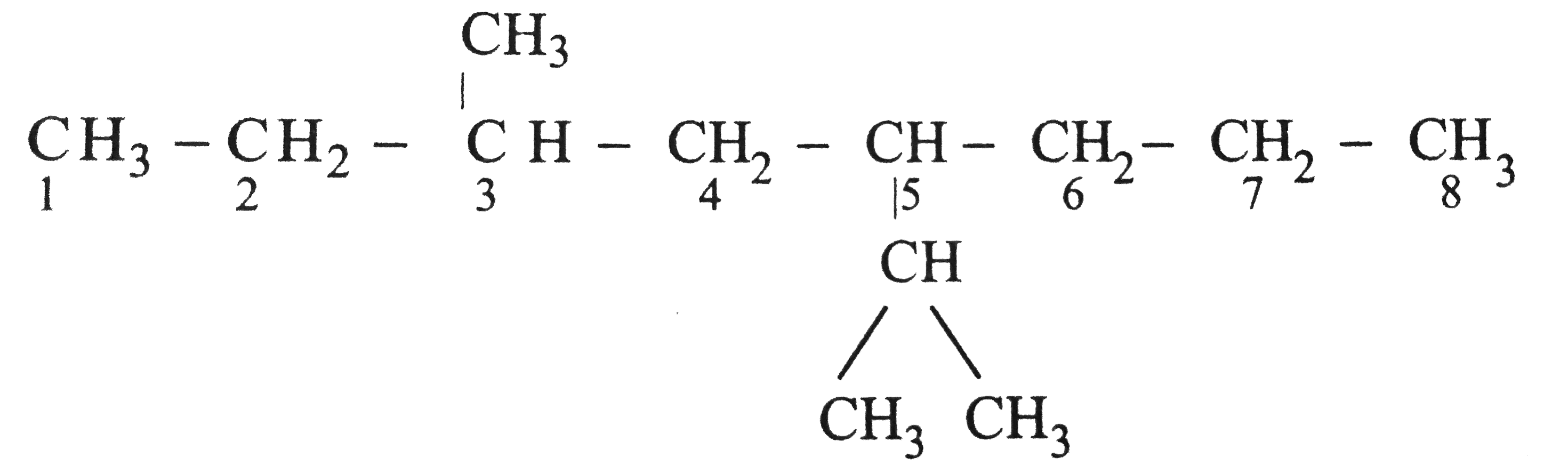
|
|
| 35. |
IUPAC name of the alkene which contains three C-C, eight C-H sigmabonds are one C-C pibond and gives two moles of an aldehyde of molar mass 44u on ozonolysis |
|
Answer» 3-Hexene |
|
| 36. |
IUPAC name of the alkene which gives a mixture of ethanal and pentan-3-one as ozonolysis products |
|
Answer» 2-Ethylpent-2-ene |
|
| 37. |
IUPAC name of HOOC- CH_(2)-CHO is |
|
Answer» FORMYL ETHANOIC acid |
|
| 38. |
IUPAC name of H_(3)C-overset(CH_(3))overset(|)underset(CH_(3))underset(|)C-CH=C(CH_(3))_(2) is ............ . |
|
Answer» 1) 2, 4, 4 - Trimethylpent-2-ene |
|
| 39. |
IUPAC name of compound {:(""CH_(3)),("|"),(H_(3)C-C-CH=C-CH_(3)),("|""|"),(""CH_(3)""CH_(3)):} is |
|
Answer» 2, 2, 4-Trimethylpent -2-ene |
|
| 40. |
IUPAC name of compound H- underset(underset(O)(||))(C )-O-underset(underset(O)(||))(C )-H is……. |
|
Answer» FORMIC Anhydride |
|
| 41. |
IUPAC name ofcompound CH_(3)-underset(OH)underset(|)(CH)-overset(NH_(2))overset(|)(CH)-underset(CH_3)underset(|)(CH)-OH is |
|
Answer» 3 - amino , 1 - methyl , 2 - HYDROXY , - 1 - butanol |
|
| 44. |
IUPAC name of CH_(3)CH_(2)COCH_(2)COCH_(3) is……. |
|
Answer» 3, 5-diketonhexane |
|
| 45. |
IUPAC name of (CH_(3)CH_(2)CO)_(2)O is |
|
Answer» Prorionic ANHYDRIDE |
|
| 46. |
IUPAC name of CH_(3)CH_(2)CH_(2)COCH_(3) is |
|
Answer» 2-pentanone |
|
| 47. |
IUPAC name of (CH_(3))_(3)C-CH=CH_(2) is |
|
Answer» 2,2-dimethylbut-3-ene |
|
| 48. |
IUPAC name of (CH_(3))_(3) C CH_(3) is |
|
Answer» 1,1,1-Trimethylethane |
|
| 49. |
IUPAC name of (CH_3)_3is |
|
Answer» 1, 1, 1-Trimethylethane |
|