

Saved Bookmarks
This section includes 7 InterviewSolutions, each offering curated multiple-choice questions to sharpen your Current Affairs knowledge and support exam preparation. Choose a topic below to get started.
| 2. |
Bond angle in alkene (C_2H_4) in equal to |
|
Answer» `120^(@) ` |
|
| 4. |
Bomb calorimeteris used to determine the value of "….........................". |
| Answer» Solution :`DELTAU ` ( i.e.,internal energy CHANGE viz. heat of reaction at CONSTANT VOLUME) | |
| 5. |
Boltzmann constant represents the gas constant per |
|
Answer» MOLE |
|
| 6. |
Boiling points of methanol, water and dimethyl ether are respectively 65^@ C, 100^@ C and 34.5^@C. Which of the following best explains the wide variations in boiling points? |
|
Answer» Density of water is 1g`ml^(-1)`, methanol is 0.79g`ml^(-1)` and dimethyl ether is 0.71g`ml^(-2)` |
|
| 7. |
Boiling point of water is very high. |
| Answer» Solution :Due to the presence of INTERMOLECULAR HYDROGEN bonding in water. | |
| 8. |
Boiling point of water in Fahrenheit ? |
|
Answer»
`= 9/5 xx 100+32=212F` |
|
| 10. |
Boiling point of covalent compound depends on intennolecular force. Intermolecular forces are the force of attraction and repulsion between interacting particles (atoms and molecules). This term does not include the electrostatic forces that exist between the two oppositely charged ions and the forces that hold atoms of a molecule together i.e., covalent bonds Which of the following hydrogen bonds is the strongest? |
| Answer» Answer :B | |
| 15. |
Bohr.s theory explains that when Hydrogen-like particles are excited, their electrons are shifted higher energy orbits. As such a state of atom is not stable, electrons return to lower energy orbits releasing quantum of energy. Thus different spectral lines are formed. The wave number of spectral line is given by bar(v) = (2pi^(2)me^(4)z^(2))/(c h^(3))[(1)/(n_(1)^(2)-(1)/(n_(2)^(2)))] For a hydrogen -like particle, ionization energy is 122.4 eV. Then what is the wave number of series limit spectral line of the particle of paschen seres (R = rydberg.s constant) |
| Answer» Answer :C | |
| 16. |
Bohr.s theory explains that when Hydrogen-like particles are excited, their electrons are shifted higher energy orbits. As such a state of atom is not stable, electrons return to lower energy orbits releasing quantum of energy. Thus different spectral lines are formed. The wave number of spectral line is given by bar(v) = (2pi^(2)me^(4)z^(2))/(c h^(3))[(1)/(n_(1)^(2)-(1)/(n_(2)^(2)))] The angular momentum of an electron in a Bohr.s orbit of H-atom is 4.2178 xx 10^(-34) kg m^(2) sec^(-1). What is the wave number of the spectral line emitted when electron falls from this level to the next lower level |
|
Answer» `(7R)/(144)` |
|
| 17. |
Bohr.s theory explains that when Hydrogen-like particles are excited, their electrons are shifted higher energy orbits. As such a state of atom is not stable, electrons return to lower energy orbits releasing quantum of energy. Thus different spectral lines are formed. The wave number of spectral line is given by bar(v) = (2pi^(2)me^(4)z^(2))/(c h^(3))[(1)/(n_(1)^(2)-(1)/(n_(2)^(2)))] When electrons of excited H-atoms make transition from fifth excited state to second orbit, then maximum number of different types of photos observed is |
|
Answer» 3 |
|
| 18. |
Bohr's postulate that mv r = (nh)/(2pi) is proved mathematically by |
|
Answer» Pauli.s exclusion principle |
|
| 19. |
Bohr's equation for energy of an electron in a hydrogen atom is given as _________. |
|
Answer» `E = (-1312)/(n^2) KJ MOL^(-1)` |
|
| 20. |
Bohr radius of 1^(st) orbital of hyddrogen atom is 0529A.Assuming that the position of an electron in this orbit is determined with the accuracy of 0.5% of the radius,calculate the uncertainty in the velocity of the electron in hydrogen atom. |
|
Answer» Solution :UNCERTAINTY in POSITION`=/_\x` `=(0.5%)/(100%)xx05.29A` `=(0.5)/(100)xx10^(-10)xx0.529m` `/_\x=2.645xx10^(13)m` From Heisenberg.s uncertainty principle, `/_\x./_\.+h/(4pi)` `/_\x.m./_\V.+h/(4pi)` `/_\vgt=h/(/_\x.m.4pi)` `/_\v=(6.626xx10^(-34)Khm^(2)s^(-1))/(2.645xx10^(13)mxx9.11xx10^(-31)kGxx4xx3.14)` `/_\v=2.189xx10^(8)m` |
|
| 21. |
Bohr proposed his atomic model based on Planck.s quantum theory and derived following relations for one electron system in C.G.S. units : For H -atom : r_(n) = n^(2) xx r_(1), E_(n) = E_(1) xx Z^(2), u_(n) = (u_(1))/(n), u_(1) = 2.19 xx 10^(8) cm//sec., E_(1) = -13.6eV For 1 electron system, other than H r_(n) = (n^(2) xx r_(1H))/(Z), E_(N) = (E_(1H) xx Z^(2))/(n^(2)), u_(n) = (u_(1H) xx Z)/(n). Later on de Broglie proposed the dual nature of electron and put forward his wave concept. The wave length of electron in an orbit was given lambda = h/mu The potential energy of electron in3^(rd) Bohr orbit of H-atom is : |
|
Answer» `-242 xx 10^(-12)` erg |
|
| 22. |
Bohr’s atomic model could explain the spectrum o f ............ |
|
Answer» Atoms or IONS which have TWO electrons. |
|
| 23. |
Bohr.satomicmodel. |
|
Answer» Solution :Nells Bohr (1913) was the firstto explainquqntitatively thegeneralfeaturesof hydrogenatomstructure andtisspectrum. Pitulatesof model: (i) Theelectron is the hydrogenatom can movearoundthenucleusin acircularpathcalledorbitsstationarystatesor allowedenergystates. Theseorbitsare arrangestconcentrically aroundthe nucleus. (ii) The energyof anelectronin the orbit DOESNOT changewith timeHowever the electron willmovefroma lowerstationarystateto ahigherstationarystatewhenrequiredor energyis emitted whenelectronmovesdoesnottakeplace in acontinuouschange (iii) The frequency of radiationabsorbedoremitted whentransitionoccursbetweentwostationarystatesthatdifferin energyby Where`E_(1)`and `E_(2)`are the energies of lowerand higherallowedenergystatesrespectivelythisexpressionis commonlyknown asbohrfrequencyrule Thusanelectroncan MOVE only in thoseorbitsfor whichitsangularmomentumisintegralmultiple of `((h)/( 2pi))` that iswhyonlycertain fixedorbitsare ALLOWED. |
|
| 24. |
Bohr proposed his atomic model based on Planck.s quantum theory and derived following relations for one electron system in C.G.S. units : For H -atom : r_(n) = n^(2) xx r_(1), E_(n) = E_(1) xx Z^(2), u_(n) = (u_(1))/(n), u_(1) = 2.19 xx 10^(8) cm//sec., E_(1) = -13.6eV For 1 electron system, other than H r_(n) = (n^(2) xx r_(1H))/(Z), E_(N) = (E_(1H) xx Z^(2))/(n^(2)), u_(n) = (u_(1H) xx Z)/(n). Later on de Broglie proposed the dual nature of electron and put forward his wave concept. The wave length of electron in an orbit was given lambda = h/mu The circumference (in m) of 3^(rd) Bohr orbit in H-atom is : |
|
Answer» `3.0 XX 10^(-7)` |
|
| 25. |
Bohr model of atom is contradicted by |
|
Answer» Pauli EXCLUSION PRINCIPLE |
|
| 26. |
Bohr’s theory based on the Planck’s quantum theory. |
|
Answer» |
|
| 27. |
Bohr’s theory cannot explain the spectra of multi-electron atoms. |
|
Answer» |
|
| 28. |
Bohr model of hydrogen atom contradicts dual behaviour of matter and Heisenberg’s uncertainty principle. Justiy. |
| Answer» SOLUTION :According to de Broglie concept, a moving electron has both particle and wave character. But Bohr considered electron only as particles. HEISENBERG’s uncertainty principles RULES out the existence of definite paths for electrons. But in Bohr’s model, electron in an atom is ASSUMED to be REVOLVING around the nucleus through definite paths called orbits. | |
| 29. |
BOH_((aq)) + H_((aq))^(+) rarr B_((aq))^(+) + H_2O, DeltaH = -48 KJ.Heat of ionisation of the weak base is |
|
Answer» `9.3 KJ` |
|
| 30. |
Bohr’s atomic theory is not able to explain the atomic spectra of atoms containing ________electron. |
| Answer» SOLUTION :more than 1 | |
| 32. |
B(OH)_(3)+NaOH rarr Na[B(OH)_(4)]+H_(2)O How can this reaction is made to proceeds in forward direction ? |
|
Answer» ADDITION of cis-1,2-diol |
|
| 33. |
B(OH)_(3)+NaOH hArr NaBO_(2)+Na[B(OH)_(4)]+H_(2)OHow can this reaction is made to proceed in forward direction ? |
|
Answer» addition of cis - 1, 2 DIOL 
|
|
| 35. |
Body centred cubic lattice has co-ordination number of |
|
Answer» 8 |
|
| 36. |
Body centred cubic lattic has a coordination number |
|
Answer» 8 |
|
| 37. |
BOD_5 is |
|
Answer» waste DECOMPOSED in 5 days |
|
| 38. |
BOD values less than 5 ppm indicates a water sample to be |
|
Answer» POOR in DISSOLVED oxygen |
|
| 40. |
B.O.D is connected with |
|
Answer» Organic MATTER |
|
| 41. |
BOD is a measure of ...... |
|
Answer» ORGANIC POLLUTANTS in WATER |
|
| 43. |
BOD is a measure of : |
|
Answer» Organic POLLUTANT in water |
|
| 44. |
BOD is |
|
Answer» Biological oxygen DEFICIT |
|
| 45. |
Blue compound Q is: |
|
Answer» `Co(BO_(2))_(2)` 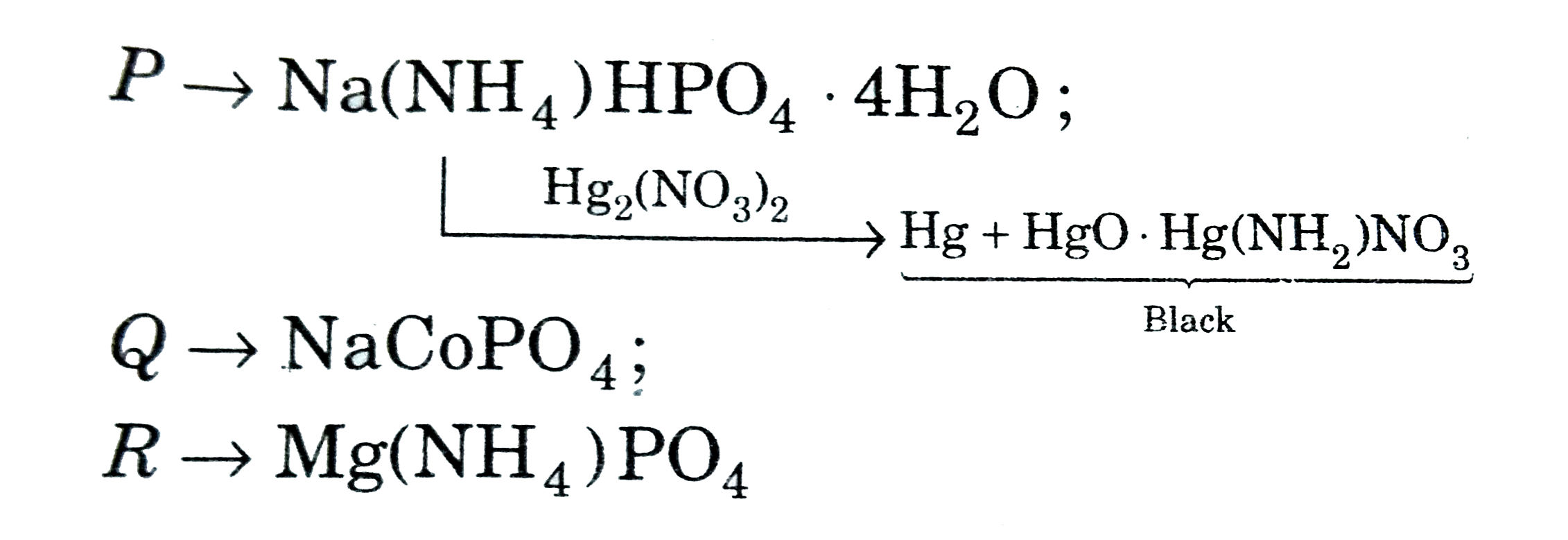 `Q RARR NaCoPO_(4)`, `R rarr Mg(NH_(4))PO_(4)` |
|
| 46. |
Blue colour of C is due to the formation of : |
|
Answer» `Mn^(2+)` |
|
| 47. |
Blue color of concentrated ammoniated solution of alkali metals get converted into ......... color. |
| Answer» Answer :A | |
| 48. |
Blood may be purified by |
|
Answer» Dialysis |
|
| 49. |
Blood is a buffer of H_(2)CO_(3) and[HCO_(3)^(-)]with pH = 7.40. Given K_(1)of H_(2)CO_(3) = 4.5xx10^(-7). What will be the ratio of [HCO_(3)^(-)] to [H_(2)CO_(3)] in the blood ? |
|
Answer» SOLUTION :`H_(2)CO_(3)hArr H^(+)+HCO_(3)^(-), K_(1)=([H^(+)][HCO_(3)^(-)])/([H_(2)CO_(3)]) or ([HCO_(3)^(-)])/([H_(2)CO_(3)])=(K_(1))/([H^(+)])` `PH = 7.40` means - log `[H^(+)] = 7.4` or log `[H^(+)] = -7.4= bar(8).6or [H^(+)]=3.981 xx 10^(-8)` `([HCO_(3)^(-1)])/([H_(2)CO_(3)])=(4.5xx10^(-7))/(3.981xx10^(-8))=11.3`. |
|
| 50. |
Blister copper is |
|
Answer» Impure Cu |
|