

Saved Bookmarks
This section includes 7 InterviewSolutions, each offering curated multiple-choice questions to sharpen your Current Affairs knowledge and support exam preparation. Choose a topic below to get started.
| 1. |
Mesomeric effect involves the delocalization of |
| Answer» Solution :pi electrons | |
| 2. |
Mercury manometer can be used to determine "____________". |
|
Answer» density |
|
| 3. |
Mercury has almost no vapour pressure. Why? |
|
Answer» Solution :The ATOMIC FORCES in mercury are very stronger metallic bonds. THEREFORE, HG is almost non-volatile |
|
| 4. |
Mercuric chloride is reduced to mercurous chloride by |
|
Answer» Formic acid |
|
| 5. |
Identify the substances that are oxidised and the substances that are reduced in the following reactions. (i) 4Na(s)+O_(2)(g) to 2Na_(2)O(s) (ii) CuO(s)+H_(2)(g) to Cu(s)+H_(2)O(I) |
Answer» SOLUTION :
|
|
| 6. |
Mention which gets reduced and which gets oxidized in the following reactions. 2Na(s)+Cl_2(g) to 2 NaCl(s) |
Answer» SOLUTION :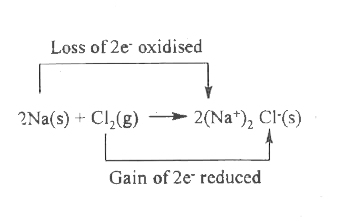
|
|
| 7. |
Mention whetherthefollowing are elements, compounds or mixtures : (i) glass, (ii) german silver (iii) llimestone, (iv) pure gold (v) diamond, (vi) glucose (vii) salt solution, (viii) helium (ix) oxygen, (x) water |
|
Answer» Solution :(i) Glass : mixture (ii) German silver : mixture (iii) Limestone : compound (`CaCO_3`) (iv) Pure GOLD : element (v) Diamond : element (carbon) (VI) GLUCOSE : compound(`C_6H_12O_6`) (vii) Salt solution : mixture (viii) Helium : element (He) (ix) Oxygen : element (x) Water : compound (`H_2O`). |
|
| 8. |
Mention which gets reduced and which gets oxidized in the following reactions. 2 Na(s)+S(s) to Na_2 S(s) |
Answer» SOLUTION :
|
|
| 9. |
Mention whether the following mixtures are homogeneous or heterogeneous: (i) sugar solution (ii) milk (iii) brass (iv) glass (v) mixture of sand and sulphur (vi) coin (vii) LPG. |
|
Answer» Solution :(i) Sugar solution : homogeneous mixture (ii) MILK : heterogeneous mixture (iii) Brass : homogeneous mixture (IV) Glass : homogeneous mixture (v) Mixture of sand and SULPHUR : heterogeneous mixture (vi) COIN : homogeneous mixture (vii) LPG : homogeneous mixture. |
|
| 10. |
Mention whether each of the following conversion involves oxidation or reduction. a) HCl rarr HOCl, b) KMnO_(4)rarrK_(2)MnO_(4) and c) HNO_(3)rarr NaNO_(3) |
|
Answer» Solution :(a) Oxidation number of CL in HCl is -1 and in HOCl is +1. The conversion involves oxidatioin. (b) Oxidation number of Mn in `KMnO_(4)` is +7 and in `K_(2)MnO_(4)` is +6. The conversion involves reduction. (c ) Oxidation number of N in `HNO_(3)` is +5 and in `NaNO_(3)` is +5. The conversion involves neither oxidation nor reduction. It involves no electrons transfer (neutralisation). |
|
| 11. |
Mention uses of pure forms of germanium and silicon. |
| Answer» SOLUTION :To MAKE TRANSISTOR and as SEMI CONDUCTOR. | |
| 12. |
Mention two ways to prevent and rain. |
|
Answer» Solution :(i) Reduce the USE of FOSSILE fuel driven VEHICLES. (II) Use less sulfate coal in industries and electricity or use the best full NATURAL gas coal. |
|
| 13. |
Mention two solutions to control photo-chemical smog. |
| Answer» Solution :(i) Certain PLANTS e.g. Pinus, Juniparus, Quercus, Pyrus and Vitis can METABOLISE nitrogen oxide and therefore, their PLANTATION could help in this matter. (ii) Catalytic CONVERTERS should be used in automobiles. | |
| 14. |
Mention two postulates of Dalton's atomic theory? |
|
Answer» Solution :The POSTULATES of Dalton.s ATOMIC THEORY are: 1. The matter consists of indivisible atoms. 2. All the atoms of a given elements have identical properties including identical mass. Atoms of different ELEMENT differ in mass. 3. Compounds are formed when atoms of different elements combine in a FIXED ratio. |
|
| 15. |
Mention two general components of photochemical smog. |
| Answer» SOLUTION :NITROGEN OXIDE and HYDROCARBON | |
| 16. |
Mention three important uses of borax. |
|
Answer» Solution :It is used: (i) as a flux in the soldering and WELDING industries . (ii) in the manufacture of borosilicate glass ( or pyrox glass) . (III) in making enamels and glazes. (IV) in stiffening of candle wicks. (v) in softening of water. (vi) in qualitative ANALYSIS for borax bead test in laboratory. |
|
| 17. |
Mention the uses of washing soda (or) sodium carbonate. |
|
Answer» Solution :(i) Solution carbonate is HIGHLY used in LAUNDERING (II) It is an important labortory reagent used in the qualitative analysis and in VOLUMETRIC analysis. (iii) It is also used in water treatment to convert the hard water to soft water (iv) It is used in the MANUFACTURE of grass, paper and paint. |
|
| 18. |
Mention the uses of washing soda (or) sodium carbonate |
|
Answer» Solution :SODIUM carbonate is highly used in LAUNDERING (ii) It is an important laboratory reagent used in the QUALITATIVE analysis and in volumetric analysis. (iii) It is also used in water treatment to convert the hard water to soft water. (IV) It is used in the manufacture of GLASS, paper and paint. |
|
| 19. |
List down the uses of washing soda. |
|
Answer» Solution :Sodium CARBONATE is highly used in laundering (ii) It is an IMPORTANT laboratory reagent used in the qualitative analysis and in volumetric analysis. (iii) It is also used in water treatment to convert the HARD water to soft water. (iv) It is used in the manufacture of GLASS, PAPER and paint. |
|
| 20. |
Mention the uses of tritium. |
|
Answer» SOLUTION :(i) Tritium has REPLACED RADIUM in APPLICATION such as emergency EXIT sign. (ii) Tritium is used in illumination of wrist watches. |
|
| 21. |
Mention the uses of sodium chloride. |
|
Answer» Solution : It is used as a common salt (or) table salt for DOMESTIC purpose. (II) It is used for the preparation of many INORGANIC COMPOUNDS such as `Na_(2)CO_(3)` |
|
| 22. |
Mention the uses of quick lime. |
|
Answer» SOLUTION :Calcium oxide (quick lime) is used (i) to manufacture CEMENT, mortar and glass. (ii) in the manufacture of sodium CARBONATE and slaked lime. (iii) in the purification of SUGAR (iv) as drying agent. |
|
| 23. |
Mention the uses of radium. |
|
Answer» Solution : In self-luminous PAINTS for WATCHES (ii) In nuclear PANELS (iii) In aircraft switches (IV) In clocks and instrument dials. |
|
| 24. |
Mention the uses of plaster of paris. |
|
Answer» SOLUTION :I .Thelargestuseof plaster of parisisin thebuildingindustry as WELLAS PLASTERS II .It isused, wherethereis a bonefractureorsprain iii .It isalso employedin dentistry, inornamentalworkand formakingcastsof stauesadn busts |
|
| 25. |
Mention the uses of plaster of paris |
|
Answer» SOLUTION :The largest use of Plaster of PARIS is in the building industry as well as plasters (ii) It is USED for immobilizing the affected part of organ, where there is a bone fracture or spra (iii) It is also employed in dentistry, in ornamental work and for MAKING CASTS of statues and buste |
|
| 26. |
Mention the uses of lithium and its compounds. |
|
Answer» Solution :Lithium metal is used to make useful alloys. For e.g, with lead, lithium is used to make white metal bearings for motor engines, with ALUMINIUM to make aircraft parts and with magnesium to make ARMOUR plates. It is ALSO used in thermonuclear REACTIONS (ii) Lithium is used to make electrochemical cells (iii) Lithium carbonate is used in medicines. |
|
| 27. |
Mention the uses of deuterium.. |
|
Answer» SOLUTION :(I )Deuteriumis usedasa tracerelement . (II )Deuteriumis USEDTO studythe MOVEMENTOF groundwaterby isotopiceffect . |
|
| 28. |
Mention the uses of DDT. |
|
Answer» Solution :(i) DDT is used to control certain insects which carries diseases like malaria and yellow fever. (ii) It is used in farms to control some AGRICULTURAL PESTS. (iii) It is used in BUILDING construction as pest control AGENT. (iv) It is used to kill certain kind of insects like housefly and mosquitoes due to its HIGH and specific toxicity. |
|
| 29. |
Mention the uses of chloroform. |
|
Answer» SOLUTION :(i) CHLOROFORM is used as a SOLVENT in pharmaceutical industry. (ii) It is used for producing PESTICIDES and drugs. (iii) It is used as an anaesthetic. |
|
| 30. |
Mention the uses of buffer solutions. |
|
Answer» SOLUTION :(a) It is used in chemical industries like PAPER, SUGAR, PHARMACEUTICALS. (b) It is used in all BIOLOGICAL fluids to maintain a constant pH by buffer action. |
|
| 31. |
Mention the uses of beryllium. |
|
Answer» SOLUTION :(i) Beryllium is used as radiation windows for X-ray tubes and X-ray detectors. (ii) The sample holder in X-ray emission studies is MADE of beryllium. (iii) Beryllium is used to build the beam PIPE in accelerators. (iv) Beryllium is used in detectors due to its LOW density and diamagnetic nature |
|
| 32. |
Mention the uses of alkenes. |
|
Answer» Solution :(i) Alkenes are used as STARTING MATERIAL in the synthesis of alcohols , plastics detergents and fuels. (ii) Ethene is the most important organic feedstock in the polymer industry. Examples are , PVC, Sarans and POLYTHENE . These polymers are used in the manufacture of FLOOR tiles, shoesoles , synthetic FIBRES, raincoats , pipes etc. |
|
| 33. |
Mention the uses of alkanes |
|
Answer» SOLUTION :(i) ALKANES areextensivelyusedas fuels. (ii) Methanepresentin naturalgas isusedin homeheating (ii) Amixtureof propaneandbutaneis KNOWAS LPGgas WHICHIS usedfor domocookingpurpose (iv) Gasolineis a complexmixtureof manyhydrocarbonsusedas a fuelfor intecombustionengines. |
|
| 34. |
Mention the uses of acetylene |
|
Answer» Solution :(i) Acetyleneis usedin OXY acetylenelorchusedfor weldingand cuttingmetals. (II)It isusedfor MANUFACTUREOF PVC. Polyvinlyaccetae polyvinly ether .RUBBERS |
|
| 35. |
Mention the uses of alkenes |
|
Answer» Solution :(i) Alkenes are usedstartingmaterialin thesynthesisof alcohols , plasticsdetergents anfuels. (ii)ETHANE ISTHE mostimportantorginicfeedstock INTHE polymerindustry . Examplesand shoe- solessyntheticfibres. Raincoatspipesetc. |
|
| 36. |
Mention the units of specific heat capacity and molar heat capacity. |
|
Answer» Solution :Specific heat CAPACITY = Jule/kelvin GRAM MOLAR heat capacity = Jule/Kelvin MOLE |
|
| 37. |
Mention the types of pollution. |
|
Answer» Solution :Types of POLLUTION are as below: (i) Environmental pollution (ii) Atmospheric pollution (III) Water pollution (iv) Soil pollution (V) Industrial pollution |
|
| 38. |
Mention the types of fission of a covalent bond? |
| Answer» SOLUTION :There are THREE TYPES of fission of a COVALENT bond.They are (i) Homolytic cleavage (ii) Heterolytic cleavage | |
| 39. |
Mention the type of pollutants of tropospheric pollution. |
|
Answer» Solution :POLLUTANTS of TROPOSPHERIC pollution are mainly of two TYPES : (i) Gaseous air pollutants. (II) PARTICULATE pollutants. |
|
| 40. |
Mention the types of atmospheric pollution. |
|
Answer» SOLUTION :There are two types of ATMOSPHERIC POLLUTION : (i) Tropospheric pollution. (II) Stratospheric pollution. |
|
| 41. |
Mention the type of Hydrogen bond in the following compounds. (i) Water (ii) ortho-Nitrophenol |
|
Answer» SOLUTION :(i)Inter MOLECULAR hydrogen bonding ………1 (ii) Intra molecular hydrogen bonding ………..1 |
|
| 44. |
Mention the type of bond formed between the atoms having same electronegativity. |
| Answer» SOLUTION :COVALENT BOND. | |
| 45. |
Mention the type of bond formed between the atoms having different electronegativity. |
| Answer» SOLUTION :IONIC BOND | |
| 46. |
Mention the third law of thermodynamics. |
| Answer» Solution :"The value of entropy of a completely PURE CRYSTALLINE SUBSTANCE is zero at absolute zero TEMPERATURE". | |
| 48. |
Mention the state of hybridisation of the central atom of the following molecules/ ions, CO_(3)^(2-),PH_(4)^(+),ClO_(3)^(-),CS_(2) or, write the resonating structures of ClO_(4)^(-) ion. |
Answer» SOLUTION :
|
|
| 49. |
Mention the standards prescibed by BIS for quality of drinking water. |
Answer» SOLUTION :Standard the standards prescribed for deciding the quality of dringking WATER by BIS are as follows:
|
|
| 50. |
Mention the specific type of isomerism exhibited by each of the following pairs. 1,2-dichloro ethane and 1,1-dichloro ethene (b) Propanoic acid and methyl acetate (c) Methyl acetate and ethyl formate (d) o-Nitrophenol and P-nitrophenol ltbRgt Anisole and ocresol (f) Phenol and cyclohexa-2,4-dien-1-one |
|
Answer» |
|