

Saved Bookmarks
This section includes 7 InterviewSolutions, each offering curated multiple-choice questions to sharpen your Current Affairs knowledge and support exam preparation. Choose a topic below to get started.
| 1. |
Let X be a discrete random variable whoose probability distribution is defined as follows. P(X=x)={{:(k(x+1)",for x=1,2,3,4"),(2kx",forx=5,6,7"),(0",otherwise"):} where,k is a constant. Calculate (i) the value of k. (ii) E (X). (ii) standard deviation of X. |
|
Answer» Solution :`P(X=x)={{:(k(x+1)",for x=1,2,3,4"),(2kx",forx=5,6,7"),(0",otherwise"):}` Thus, we have FOLLOWING table 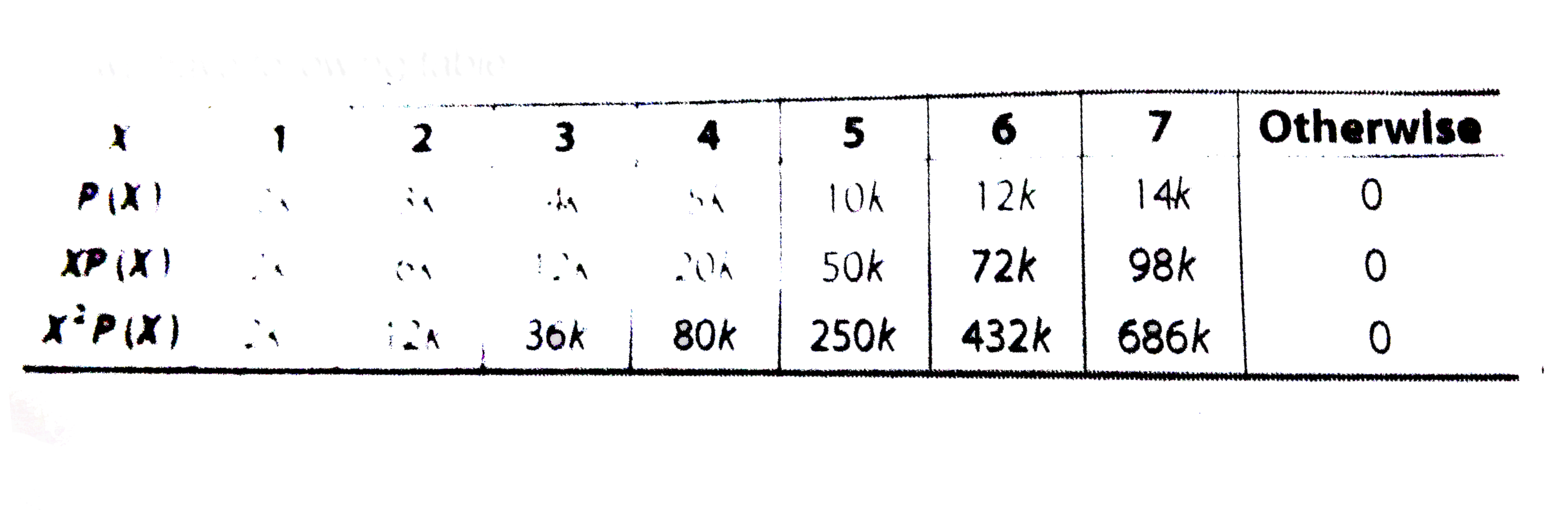 (i) since, `sumP_(i)=1` `rArrk(2+3+4+5+10+12+14)=1rArrk=1/50` (ii) `because E(X)=sumXP(X)` `therefore E(X)=2k+6k+12k+20k+50k+72k+98k+0=260k` `=260xx1/50=26/5=5.2` [`becausek=1/50`] ....(i) (iii) We know that, Var(X)=`[E(X^(2))]-[E(X)]^(2)=sumX^(2)P(X)-[sum{XP(X)}]^(2)` `=[2 k+12 k+36k+80K+250k+432k+686k+0]-[5.2]^(2)` [using Eq. (i)] `=[1498k]-27.04=[1498xx1/50]-27.04`[`becausek=1/50`] =29.96-27.04=2.92 We know that , STANDARD deviation of X=`SQRT(Var(X))=sqrt(2.92)-1.7088=1.7`(approx) |
|
| 2. |
Consider the following lines : L_(1) : x-y-1=0 L_(2):x+y-5=0 L_(3):y-4=0 Let L_(1) is axis to a parabola, L_(2) is tangent at the vertex to this parabola and L_(3) is another tangent to this parabola at some point P. Let 'C' be the circle circumscribing the triangle formed by tangent and normal at point P and axis of parabola. The tangent and normals at normals at the extremitiesof latus rectum of this parabolaforms a quadrilateral ABCD. Q. The area of the quarilateral ABCD is : |
|
Answer» 16 |
|
| 3. |
If x_1,x_2,…….,x_nbe the observed data such that underset(i=1) overset(n) sum x_i -2n =180 and underset(i=1) overset(n) sumx_i =7n =30,then the mean of the data (x_1-3), (x_2-3), …. (x_n-3)is equal to |
| Answer» ANSWER :A | |
| 4. |
Consider the following lines : L_(1) : x-y-1=0 L_(2):x+y-5=0 L_(3):y-4=0 Let L_(1) is axis to a parabola, L_(2) is tangent at the vertex to this parabola and L_(3) is another tangent to this parabola at some point P. Let 'C' be the circle circumscribing the triangle formed by tangent and normal at point P and axis of parabola. The tangent and normals at normals at the extremitiesof latus rectum of this parabolaforms a quadrilateral ABCD. Q. The given parabola is equal to which of the following parabola ? |
|
Answer» `y^(2)=16sqrt(2)X` |
|
| 5. |
A city building code requires that the area of the windows must be at least (1)/(8) of the area of thewalls and roots ofall new building. The daily heating cost of a new building is ₹ 3 per square meter of window areaand ₹ 1 per square metre of wall and roof area. To the nearest square metre of wall and roof area. To the nearest square metre, whatis the largest surface area a new building can have if itsdaily heating cost cannot exceed ₹ 1,000 ? |
|
Answer» |
|
| 6. |
Consider the following lines : L_(1) : x-y-1=0 L_(2):x+y-5=0 L_(3):y-4=0 Let L_(1) is axis to a parabola, L_(2) is tangent at the vertex to this parabola and L_(3) is another tangent to this parabola at some point P. Let 'C' be the circle circumscribing the triangle formed by tangent and normal at point P and axis of parabola. The tangent and normals at normals at the extremitiesof latus rectum of this parabolaforms a quadrilateral ABCD. Q. The equation of the circle 'C' is : |
|
Answer» `X^(2)+y^(2)-2x-31=0` |
|
| 7. |
A coin is tossed 20 times. Find the probability of getting atleast 12 consecutive heads. |
|
Answer» |
|
| 8. |
When any two sides and one of the opposite acute angle are given, under certain additional conditions two triangles are possible. The case when two triangles are possible is called the ambiguous case. In fact when any two sides and the angle opposite to one of them are given either no triangle is posible or only one triangle is possible or two triangles are possible. In the ambiguous case, let a,b and angle A are given and c_(1), c_(2) are two values of the third side c. On the basis of above information, answer the following questions If 2b=(m+1) a and cos A =1/2 sqrt((((m+1)(m+3))/(m))), where 1 lt m3, then (c_(1))/(c_(2)) is |
|
Answer» m or `1/m` |
|
| 9. |
When any two sides and one of the opposite acute angle are given, under certain additional conditions two triangles are possible. The case when two triangles are possible is called the ambiguous case. In fact when any two sides and the angle opposite to one of them are given either no triangle is posible or only one triangle is possible or two triangles are possible. In the ambiguous case, let a,b and angle A are given and c_(1), c_(2) are two values of the third side c. On the basis of above information, answer the following questions If angle A =45^(@) and in ambiguous case (a,b, A are given) c_91),c_(2) are two values of c and if theta be the angle between the two positions of the ambiguous side c then cos theta is |
|
Answer» `(c_(1)c_(2))/(c_(1)^(2)+c_(2)^(2))` |
|
| 10. |
Three planes 4y+6z = 5, 2x + 3y + 5z = 5 and 6x + 5y + 9z = 10 ................. |
|
Answer» meet in a PIONT |
|
| 11. |
When any two sides and one of the opposite acute angle are given, under certain additional conditions two triangles are possible. The case when two triangles are possible is called the ambiguous case. In fact when any two sides and the angle opposite to one of them are given either no triangle is posible or only one triangle is possible or two triangles are possible. In the ambiguous case, let a,b and angle A are given and c_(1), c_(2) are two values of the third side c. On the basis of above information, answer the following questions The value of c_(1)^(2) -2c_(1) c_(2) cos 2A +c_(2)^(2) is |
|
Answer» `4A COS A` |
|
| 12. |
(i) int (2-x)/(1-x)^2 e^x dx (ii) int (xe^(2x))/(1+2x)^2 dx (iii) int e^(2x) ((2x-1)/(4x^2)) dx |
|
Answer» (II) `e^(2x)/(4(1+2x))` (III) `e^(2x)/(4X)+c` |
|
| 13. |
When any two sides and one of the opposite acute angle are given, under certain additional conditions two triangles are possible. The case when two triangles are possible is called the ambiguous case. In fact when any two sides and the angle opposite to one of them are given either no triangle is posible or only one triangle is possible or two triangles are possible. In the ambiguous case, let a,b and angle A are given and c_(1), c_(2) are two values of the third side c. On the basis of above information, answer the following questions The difference between two values of c is |
|
Answer» `2sqrt((a ^(2)-B^(2)))` |
|
| 14. |
Differentiate the functions given in w.r.t. x. sqrt(((x-1)(x-2))/((x-3)(x-4)(x-5))). |
|
Answer» |
|
| 15. |
Prove that abs{:(a^(2) + 1, ab , ac),(ab, b^(2) + 1, bc),(ca, cb, c^(2) +1):}=1 + a^(2) + b^(2)+c^(2) |
|
Answer» |
|
| 16. |
A and B are events such that P(A) ne 0, P(B) ne 1then P(barA // barB)=……….. |
|
Answer» `(P(BARA))/(P(barB))` |
|
| 17. |
For what value of 'k' is the function defined by : f(x)={{:(k(x^(2)+2)",if "xle0),(3x+1",if "xgt0):} continuous at x = 0? Also, write whether the function is continuous at x = 1. |
|
Answer» |
|
| 18. |
Find the slope of the tangent to the curve y=3x^4-4x" at "x=4 |
| Answer» Solution :`(DY)/dx=3xx4x^3-4xx1=12x^3-4therefore` SLOPE of the tangent at `=4=(dy)/dx|_("at"x=4)=12xx4^3-4=764` | |
| 19. |
Evaluate rhe following integrats as the limits of sum: (i)int_(0)^(1)(5x+4)dx. (ii) int_(1)^(2)(4x^(2)-1)dx. |
|
Answer» (ii) `(25)/(3)` |
|
| 20. |
Consider the equation|2x|-|x-4|=x+4 The least integer satisfying the equation is |
|
Answer» -4 |
|
| 21. |
Findthe areaof the regionboundedby thecurve y^2 =4x and thelinex=3. |
|
Answer» 2 |
|
| 22. |
A circle touches x-axisand cuts off constant length 2p from y-axis then the locus of its centre is |
|
Answer» `X^(2)+y^(2)=p^(2)` |
|
| 23. |
If the roots of the equation (1)/(x+p)+(1)/(x+q)=(1)/(r ),(x ne -p, x ne -q, r ne 0) are equal in magnitude but opposite in sign, then p+q is equal to |
| Answer» ANSWER :B | |
| 24. |
If (alpha, beta) is the centre of a circle passing through the origin then its equation is |
|
Answer» `X^2 + y^2 - alpha x + beta y = 0` |
|
| 25. |
Obtain following definite integrals : overset((pi)/(2)) underset(0) int (tanx)/(1+m^(2)tan^(2)x)dx |
|
Answer» |
|
| 26. |
C_1 + 4.C_2 +7.C_3 +…….+(3n-2).C_n= |
|
Answer» `(3N-4)2^(n+1)` |
|
| 27. |
Draw the graph of f(x)="ln" (1-"ln "x). Find thepoint of inflection. |
|
Answer» Solution :`f(X) = "ln"(1-"ln "x)` `f(x)` is defined if `1-"ln "x gt0` or `"ln " x lt 1` or `0 lt x lt e` So the DOMAIN is (0,e). ALSO, `f^(')(x)=-1/((1-"ln "x). 1/x lt 0` So `f(x)` is continous and decreasing `AA x in (0,e)`. Further `underset(xto0^(+))"lim""ln "(1-" ln "x)="ln "(1+infty)=infty` `underset(x to e^(-))"lim" "ln "(1-"ln"x) = "ln "(1-1^(-))="ln "0^(+)=-infty` For the point of inflection, `f^('')(x) = (-"ln "x)/(x^(2)(1-"ln "x)^(2))` Clearly, `f^('')(1)=0`, so `x=1` is a point of inflection. From the above discussion, the graph of `y=f(x)` is as shown in the following figure. 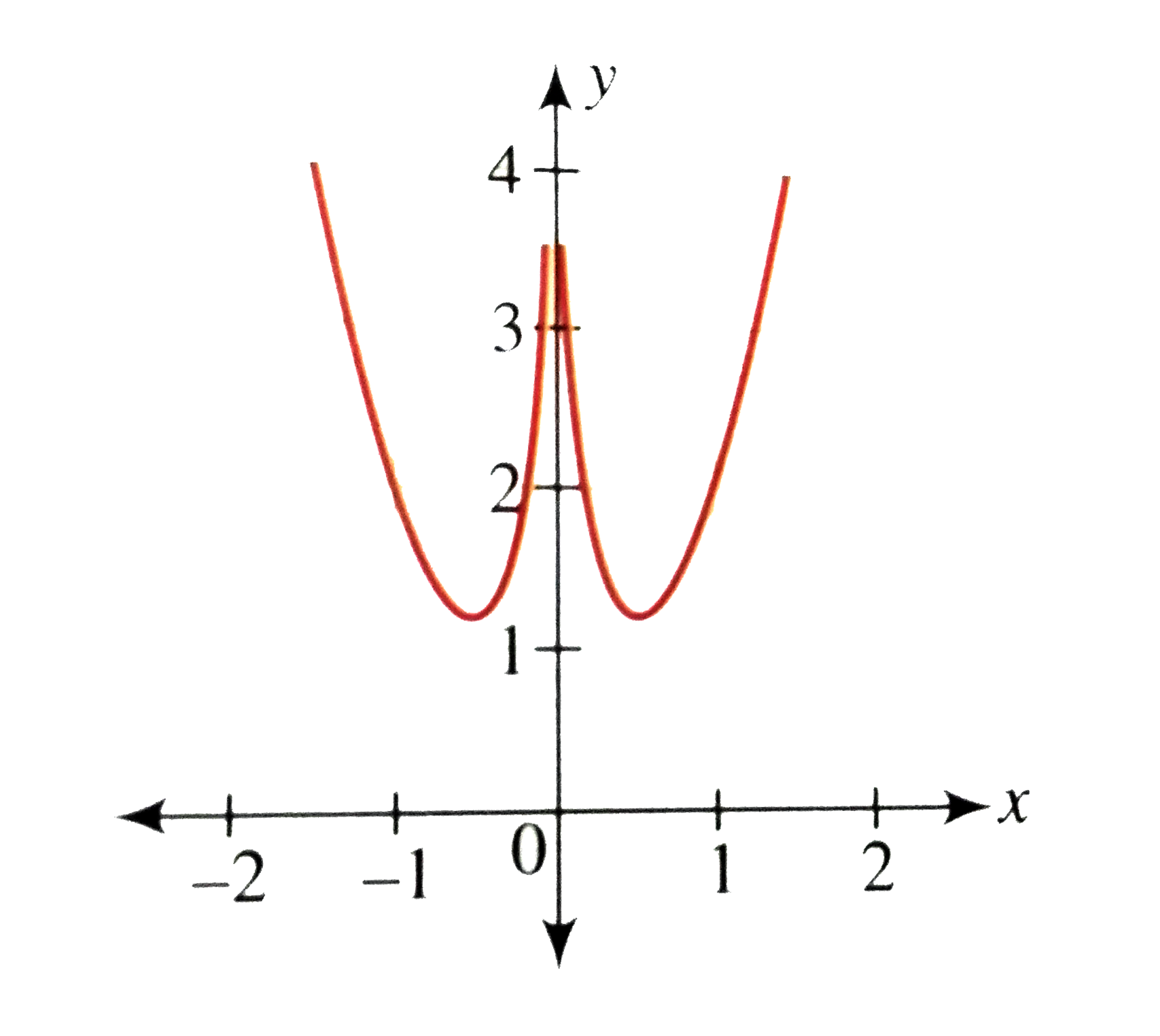 From the graph, `y=0` and y=e are asymptotoes. |
|
| 28. |
Differentiate w.r.t.x the function in Exercises 1 to 11. cot^(-1)[(sqrt(1+sin x)+sqrt(1-sin x))/(sqrt(1+sin x)-sqrt(1-sin x))],0 lt x lt (pi)/(2). |
|
Answer» |
|
| 29. |
Solve the following equations (i) (log_(2)(9-2^(x)))/(3-x)=1 (ii) x^((log_(10)x+7)/(4))=10^((log_(10)x+1) (iii) (log_(10)(100x))^(2)+(log_(10)(10x))^(2)=14+log_(10)(1//x) (iv) log_(10)5+log_(10)(x+10)-1=log_(10)(21x-20)-log_(10)(2x-1) (v)5^(2x)=3^(2x)+2.5^(x)+2.3^(x) |
|
Answer» |
|
| 30. |
Fundamental theorem of definite integral : int_(-1)^(2)sqrt(5x+6)dx=........ |
|
Answer» 0 |
|
| 31. |
If (a + b)/(1- ab) ,b , (b +c)/(1 -bc) are in A.P. then prove that (1)/(a), b (1)/(b) are in A.P. |
|
Answer» |
|
| 32. |
The locus of the variable point P for which the chord of contact of touch thecircle x^(2)+ y^(2) = r^(22)is |
|
Answer» `(x^(2))/(a^(4))+(y^(2))/(b^(4))=(1)/(R^(4))` |
|
| 33. |
If veca, vecb, and vecc are unite vectors, such that veca + vecb + vecc = vec0, then 2 veca. vecb.vecc+2vecc.veca= |
| Answer» ANSWER :B | |
| 34. |
Consider a tetrahedron D-ABC with positionvectors if its angular points as A(1, 1, 1), B(1, 2, 3), C(1, 1, 2) and centreof tetrahedron((3)/(2), (3)/(4),2). Q.If N be the foot of the perpendicular from point D on the plane face ABC then the position vector of N are : |
|
Answer» (-1, 1, 2) |
|
| 35. |
Consider a tetrahedron D-ABC with positionvectors if its angular points as A(1, 1, 1), B(1, 2, 3), C(1, 1, 2) and centreof tetrahedron((3)/(2), (3)/(4),2). Q.Shortestdistance between the skew lines AB and CD : |
|
Answer» `(1)/(2)` |
|
| 36. |
If A and B are independent events such that P(A)=p, P(B)=2p and P(Exactly one of A,B) =5/9 , then find p. |
|
Answer» |
|
| 37. |
Three vectors satisfy the condition veca,vecb and vecc satisfy the condition veca+vecb+vecc=vecO. |
|
Answer» |
|
| 38. |
If cosx=tany,cos y=tanz cosz=tanx, then the value of sin x, is |
|
Answer» `2cos18^(@)` |
|
| 40. |
Equation of plane containing the line (x-1)/(-3)=(y-3)/(2)=(z-2)/(1) and the point (0,-3,4) is |
|
Answer» x+y+2z-5=0 |
|
| 41. |
The multiplicative inverse of ((3 + 4i))/(25) is |
|
Answer» `4 + 3I` |
|
| 42. |
If the sum of two unit vectors is a unit vector, then the magnitude of their difference is |
| Answer» Answer :C | |
| 43. |
Differentiate the following functions with respect to x. y= (sin x)^(x)+ ((1)/(x))^(cos x) |
|
Answer» |
|
| 44. |
Evaluation of definite integrals by subsitiution and properties of its : int_(0)^(1)(dx)/(sqrt(1+x^(4)))in[a,b] then [a,b] =……… where [a,b] is the smallest interval. |
| Answer» Answer :A | |
| 45. |
A closed organ pipe of length 28 cm closed at one end is found to be at resonance when a tuning fork of frequency 850Hz is sounded near the open end. Ifvelocity of sound in air is 340 m/s, then the |
|
Answer» air in the PIPE is VIBRATING in fundamental mode `lambda=(v)/(u)=40 cm` `(3lambda)/(4)=28+eimplies"first overtone"` |
|
| 46. |
If Delta_(1), Delta_(2), Delta_(3) are the areas of the triangles with vertices (0, 0), (a tan alpha, b cot alpha), (a sin alpha, b cos alpha), (a, b), (a sec^(2) alpha, b cosec^(2)alpha), (a+a sin^(2)alpha, b+b cos^(2)alpha) and (0, 0), (a tan alpha, -b cot alpha), (a sin alpha, b cos alpha), then Detla_(1), Delta_(2), Delta_(3) are in G.P. for |
|
Answer» all VALUES of `alpha` |
|
| 48. |
Evaluate the following lim_(xto0) (3x^2 +4x -1) (x^4+2x^3-3x^2 +5x+2) |
|
Answer» SOLUTION :`lim_(xto0) (3x^2 +4X -1)` `(x^4+2x^3-3x^2 +5x+2)` (-1)2=-2 |
|
| 49. |
Two numbers are selected at random (without replacement) from the first six positive integers. Let X denote the larger of the two numbers obtained. Find E(X). |
|
Answer» |
|
| 50. |
If t and p are acalars, the equation of the plane |
|
Answer» |
|