

Saved Bookmarks
This section includes 7 InterviewSolutions, each offering curated multiple-choice questions to sharpen your Current Affairs knowledge and support exam preparation. Choose a topic below to get started.
| 1. |
Find the areaof the ellipse(x^2 )/(a^2) + (y^2)/(b^2)=1 (a gt b) . |
|
Answer» |
|
| 2. |
If AB=BAandA=[{:(1,1),(0,1):}]then, B=...... |
|
Answer» `[{:(X,x),(y,0):}]` |
|
| 3. |
A circle S_(1) passes through the point P(4,-3) and touches the circle S_(2)-=x^(2)+y^(2)-10=0 at the point Q(3,1) on it. If (a,b) is the centre of the director circle of S_(1), then the value of (a)/(b) is less than |
|
Answer» Solution :Equation of tangent at Q on `S_(2)` is `3x+y-10=0`. Equation of circle `S_(1)" is "(x-3)^(2)+(y-1)^(2)+lambda(3x+y-10)` It passes through `P(4,-3)`. 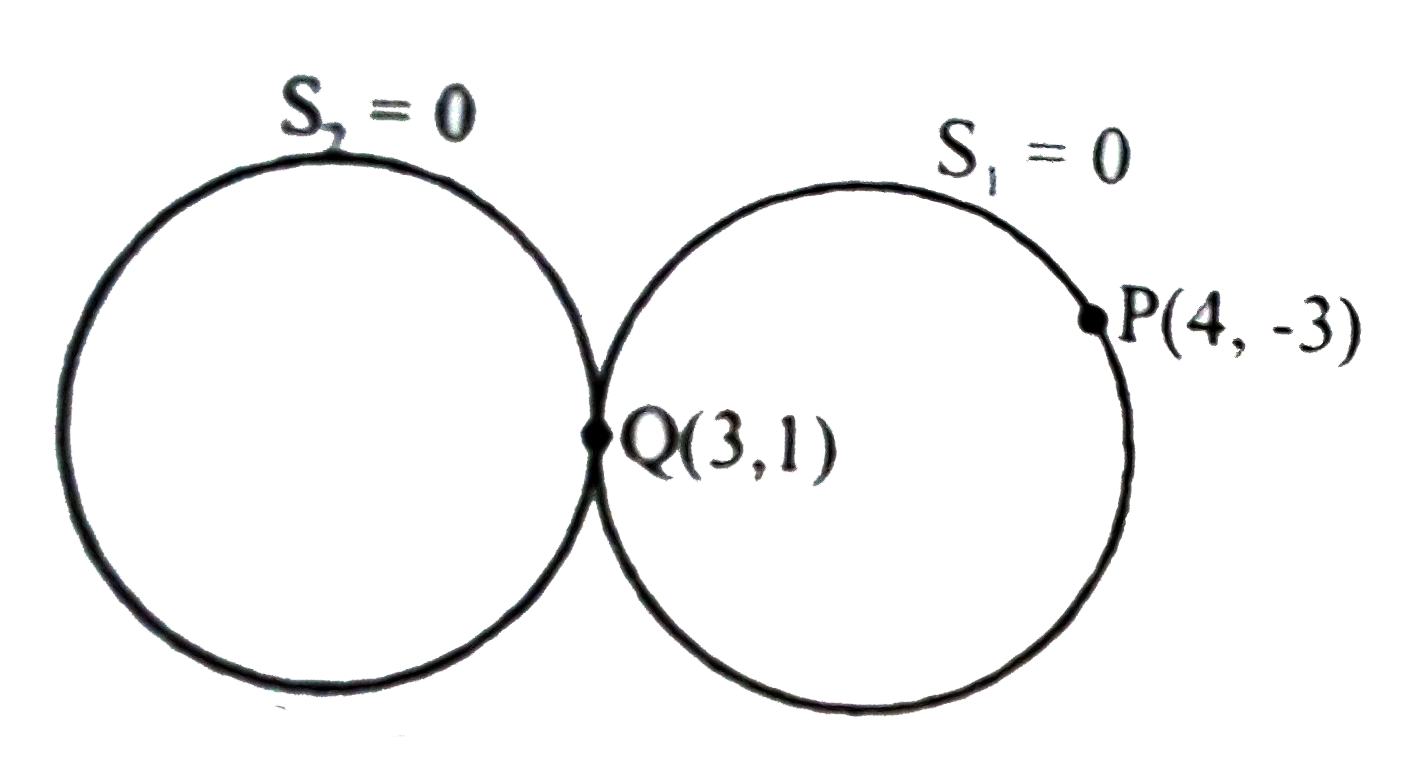 `1+16+lambda(12-3-10)=0implieslambda=17` `:.""S_(1)-=x^(2)+y^(2)+45x+15y-160=0` CENTRE of `S_(1)=0` and its director circle will be same. `((-45)/(2),(-15)/(2))."":.(a)/(b)=3.` |
|
| 4. |
The logically equivalent statement of (p ^^ q) vv ( p ^^r)is |
|
Answer» `p VV ( Q ^^ R)` |
|
| 5. |
Two in-phase sources of waves are separated by a distance of 4.00 m These sources produce identical waves that have a wave length of 5.00 m. On the line between line them, there are two places at which the same type of interference (constructive or destructive) occurs . |
|
Answer» This interference refers to construtive interference `1.5=2x` `x=00.75` For MAX. `4-2x=5m` `x=4-4n` not possible. |
|
| 6. |
Integrate the function (5x-2)/(1+2x+3x^(2)) |
|
Answer» |
|
| 7. |
The value ofint_(0)^(x)[t+1]^(3) dt (where, [.] denotes the greatest integer function of x) is qeual to |
|
Answer» `(([x]([x]+1))/(2))^(2)+([x]+1)^(3){x}` |
|
| 8. |
Choose the correct answer int(xdx)/((x-1)(x-2)) equals |
|
Answer» `logabs(((x-1)^(2))/(x-2))+C` |
|
| 9. |
If f(x) = {{:((3 sin pi x)/(5 x),x ne 0),(2k,x = 0):} is continuous at x = 0, then the value of k is equal to : |
| Answer» Answer :B | |
| 10. |
Write down and simplify Write down and simplify 6th term in((2x)/(3) + (3y)/(2))^9 |
|
Answer» |
|
| 11. |
Find which one is not correct statement. |
|
Answer» TWO STRAIGHT lines are SAID to be SKEW lines if the lines are neither parallel nor intersecting |
|
| 12. |
Integrate the following functions : intsqrt(3-2x-x^(2))dx |
|
Answer» |
|
| 13. |
Find the maximum and minimum values, if any, of thefunctions given by h(x) = sin(2x) + 5 |
|
Answer» |
|
| 14. |
A set A contains 10 elements. A function from A to itself is formed . The probability that the function so formed is not on-to is |
|
Answer» `(/_10)/((10)^(10))` |
|
| 15. |
Evalute the following integrals int (x+ 3)/((x-1)(x^(2)+1)) dx |
|
Answer» |
|
| 16. |
If A={1,2,3,5}, B={2,4,6,8} and C={4,16,36,39}are three sets and R is a relation from A to B and S from B to C defined as ""_(a)R_(b) iff b=2a where a in A, b in B ""_(b)S_(c) iff c=b^(2) where b in B, c in C :. Find SoR. |
|
Answer» |
|
| 17. |
Consider L _(1) : 3x + y + alpha -2 =0 and L _(2) : 3 x + y -alpha + 3 =0, where alphais a positive real number, and C: x ^(2) +y ^(2) - 2x + 4y - 4 =0. Statement-1: If L _(1) is a chord of the circle C, then the line L _(2) is not always a diameter of the circle C. Statement-2: If L _(1) is a diameter of the circle C, then the line L _(2) is not a chord of the circle C. then |
|
Answer» both the STATEMENTS are TRUE |
|
| 18. |
Let t_(n) denote the n^(th) term in a binomial expansion. If t_(6)/t_(5) in the expansion of (a + b)^(n + 4) and t_(5)/t_(4) in the expansion of (a + b)^(n) are equal, thenn is |
|
Answer» 9 |
|
| 19. |
Find the probability distribution of the number of successes in two tosses of a die, where a success is defined as i. number greater than 4 ii. six appears on atleast one die |
|
Answer» |
|
| 20. |
The set of values of alpha for which the quadratic equation (alpha+2)x^(2)-2alphax-alpha=0 has two roots on the number line symmetrically placed about the point 1 is |
|
Answer» `{-1,0}` |
|
| 21. |
If f(x-y), f(x).f(y) and f(x+ y) are in arithmatic progression and f(0) ne 0 then (for AA x and y……… |
|
Answer» `F(2) + f'(2) = 0` |
|
| 22. |
For any two complex numbers z_(1), z_(2) the value of abs(z_(1)+z_(2))^(2)+abs(z_(1)-z_(2))^(2) is |
|
Answer» `abs(z_(1))^(2)+abs(z_(2))^(2)` |
|
| 23. |
If radii are 2, sqrt2 and distance between centres is sqrt2 then the angle between the circles is |
| Answer» ANSWER :D | |
| 24. |
A: The angle between the tangent drawn from origin to the circle x^(2)+y^(2)-14x+2y+25=0," is "pi//2. R: If theta is the angle between the pair of tangents drawn from (x_(1),y_(1)) to the circle S=0 of the radius r then theta tan""theta/2=r/(sqrt(S_(1)) |
|
Answer» Both A and R are TRUE and R is the correct EXPLANATION of A |
|
| 25. |
If alpha, beta, gamma are roots of x^(3) + px^(2) + qx + r = 0then sum (1)/( alpha^(2) beta^(2)) |
|
Answer» `(Q^(2) - 2pr)//R^(2)` |
|
| 26. |
Let S = { x in R : sqrt(x + 2) - sqrt(x - 2) = sqrt(4x - 2)}If alpha = the number of elements in S, then |alpha + sqrt(3)i//2| ^(2) ________ |
|
Answer» |
|
| 27. |
Evaluate the following integrals: int sqrt(5-2x-x^2dx) |
|
Answer» |
|
| 28. |
Locous of the intersection of perpendicular tangents drawn to the curve 4y ^(3) = 27x^(2) is |
|
Answer» `y = X ^(2) + 3` |
|
| 29. |
If y=sqrt(x+sqrt(x+sqrt(x+.........+infty)))," find "(dy)/(dx). |
|
Answer» |
|
| 30. |
The subshell that arises after f subshell is called g subshell. ltBrgt What is the total number of orbitals in the shell in which the g- subshell first occur ? |
|
Answer» 9 |
|
| 31. |
Integrationof certainirrational expressions int(x-2)sqrt((1+x)/(1-x))dx. |
|
Answer» |
|
| 32. |
Findthepolynomialwithrationalcoefficientsand whoserootsare 1 +- sqrt(3),2,5 |
|
Answer» |
|
| 33. |
Area of the regin enclosed by the region y ^(2) le 3x, x ^(2) + y^(2) le 4 and y ge 0 is: |
|
Answer» `(4pi - sqrt3)/(6)` 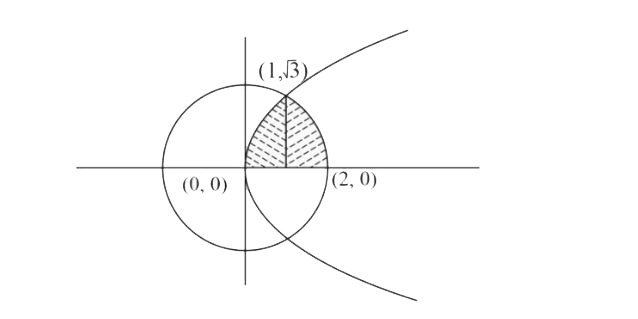 `int _(0) ^(1)sqrt3 SQRTX dx t int _(1)^(2) sqrt(4 -X ^(2)) dx` `sqrt3 ((x ^(3/2))/(3/2))^(1)+ [(x + sqrt(4-x ^(2)))/(2 ) +4/2 sin ^(-1)""x/2]_(1)^(2)""[{:(x ^(2) + 3x -4 =0),(x ^(2) + 4x -x -4 =0),(x (x +y)- (x +y) =0),((x-y)(x+y)=0):}` `(2 sqrt3)/(3) + pi = (sqrt3)/(2) - (pi)/(3)` `sqrt3((2)/(3) - (1)/(2))+ (2pi)/(3) IMPLIES(sqrt3)/(6) + (2pi)/(3) = ( 4pi + sqrt3)/(6)` |
|
| 35. |
If and c are positive real number and the ellipse(x^(2))/( 4c^(2)) +(y^(2))/( c^(2)) = 1has four distinct points in the common with circlex^(2) + y^(2) =9a^(2)then |
|
Answer» ` 9ac -9A^(2) -2c^(2) LT 0 ` |
|
| 36. |
If H is the orthocentre of triangle ABC, R = circumradius and P = AH + BH + CH, then |
|
Answer» <P>`P = 2 (R + r)` `:. P = 2R (cos A + cos B+ cos C)` `= 2R (1+(r)/(R))` `=2 (R + r)` We know that in any triangle, `r le(R)/(2)` `:. P le 2R + R` `rArr P le 3R` |
|
| 37. |
Show that -a isnot the inverse of a in N for the addition opertion + on N and 1/a is not the inverse of a ne N for multiplication opertion xx on N , for a ne 1. |
|
Answer» |
|
| 38. |
Let A*B=A^(T)B^(-1) where A^(T) represents transpose of matrix A and B^(-1) represents inverse of square matrix B. This operation is defined when the number of rows of A is equal to the number of rows of B. Matrix A is said to be orthogonal if A^(-1)=A^(T) If A*B is defined then choose the incorrect statement |
|
Answer» `(A*B)^(-1)=B*A` if `A` is SYMMETRIC matrix |
|
| 39. |
The shortest distance from (-2,14) to the circle x^(2)+y^(2)-6x-4y-12=0 is |
|
Answer» 4 |
|
| 40. |
Let A*B=A^(T)B^(-1) where A^(T) represents transpose of matrix A and B^(-1) represents inverse of square matrix B. This operation is defined when the number of rows of A is equal to the number of rows of B. Matrix A is said to be orthogonal if A^(-1)=A^(T) If A*B is defined then which of the following operations are always define? |
|
Answer» `(A*B)*A^(T)` |
|
| 41. |
Let A and B be two events. IfP(A | B) = P(A) , then A is ………… of B. |
|
Answer» |
|
| 42. |
Consider the following statements p: Suman is brilliant q: Suman is rich r: Suman is honest The negation of the statement "Suman is brilliant and dishonest if and only if Suman is rich" can be expressed as |
|
Answer» <P>`~qharr~p^^r` |
|
| 43. |
Determine order and degree (if defined) of differential equations given in Exercises 1 to 10 (1) (d^(4)y)/(dx^(4)) + sin (y''') = 0 |
|
Answer» |
|
| 44. |
Iflx+my+n=0 is a normal to the parabola y(2)=4ax, then show that al^(3)+2alm^(2)+nm^(2)=0. |
|
Answer» |
|
| 46. |
Equationlambda x^3-10x^2y-xy^2+4y^3=0 represented three straight lines ,out of these three , two makes equal angle with y=xlambdalt0, then the value of lambda is |
|
Answer» Area enclosed by curves `y^2-5xy+6x^2+3x-y=0` and `y^2-5xy+6x^2+2x-y=0 is lambda` SQ UNITS , then the VALUE of `lambda` is |
|
| 47. |
Which of the following could be a factor of n(n+1),if n is a positive integers less than 3? |
| Answer» ANSWER :A | |
| 48. |
If the function f(x) = a sin x + 1/3 sin 3xis maximum at x= pi/3a=? |
|
Answer» 1 |
|
| 49. |
Given three identical boxes I, II and III, each containing two coins. In box I, both coins are gold coins, in box II, both are silver coins and in the box III, there is one gold and one silver coin. A person chooses a box at random and takes out a coin. If the coin is of gold, what is the probability that the other coin in the box is also of gold? |
|
Answer» |
|