

Saved Bookmarks
This section includes 7 InterviewSolutions, each offering curated multiple-choice questions to sharpen your Current Affairs knowledge and support exam preparation. Choose a topic below to get started.
| 1. |
If the pair of straight lines xy - y - y + 1 = 0 and the line ax + 2y - 3a = 0 are concurrent , then a equal to |
|
Answer» 0 |
|
| 2. |
Lines (x)/(1)=(y-2)/(2)=(z+3)/(3)" and "(x-2)/(2)=(y-6)/(3)=(z-3)/(4) are |
|
Answer» parallel |
|
| 5. |
Consider the followingcurves: C_(1):x^(2)+y^(2)=4," " C_(2):x^(2)-2sqrt3y=3, " " C_(3)+sqrt3, " "C_(3):x^(2)+2sqrt3y=3-sqrt3 Statement-1: Parabolas C_(2)and C_(3) have the same latusrectum, the line joining the end -points oflatusrecla of the ellipse C_(1) with negative ordinates. Statement-2: Common chord of C_(2) and C_(3) is a laturectum of C_(1). |
|
Answer» Statement-1 is TRUE, Statement-2 is True, Statement-2 is a CORRECT explanation for Statement-1 |
|
| 6. |
Obtain the following integrals : int sqrt((a+x)/(a-x))dx |
|
Answer» |
|
| 8. |
Let R={(3,3),(6,6),(9,9),(12,12),(6,12),(3,9),(3,12),(3,6)} be a relation on the set A= {3,6,9,12} The relation is |
|
Answer» an equialence RELATION |
|
| 9. |
The mid point of the chord x-2y+7=0 w.r.t the circle x^(2)+y^(2)-2x-10y+1=0 is |
|
Answer» `(7,21)` |
|
| 10. |
Using properties of determinants in Exercises prove that : {:|( alpha , alpha ^(2) ,beta +gamma ),( beta , beta ^(2) , gamma +alpha ),( gamma , gamma ^(2) ,alpha +beta ) |:} =(beta -gamma ) (gamma -alpha ) (alpha -beta ) (alpha +beta +gamma ) |
|
Answer» |
|
| 11. |
A fair coin is tossed repeatedly. If tails appear on first four tosses, what is the probability of head appearing on the fifth toss ? |
| Answer» SOLUTION :When a FAIR coin is tossed, each toss is independent of other `therefore` (HEAD in 5th toss) =1/2 | |
| 12. |
Two letters are chosen from the letters of the word 'EQUATIONS'. The probability that one is vowel and the other is consonant is |
| Answer» ANSWER :C | |
| 13. |
Choose the correct answer inte^(x)secx(1+tanx)dx equals |
|
Answer» `e^(x) cos x + C` |
|
| 14. |
Vertify mean value theorem for the following functions: f(x)= x- 2 sin x, x in [-pi, pi] |
|
Answer» |
|
| 15. |
Evaluate the following integrals f x cosh^(-1)x dx |
|
Answer» |
|
| 16. |
int((x^(2) +1))/(x^(4) + 7x^(2) + 1) dx = |
|
Answer» `(1)/(3) tan^(-1) ((X^(2) - 1)/( 3x) )+ c ` |
|
| 17. |
A value of k each that the straight lines y - 3kx + 4 = 0 and (2k - 1) x - (8k - 1) y - 6= 0 are perpendicular |
| Answer» Answer :a | |
| 18. |
Evaluate the definite integral in exercise overset(1)underset(0)int(x e^(x)+"sin"(pix)/(4))dx |
|
Answer» |
|
| 19. |
If f(x)={{:(x " for"x lt 1),(x-1 " for "x ge1):} then int_(0)^(2)x^(2)f(x)dx= |
|
Answer» `5/3` |
|
| 20. |
The value of the integratio int_(-pi//4)^(pi//4)(lambda|sinx|+(mu sinx)/(1+cosx)+gamma)dx |
|
Answer» is independent of `LAMBDA` only |
|
| 21. |
One of the methods of determining mode is |
|
Answer» MODE = 2 MEDIAN - 3 mean |
|
| 22. |
Consider two points P and Q with position vectors bar(OP) = 3bar(a) - 2bar(b) and bar(OQ) = bar(a)+bar(b). Find the position vector of a point R which divides the line joining P and Q in the ratio 2:1 externally. |
|
Answer» |
|
| 23. |
Consider two points P ans Q with position vectors bar(OQ)=bar3(a)+bar2(b) and bar(OQ)=bar(a)+bar(b). Find the position the line joining P and Q in the ratio 2 : 1internally |
|
Answer» |
|
| 24. |
If the function f(x) satisfies lim_(x rarr 1) (f(x) - 2)/(x^(2) - 1) = pi, then lim_(x rarr 1) f(x) = |
|
Answer» 1 |
|
| 25. |
Three matrices are given as A = [{:( alpha ^(2) ,4,6),(9,beta ^(4) , 7),( 1,2,2gamma ^(2)):}] B= [{:( 2beta ^(2),-1,0),( 2,gamma^(2)-2gamma ,1),( 1,9,2alpha-1):}] C= [{:( gamma , 2,1),(1,alpha , 1),(2,0,beta ) :}] If Tr(A)=Tr (B) -2 and alpha, beta , gamma in Rthen det( c) can be |
| Answer» Answer :A::C | |
| 26. |
Differentiate cos(x^3). sin^(2)(x^5) with respect to x. |
|
Answer» |
|
| 27. |
If alpha and beta be the coefficients of x^4 and x^2 respectively in the expression of (x+sqrt(x^2-1))^6+(x-sqrt(x^2-1))^6, then : |
|
Answer» `alpha+beta=-30` |
|
| 28. |
Let f(x)={{:(3x^2-2x+10, x lt 1),(-2,x gt 1):} The set of values of b for which f(x) has greatest value at x=1 is |
|
Answer» `(-6,-2)` `f(x)={{:(3x^2-2x+10, x lt 1),(-2,x gt 1):}` Clealy `f(x) gt 0 for x lt 1 ` and`f(x)lt 0 for x gt 1` Thus f(x) is INCREASING for all `x lt 1` and decreasing for `x gt 1` Therfore f(x) will have grastest value at x=1 if `underset(x to 1)lim f(x)lt f(1)=underset(x to 1)limf(x)` `rArr underset(x to 1)lim -2x+log_2 (b^2-4)lt -1+10-7` `rArr-2 + LOG _2(b^2-4) lt 3` `rArrlog_2(b^2 -4)lt 5` `b^2 -36 lt 0 and b^2 -4 gt 0 ` `rArr-6 lt b lt 6and b in (-oo,-2) cup (2,oo)` `RARRB in (-6,-2) cup (2,6)` |
|
| 29. |
Identify the wrong statement from the below |
|
Answer» `~[PVV(~q)]cong(~p)^^q` |
|
| 30. |
if the two circles x^2 + y^2 + 2gx + 2fy = 0 and x^2 + y^2 + 2g'x + 2 f'y = 0 touch each other then show that f'g = fg' |
|
Answer» |
|
| 32. |
The power of the point B(-1,1) with respect to the circle S equiv x^(2) + y^(2) -2x -4y + 3 = 0is p. If the length of the tangent drawn from B to the circles S = 0 is t , then the point (2, 3) with respect to circle S' = 0 having centre at (p, t^(2)) and passing through the origin. |
|
Answer» lies inside the CIRCLE `S' = 0` |
|
| 33. |
State which of the following statements are true (T) or false(F) The line (x-2)/3=(1-y)/4=(5-z)/1 is parallel to the plane 2x -y-2z=0. |
|
Answer» |
|
| 34. |
A man observes that when he moves up a distance c metres on a slope, the angle of depression of a point on the horizontal plane from the base of the slope is 30^(@), and when he moves up further a distance c metres the angle of depression of that point is 45^(@). The angle of inclination of the slope with the horizontal is (Man starts from bottom of slope) |
|
Answer» `60^(@)` we GET 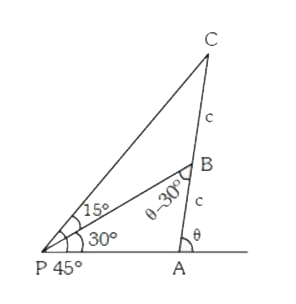 `(C + c) cot (THETA-30^(@))c cot 15^(@) - c cot 30^(@)` or `cot (theta -30^(@)) = 1` `= theta - 30^(@) = 45^(@)` `:. theta = 75^(@)` |
|
| 35. |
The solution of the differential equation dy - (ydx)/(2x) = sqrt(x) ydy is (where , c is an arbitrary constant) |
|
Answer» `y/(SQRTX) = y + c` |
|
| 36. |
On a holiday, a father gave a puzzle from a newspaper to his son Ravi and his daughter Priya. The probabiliy of solving this specific puzzle independent by Ravi and Priya are (1)/(4) and (1)/(5) respectively. Based on the above information, answer the following questions. The chance that both Ravi and Priya solved the Puzzle, is |
| Answer» ANSWER :B | |
| 37. |
sin A + 2 sin 2 A + sin 3 Ais equal to which of the following ? 1.4sin2Acos^(2)((A)/(2)) 2.2 sin2A("sin"(A)/(2)+"cos"(A)/(2))^(2)3.8sin A cos A cos ^(2)((A)/(2))Select the correct answer using the code given below : |
|
Answer» 1 and 2 only `rArrsinA+2sin2A=sin3A=sin30^(@)+2sin60^(@)+sin90^(@)` `=(1)/(2)+(2sqrt(3))/(2)+1=(2sqrt(3)+3)/(2)` `(because2cos^(2)A=1+cos2A)` Now , `4sin2Acos^(2)((A)/(2))=2sin2A[1+cosA]` `=2sin60^(@)[1+COS30^(@)]=(2sqrt(3)+3)/(2)` Also ,`sin2A=2sinAcosA&SIN^(2)A+cos^(2)A=1` `2sin2A["sin"(A)/(2)+"cos"(A)/(2)]^(2)` `=2sin2A["sin"^(2)(A)/(2)"cos"^(2)(A)/(2)+2"sin"(A)/(2)"cos"(A)/(2)]` `=2sin2A[1+sinA]=2sin60^(@)[1+sin30^(@)]` `=(3sqrt(3))/(2)` & 8 sin A cos A`cos^(2)((A)/(2))` `=4sinAcosA[1+cosA]` `=4sin30^(@)cos30^(@)[1+cos30^(@)]` `=(2sqrt(3)+3)/(2)` |
|
| 38. |
The radius of the circle passing through the point (6,2) and two of whose diameter are x + y = 6 and x + 2y = 4 is |
| Answer» ANSWER :D | |
| 39. |
Evaluation of definite integrals by subsitiution and properties of its : If I_(n)=int_(pi//4)^(pi//2)cot^(n)xdx, then 100(I_(99)+I_(101))=....... |
|
Answer» 100 |
|
| 40. |
If the sum of first 75 terms of an A.P. is 2625, then the 38^(th) term of the A.P. is |
|
Answer» 39 |
|
| 42. |
Without expanding at any stage, prove that |(a-b,1,a),(b-c,1,b),(c-a,1,c)| = |(a,1,b),(b,1,c),(c,1,a)| |
|
Answer» |
|
| 43. |
Shortest distance between z-axis and the line(x-2)/(3) =(y-5)/(2) =(z+1)/(-5)is |
|
Answer» `1//SQRT(13)` |
|
| 44. |
If Integration using rigonometric identities : int(dx)/(sqrt(sin^(3)x(sinx+2cosx)))=f(x)+c then f((pi)/(4))=.... |
|
Answer» `-1` |
|
| 45. |
If the bisectors of the angles between the lines given by 3x^(2)-4xy+5y^(2)=0 and 5x^(2)+4xy+3y^(2)=0 asre same, then, the angle made by the lines in the first pair with the second is |
|
Answer» `30^(@)` |
|
| 46. |
If the roots of ax^(2)+ bx + c = 0 are equal in magnitude but opposite in sign, then |
|
Answer» `a lt 0, C lt 0` |
|
| 47. |
If cos x cos y=asin x+siny=b then prove that sin (x+y)=(2ab)/(a^(2)+b^(2)) |
|
Answer» |
|
| 48. |
A special die with numbers 1, -1, 2, -2, 0 and 3 is thrown thrice. What is the probability that the total is 0. |
|
Answer» |
|
| 49. |
A bag contains 5 balls the colours of which are not known. Two balls are drawn and found them to be red. Find the probability that all the balls in the bag are red. |
|
Answer» |
|
| 50. |
Consider a pair of perpendicular straight lines ax^(2)+3xy-2y^(2)-5x+5y+c=0.Distance between the orthocenter and the circumcenter of triangle ABC is |
|
Answer» 4 `:.a-2=0` or `a=2` Also , `abc+2fgh-af^(2)-bg^(2)-ch^(2)=0` `:. C=-3` HENCE , the given pair of lines is `2x^(2)+3xy-2y^(2)-5x+5y-3=0` Factorizing , we get lines `x+2y-3=0and 2x-y+1=0` 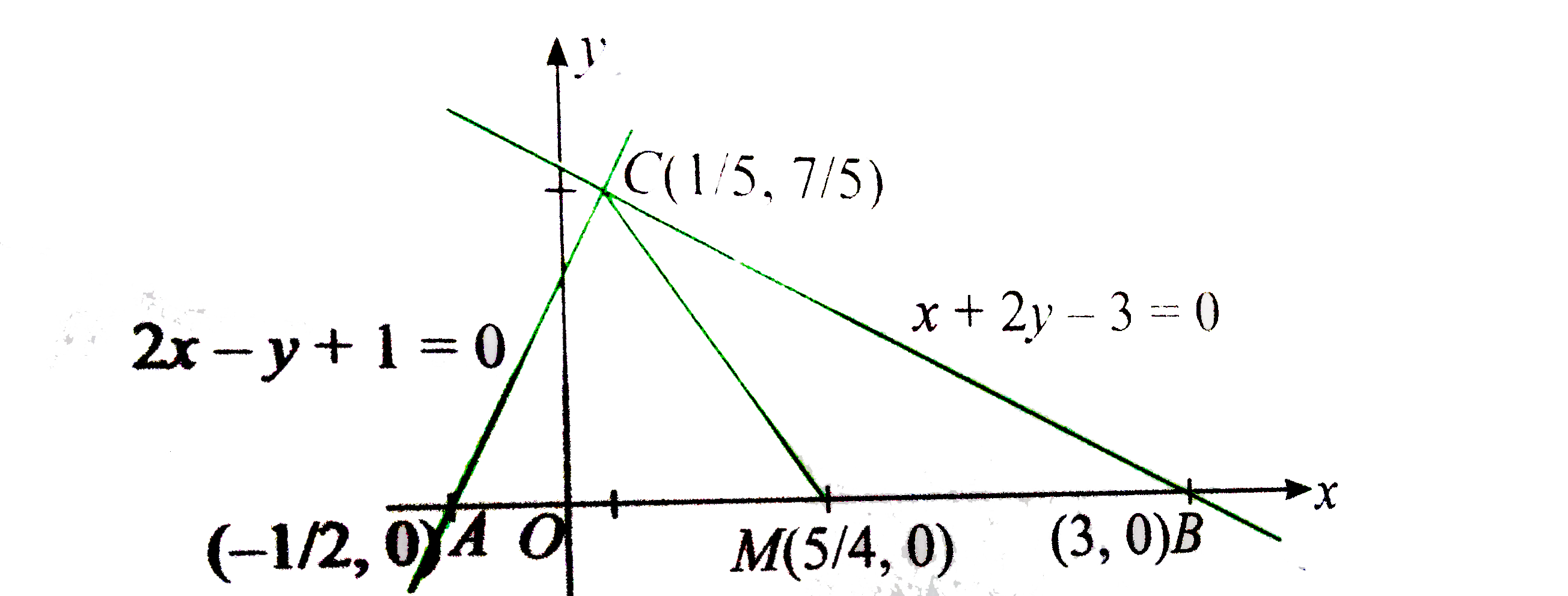 The point of INTERSECTION of the lines is C `(1//5,7//5)`. The points of intersection of the lines with the x- axis are A(3,0) and B `(-1//2,0)`. The orthocenter of triangle isC `(1//5,7//5)` and the CIRCUMCENTER is the midpoint of AB which isM `(5//4,0)`.Therefore, CM`sqrt(((5)/(4)-(1)/(5))^(2)+(49)/(25))=(7)/(4)` |
|