

Saved Bookmarks
This section includes 7 InterviewSolutions, each offering curated multiple-choice questions to sharpen your Current Affairs knowledge and support exam preparation. Choose a topic below to get started.
| 1. |
Let A = [(5,5alpha,alpha),(0,alpha,5alpha),(0,0,5)] If |A^(2)|=25 ,then |alpha| equals : |
| Answer» ANSWER :B | |
| 2. |
Let S be the set of all real values of lambda for which the system of liner equations lambdax +y+z=60 2lambdax +2y -z=1 3y +z=9 has infinitely many solutions . Then S : |
|
Answer» equals R |
|
| 3. |
Determine all value of 'a' for which the equationcos^(4) x-(a+2) cos^(2)x-(a+3)=0, possess solution. Find the solutions. |
|
Answer» |
|
| 4. |
On N, the set of natural numbers, a relation R is denned as follows: a, b in N, aRb if a |b^(2) Then |
|
Answer» R is REFLEXIVE only |
|
| 5. |
Choose the correct answer. The degree of the differential equation ((d^2y)/(dx^2))^3 + ((dy)/(dx))^2 + sin ((dy)/(dx)) + 1 = 0 |
|
Answer» 3 |
|
| 8. |
A and B are two events such that P(A) ne 0. Find P(B/A) if (i) A is a subset of B (ii) A nn B = phi |
|
Answer» |
|
| 9. |
Integrate the functions (sqrt(x^(2)+1)[log(x^(2)+1)-2logx])/(x^(4)) |
|
Answer» |
|
| 10. |
Fourteen numbered balls (1, 2, 3, …, 14) are divided in 3 groups randomly. Find the probability that the sum of the numbers on the balls, in each group, is odd. |
|
Answer» Solution :Each group should have odd numbered BALLS. Case I: Two groups have three odd numbered balls and third has only one odd numbered ball. Number of such cases = `(7!)/((3!)^(2)xx1!xx2!)xx3^(7)`(as even number of balls can go in any group) Case II: Two groups have one odd numbered ball each and the third group has five odd numbered balls. Number of such cases = `(7!)/((1!)^(2)xx5! xx 2!)xx3^(7)` Total number of cases = Number of ways in which three non-empty group can be formed `=(3^(14)-.^(3)C_(1)2^(14) + .^(3)C_(2))/(3!)` `therefore` Required PROBABILITY = `((7!)/(3!)^(2)+(7!)/(5! xx 2!))/(3^(14) - .^(3)C_(1)2^(14)+.^(3)C_(2))xx3!xx3^(7)` |
|
| 11. |
Coefficient of the term independent of x in the expansion of (x+1/x)^(4)(x-1/x)^(12) is |
|
Answer» 192 |
|
| 12. |
The vertices of a triangle are A(1, 1, 2), B(4, 3, 1) and C(2, 3, 5). A vector representing the internal bisector of the angle A is |
|
Answer» `HATI + HATJ + 2HATK` |
|
| 13. |
a,b,cin Ralphais aroot ofa^2 x^2 +bx+c=0 betais a rootofa^2x^2 - bx- c=0 andgammais aroot ofa^2x^2 + 2 bx+ 2c=0then |
| Answer» Answer :B | |
| 14. |
Given that f(x)= {((1-cos4x)/(x^(2))",","if "x lt 0),(a",","if "x =0),((sqrt(x))/(sqrt(16+sqrt(x))-4)",","if "x gt 0):} If f(x) is continuous at x=0 find the value of a. |
|
Answer» |
|
| 15. |
f(x)= {(|x+1|",",x lt -2),(2x+3",",-2 le x lt 0),(x^(2) + 3",",0 le x lt 3),(x^(3)-15,3 le x):}. Find at which points, the function f(x) is discontinuous ? |
|
Answer» |
|
| 16. |
Evaluate the following integrals (i) int_(0)^(pi/2)(cos^(5//2)x)/(sin^(5//2)x+cos^(5//2)x)dx |
|
Answer» |
|
| 17. |
Area of the parallelogram formed by 2 x^(2)+5 x y+3 y^(2)=0 and 2 x^(2)+5 x y+3 y^(2)+3 x+4 y+1=0 is |
| Answer» ANSWER :A | |
| 18. |
If |z_(1)| = |z_(2)| and arg z_(1) + "arg" z_(2) = 0, then which of the following not true. |
|
Answer» `z_(1) + z_(2) = 0` |
|
| 19. |
Find x such that the four points A(3,2,1), B(4,x,5), C(4,2,-2) and D(6,5,-1) are coplanar |
|
Answer» |
|
| 20. |
S.T the curves 6x^2-5x+2y=0,4x^2+8y^2=3 touch each other at (1/2,1/2). |
|
Answer» |
|
| 21. |
Applying the method of indefinite coefficients, evaluate I= int (3x^(3) - 17) e^(2x) dx. |
|
Answer» |
|
| 23. |
If P(A)=0.5, P(B)=0.3 and P(AnnB)=0.1 then find the probability that exactly one of A, B happen. |
|
Answer» |
|
| 25. |
Integration by partial fraction : int(dx)/(sinx-cosx+sqrt(2))=....+c |
|
Answer» `-(1)/(SQRT(2)) tan((X)/(2)+(PI)/(8))` |
|
| 26. |
Integrate the function (x-1)/(sqrt(x^(2)-1)) |
|
Answer» |
|
| 27. |
If f(x) is a twice differentiable function such that f(0)=f(1)=f(2)=0. Then |
|
Answer» `F(X)=0` has EXACTLY 3 roots |
|
| 29. |
If the average sales per month at Produce Stand P were calculated at $4,725, and then it was discovered that the sales in January were actually $4,072 instead of the amount shown, what would the approximate correct average sales per month be? |
|
Answer» `$4,740` |
|
| 30. |
Consider an ellipse 4x^(2)=52-13y^(2) and a variable point P on the line y+2x = 12 such that angle F_(1) P F_(2) is maximum where F_(1) and F_(2) are the foci of the given ellipse then ((F_(2)P)/(F_(1)P))^(2) is equal to (where F_(1)lies on positives x-axis) |
Answer» 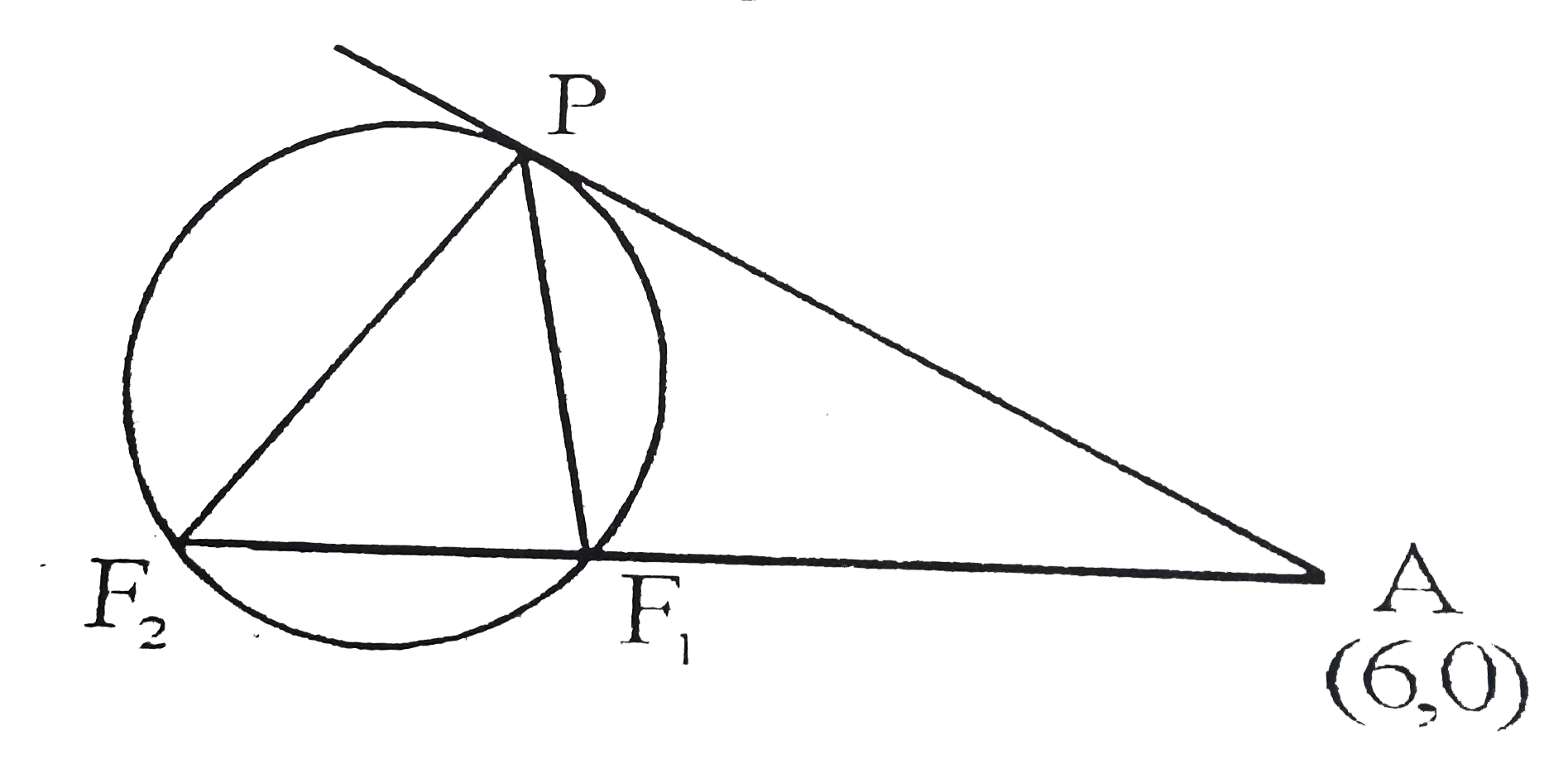 `angleAPF_(1)=angle AF_(2)PimpliesDeltaAPF_(1)~DeltaAF_(2)P` `implies(F_(1)P)/(F_(2)P)=(AP)/(AF_(2)) & AP^(2)=AF_(1)AF_(2)` `((PF_(2))/(PF_(1)))^(2)=(AF_(2))/(AF_(1))=3` |
|
| 31. |
Let N be the foot of the perpendicular of length p from the origin to a plane and l, m, n be the direction cosines of ON, the equation of the plane is |
|
Answer» `px+my+nz=1` |
|
| 32. |
Let A = [a_(ij)] and B = [b_(ij)] be two 4xx4 real matrices such that b_(ij) = (-2)^((i+j+2)) a_(ji) where i,j = 1,2,3,4.If A is scalar matrix of determinant value of 1/128 then determinant of B is: |
|
Answer» 64 |
|
| 33. |
Show that the function f(x) = (x - 1) e^(x)+2 is strictly increasing function forall x gt 0. |
| Answer» | |
| 34. |
d_(1) is the deviation of a class mark y_(i) from 'a' the assumed mean and f_(i) is the frequency, if M_(g)=x+1/(sum f_(i)) (sum_(i) d_(i)), then x is |
|
Answer» LOWER limit |
|
| 35. |
IF 3/((x-1)(x^2+x+1))=1/(x-1)-(x+2)/(x^2+x+1)=f_1(x)-f_2(x)and-(x+1)/((x-1)^2(x^2+x+1))=Af_1(x)+(B+D/(x-1)) f_2(x)=C/(x-1)^2,A+B+C+D= |
| Answer» ANSWER :C | |
| 36. |
Ifx=-1 + 5 cos theta , y = 2 + 5 sin theta ,show that the locus of the point (x,y)is a circle . Find its centre and radius . |
|
Answer» |
|
| 37. |
If |x+5|ge10 then |
|
Answer» `x in (-15,5]` |
|
| 38. |
solve x(dy)/(dx) - y + x sin ((y)/(x)) = 0 |
| Answer» | |
| 39. |
Three electric bulb holders are fixed in a room. 3 bulbs are chosen at random from a set of 20 bulbs of which 16 are good and fitted to the holders. What is the probability that the room is lighted. |
|
Answer» |
|
| 40. |
Statement 1 : If f(x) is discontinuous at x=e and lim_(xrarra)(g(x)) cannot be equal to f(lim_(xrarra)g(x)). because Statement 2 : If f(x) is continuous at x=e and lim_(xrarra)(g(x))=e, then lim_(xrarra)f(g(x))=f(lim_(xrarra)g(x)). |
|
Answer» Statement - 1 is TRUE, Statement - 2 is True, Statement - 2 is a CORRECT explanation for Statement - 2 |
|
| 41. |
Integrationof certainirrational expressions int(dx)/((1-x)sqrt(1-x^(2))). |
|
Answer» |
|
| 42. |
Steve has nuts, bolts, and washers in the ratio 5:4:6. If he has a total of 180 piece of hardware, how many bolts does he have? |
|
Answer» |
|
| 43. |
If the circles x^(2) + y^(2) + 2lambda x + 2 =0 andx^(2) + y^(2) + 4y+ 2 = 0 touch each other, then lambda = |
| Answer» ANSWER :B | |
| 44. |
The roots of the cubic equation (z + alpha beta)^(3) = alpha^(3) , alpha ne 0 represent the vertices of a triangle of sides of length |
|
Answer» `(1)/(sqrt3) |ALPHA beta|` |
|
| 45. |
Ifscalarproductof vectorsvecawithvectors3 hati- 5 hatk , 2 hati + 7 hatjandhati+ hatj+ hatkare respectively-1,6,5thenveca=……… |
|
Answer» `3 HATI + 2 HATK ` |
|
| 46. |
Find the value of cot(tan^(-1) a + cot^(-1) a) |
Answer» SOLUTION :`COT(TAN^(-1) a + cot^(-1) a)= cot(pi/2) = 0`
|
|
| 47. |
Integration using rigonometric identities : int(sin 2x)/(sin^(4)x+cos^(4)x)dx=... |
|
Answer» `cot^(-1)(tan^(2)x)+C` |
|
| 49. |
Let D(x)=|{:(x^2+4x-3, 2x+4,13),(2x^2+5x-9,4x+5,26),(8x^2-16x+1, 16x-6, 104):}|=alphax^3+betax^2 + gammax+delta then : |
|
Answer» `ALPHA+BETA=0` |
|
| 50. |
Let A = [-1,1] . Then , discuss whether the following functions defined on A are one - one , onto or bijective. g(x) =|x| |
|
Answer» |
|