

Saved Bookmarks
This section includes 7 InterviewSolutions, each offering curated multiple-choice questions to sharpen your Current Affairs knowledge and support exam preparation. Choose a topic below to get started.
| 1. |
Evaluate the integral underset(0)overset(pi)int (xsinx)/(1+cos^(2)x) dx |
|
Answer» |
|
| 2. |
Definite integration as the limit of a sum : lim_(ntooo)[(1)/(n)+(1)/(sqrt(n^(2)+n))+(1)/(sqrt(n^(2)+2n))+.......+(1)/(sqrt(n^(2)+(n-1)n))]=......... |
|
Answer» `2+2SQRT2` |
|
| 3. |
If P and Q are two points on the circle : x^(2)+y^(2)-4x-4y-1=0, which are farthest and nearest respectively from the point (6, 5), then : |
|
Answer» <P>`P-= ((-22)/(5), 3)` |
|
| 4. |
If a,b,c are in A.P, find value of|[2y+4,5y+7,8y+a],[3y+5,6y+8,9y+b],[4y+6,7y+9,10y+c]| |
|
Answer» SOLUTION :Applying `R_1toR_1+R_3-2R_2` to the GIVEN DETERMINANT, we obtain .|[0,0,0],[3y+5,6y+8,9y+b],[4y+6,7y+9,10y+c]|=0`(SINCE 2B = a+c) |
|
| 5. |
If x ge 0, y ge 0, 2x+y le 10, x+2y ge 10, then the minimum value of F=x+y is |
|
Answer» 5 |
|
| 6. |
Every relation which is symmetric and transitive is also reflexive. |
|
Answer» |
|
| 7. |
int_0^af(a-x)dx =.....a)int_0^(2a)f(x)dxb)int_-a^af(x)dxc)int_0^af(x)dxd)int_a^0f(x)dx |
|
Answer» `int_0^(2A)f(x)dx` |
|
| 8. |
If the line 3x-4y=lamda cuts the circle x^(2)+y^(2)-4x-8y-5=0 in two points then limits of lamda are |
|
Answer» `[-35,15]` |
|
| 9. |
(x+3) sqrt(3-4x-x^(2)) |
|
Answer» |
|
| 10. |
int x^(2)/(2x^(4)-7x^(2)-4)dx |
| Answer» | |
| 11. |
A man is known to speak the truth 3 out of 4 times. He throws a die and reports tht it a six. The probability that it is actually a six is |
|
Answer» |
|
| 12. |
Statement- 1 The maximum value of the term indepandent of x in the expansion of(ax^(1//6) + bx^(1//3))^(9) is 84 Statement- 2 a^(2) + b = 2 |
|
Answer» |
|
| 13. |
For any natural number n, the value of the integral int_(0)^(sqrt(n)) [x^(2)]dx is |
|
Answer» `N SQRT(n)+overset(n) UNDERSET(r=1)SUM sqrt(r )` |
|
| 14. |
Triangles are formed by pairs of tangent dreawn from any point on the ellipse a^(2)x^(2)+b^(2)y6(2)=(a^(2)+b^(2)^(2) to the ellipse x^(2)/a^(2)+y^(2)/b^(2)=1 and the chord of contact. Show that the orthocentre of each such triangles lies triangle lies on the ellipse. |
|
Answer» |
|
| 15. |
int(xe^x)/(1+x^2)dx |
|
Answer» SOLUTION :`INT(xe^x)/(1+x^2)dx=inte^x{1/(1+x)-1/(1+x)^2}dx` [Integrating by parts taking `1/(1+x)` as FIRST and `e^x` as second FUNCTION.] =`1/(1+x).e^x-int(-1)/(1+x)^2e^xdx-inte^x.1/(1+x)^2dx+C` =`1/(1+x)e^x+inte^x/(1+x)^2dx-inte^x/(1+x)^2dx+C` =`e^x/(1+x)+C` |
|
| 17. |
If x satisfies the inequalities x+7 le 2x + 3 and 2x+4 lt 5x + 3, then x lies in the interval |
|
Answer» `(-OO,3)` |
|
| 18. |
{:("Column A","" ,"Column B"),("The least number divisible by 2,3,4,5 and 6" , ,"The least number that is a multiple of 2,3,4,5 and 6"):} |
|
Answer» If column A is larger |
|
| 19. |
If the solution of the differential equation x(dy)/(dx) +y = xe^(x) "be", xy= e^(x) phi (x) +c, then phi (x) is equal to |
|
Answer» `X+1` |
|
| 20. |
Show that the scalar vec(A)*(vec(B)+vec(C)) times (vec(A)+vec(B)+vec(C))=0. |
|
Answer» |
|
| 22. |
H_(1) xy = CA^(2) and H_(2) : xy = k^(2) are two different hyperbolas. From a point on H_(1) tangents are drawn to H_(2). Area of the triangle formed by the chord of contact and the asymptote to H_(2) is |
|
Answer» `(K^(2))/(C^(2))` |
|
| 23. |
A ladder, 5 meter long, standing on a horizontal floor, leans against a vertical wall. If the top of the ladder slides downwards at the rate of 10 cm/sec, then the rate at which the angle between the floor and the ladder is decreasing when lower end of ladder is 2 metres from the wall is ............ |
|
Answer» `(1)/(10)` radian/sec. |
|
| 24. |
Match the following lists: |
|
Answer» b. `int(x^(2)-1)/(x(x-2)^(3))dx=int[(A)/(x)+(B)/(x-2)+(C)/((x-2)^(2))+(D)/((x-2)^(3))]dx` c. `int(x^(3)+1)/(x(x-2)^(2))dx=int[((x^(3)+1)/(x(x-2)^(2))-1)+1]dx` `=int[((x^(3)+1-x(x-2)^(2))/(x(x-2)^(2)))+1]dx` `=int[((A)/(x)+(B)/(x-2)+(C)/((x-2)^(2)))+1]dx` d. `int(x^(5)+1)/(x(x-2)^(3))dx=int[x+k+(g(x))/(x(x-2)^(3))]dx, ` where k is constant ` ne 0 ` and `g(x)` is a polynomial of degree less than 4. |
|
| 25. |
Angle between tangents at the ends chords of circle (x-1)^(2)+(y-2)^(2)=16 is 60^(@) then locus of midpoints of all such chords is |
|
Answer» `(X-1)^(2)+(y-2)^(2)=2` |
|
| 26. |
Match the following lists: |
|
Answer» `"Putting "2^(x)=t, 2^(x)log2dx=dt, " we get "` `I=(1)/(log2)sin^(-1)((t)/(1))+C=(1)/(log 2)sin^(-1)(2^(x))+C` ` :. K=(1)/(log2)` b. ` int(dx)/((sqrt(x))^(2)+(sqrt(x))^(7))=int(dx)/((sqrt(x))^(7)(1+(1)/((sqrt(x))^(5))))` `"PUT " (1)/((sqrt(x))^(5))=y, (dy)/(dx)=-(5)/(2(sqrt(x))^(7))` ` :. I=int(-2dy)/(5(1+y))=-(2)/(5)In|1+y|+C=(2)/(5)In((1)/(1+(1)/((sqrt(x))^(5))))` ` :. a=(2)/(5), k=(5)/(2)` c.Add and subtract ` 2x^(2)` in the numerator. Then `k=1` and ` m=1 ` d. `I=int(dx)/(5+4cosx)` `=int(dx)/(5("sin"^(2)(x)/(2)+"cos"^(2)(x)/(2))+4("cos"^(2)(x)/(2)-"sin"^(2)(x)/(2)))` `=int(dx)/(9"cos"^(2)(x)/(2)+"sin"^(2)(x)/(2))=int("sec"^(2)(x)/(2))/(9+"tan"^(2)(x)/(2))dx` `"Let " t="tan"(x)/(2) " or " 2dt="sec"^(2)(x)/(2)dx` ` :. I=int(2dt)/(9+t^(2))=(2)/(3)"tan"^(-1)((t)/(3))+C` `=(2)/(3)"tan"^(-1)(("tan"((x)/(2)))/(3))+C` ` :. k=(2)/(3), m=(1)/(3)` |
|
| 27. |
If the volume of parallelopiped whose coterminous edges are a=i+j+2k, b=2i+lambdaj+k" and "c=2i+2j+lambdak is 35 ("unit")^(3), then a*b+b*c-c*a=______ |
|
Answer» |
|
| 28. |
If the radius of a sphere is measured as 7m with an error of 0.02 m, then find the approximate error in calculating its volume |
|
Answer» |
|
| 29. |
If p, q and rare three statements and truth value of p ^^ q rarrr is F, then truth values of p,q and r are respectively |
|
Answer» T, F, T |
|
| 30. |
Assertion (A): If A, B, C are the angles of a triangle such that cos A + cos B + Cos C = 0 = sin A + sin B + sin C then cos 3A + cos 3B + cos 3C = -3Reason (R) : If cos alpha + cos beta + cos gamma = 0 = sin alpha + sin beta + singamma then cos 3 alpha + cos 3 beta + cos 3 gamma = 3 cos (gamma+alpha+beta) |
|
Answer» Both A and R are true R is CORRECT explanation to A |
|
| 31. |
Ifx^2+ 4y^2- 8x +12 =0is satifiedby realvaluesof xnad ythen ymustliesbetween |
|
Answer» `2,6` |
|
| 32. |
Identify the type of conic section for each of the following equations: x^(2)-4y^(2)+6x+16-11=0 |
|
Answer» |
|
| 33. |
A man takes a step forward with probability 0.4 and backwards with probability 0.6. Find probability that at the end of 11 steps he is just one step away from the starting point. |
|
Answer» `462xx(0.24)^(5)` |
|
| 34. |
A total charge Q is distributed over two concentric hallow uniform sphere of radii a and b, (bgta) such a way that their surface charge densities are qual. The potential at the common centre is given by : |
|
Answer» `(Q)/(4piepsilon_(0))((a+b))/((a^(2)+b^(2))` `Q'b^(2)=QA^(2)-Q'a^(2)` `Q'=(Qa^(2))/(a^(2)+b^(2))` `(KQ-Q')/(b)+(kQ')/(a)` `(K)/(b)[Q-(Qa^(2))/(a^(2)+b^(2))]+k[(Qa)/(a^(2)+b^(2))]` `(kQ(b+a))/(a^(2)+b^(2))` 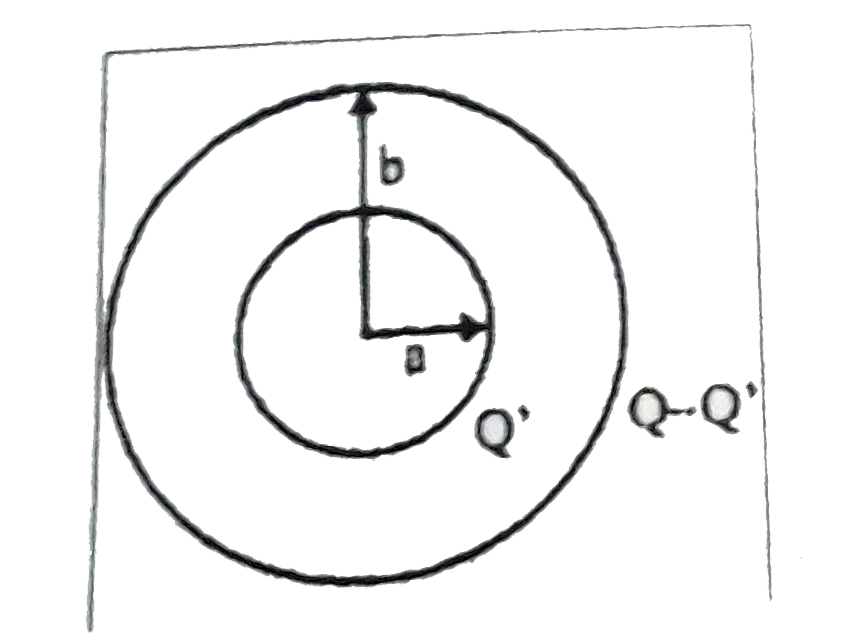
|
|
| 35. |
State which of the following statements is true? |
|
Answer» The FUNCTION `F(x)=log_(E)x` is differentiable for all real x |
|
| 36. |
The sum to n terms of a series is (n(n + 1)(n + 2))/3. The 12^(th) terms is |
|
Answer» 182 |
|
| 37. |
A curve passing through (1, 0) such that the ratio of the square of the intercept cut by any tangent off the y-axis to the subnormal is equal to the ratio of the product of the co-ordinates of the point of tangency to the product of square of the slope of the tangent and the subtangent at the same point. Determine all such possible curves. Let y = f(x) and y = g(x) be the pair of curves such that(i) the tangents at point with equal abcissae intersect on y-axis(ii) the normals drawn at points with equal abscissae intersect on x-axis and(iii) curve f(x) passes through (1, 1) and g(x) passes through (2, 3) then |
|
Answer» |
|
| 38. |
If a machine is correctly set up, it produces 90% acceptable items. If it is incorrectly set up, it produces only 40% acceptable items. Past experience shows that 80% of the set ups are correctly done. If after a certain set up, the machine produces 2 acceptable items, find the probability that the machine is correctly set up. |
|
Answer» |
|
| 39. |
If P(A') = 0.7, P(B) = 0.7, P(B | A) = 0.5 then find P ( A | B) and P(A cup B). |
|
Answer» |
|
| 40. |
Draw the graph of y= 2^(((|x|+x))/(x)). |
|
Answer» Solution :We have `y= f(X)= 2^(((|x|+x))/(x)), xne 0` `""={{:(2^((-x+x)/(x))",",,x lt 0), (2^((x+x)/(x))",",,x gt 0):}` `""= {{:(1",",, xlt0), (2",",,x GT0):}` THUS, the GRAPH of the function is as follows. 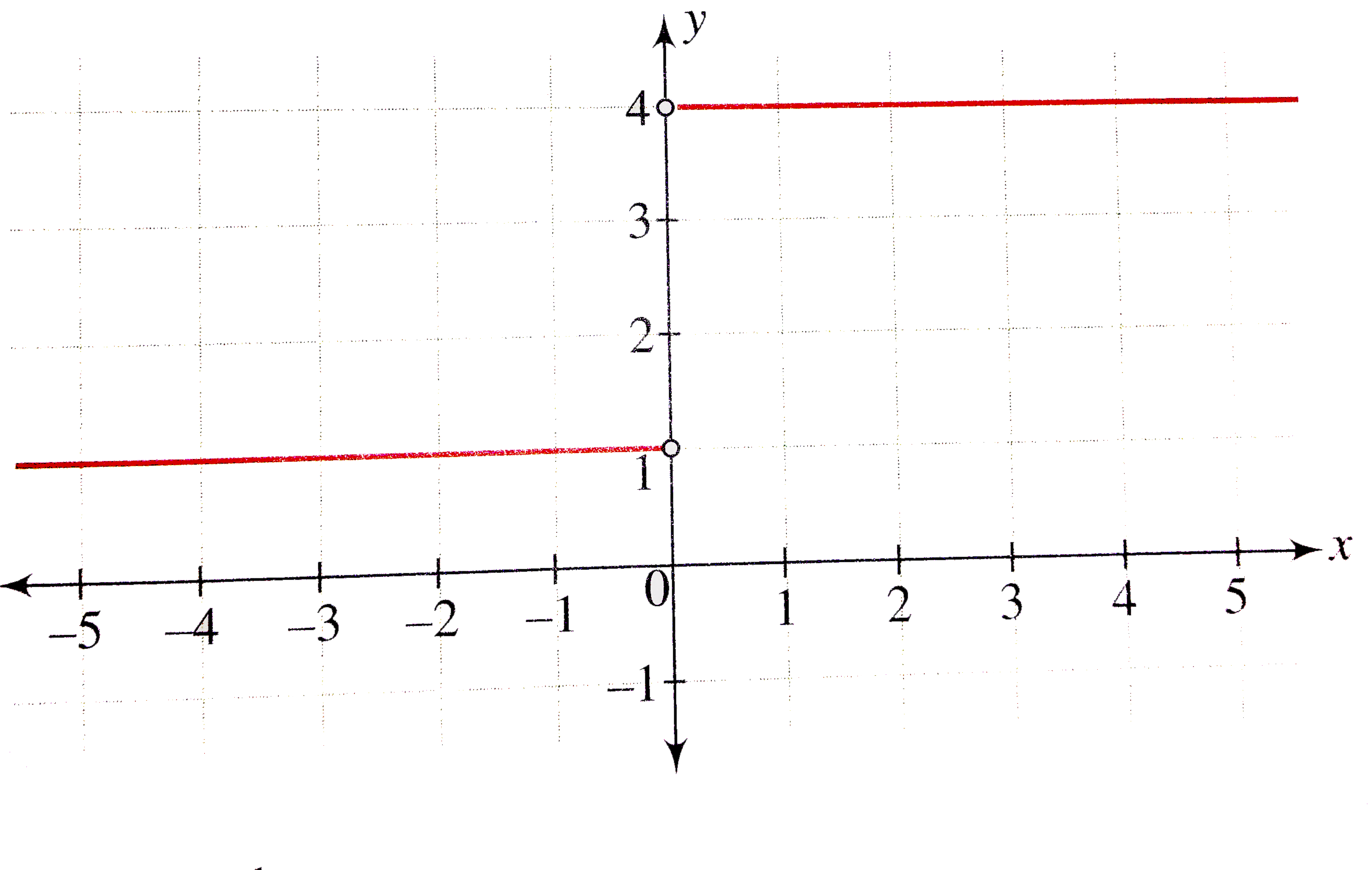
|
|
| 41. |
If the equation (m-n)x^(2)+(n-1)x+1-m=0 has equal roots, then l, m and n satisfy |
|
Answer» 2l=m+n |
|
| 42. |
Refers to question 30. Minimum value of F is |
|
Answer» 0 |
|
| 43. |
Find the value of K if the points (i) (4,K) and (2,3) are conjugate with respect to the circle x^(2)+y^(2)=17. (ii) (4,2) and (K,-3) are conjugate with respect to the circle x^(2)+y^(2)-5x+8y+6=0 |
|
Answer» |
|
| 44. |
Solve the following system of linear equations using matrix method.x-y+2z=73x+4y-5z=5 2x-y+3z =12 |
|
Answer» SOLUTION :[[1,-1,2],[3,4,-5],[2,-1,3]][(X),(y),(z)]=[(7),(-5),(12)] i.e.,AX=B `THEREFORE X + A^(-1) B` `A^(-1)=(adj A)/|A|=1/4 [[7,1,-3],[-19,-1,11],[11,-1,7]]` `X=A^(-1)B=[(2),(1),(3)]` x=2,y=1,z=3 |
|
| 45. |
For what value of x in R the following expressions are negative i) x^(2) - 5x - 6 ii) -7x^(2) + 8x - 9 |
|
Answer» |
|
| 46. |
If log 23=z, find the value of log 2,300 in terms of z. |
| Answer» SOLUTION :`log2300=log(23*100)=log23+log100=z+log10^(2)=z+2` | |
| 47. |
Integrate the functions cos^(-1)x |
| Answer» | |
| 48. |
intxcos2xdx=.......+c |
|
Answer» `(xsin2x)/(2)+(COS2X)/(4)` |
|
| 49. |
Evaluation of definite integrals by subsitiution and properties of its : f:RtoR is a differentiable function.f(2)=6, f'(2)=(1)/(48) then lim_(xto2)int_(6)^(f(x))(4t^(3))/(x-2)dt=.............. |
|
Answer» 18 |
|