Saved Bookmarks
This section includes 7 InterviewSolutions, each offering curated multiple-choice questions to sharpen your Current Affairs knowledge and support exam preparation. Choose a topic below to get started.
| 1. |
The tangent and normal to the ellipse x^(2)+4y^(2)=4 at a point P(theta) on it meets the major axis in Q and R respectively.If theta lt theta lt (pi)/(2) and QR=2 then show thattheta=cos^(-1)((2)/(3)). |
|
Answer» |
|
| 2. |
If nth term of series is 2^(n) + n, then sum of n terms= |
|
Answer» `N(2^(n) - 1) + n(n + 1) ` |
|
| 3. |
Consider a plane x+y-z=1 and point A(1, 2, -3). A line L has the equation x=1 + 3r, y =2 -r and z=3+4r. |
|
Answer» `4sqrt(26)` `RARR ""r= (3)/(2), -(5)/(2)` Hence, the points are `A((11)/(2), (1)/(2),(10)/(2)) and B ((-13)/(2), (9)/(2), (-14)/(2))` `rArr""AB= sqrt(292)` |
|
| 4. |
Find the second order derivatives of the following functions: log e^(x^(x^(x))) |
|
Answer» |
|
| 5. |
int (sin x)/(sin x - cos x )dx = |
|
Answer» `(1)/(2) x + (1)/(2)` log | sin x - cos x | + C |
|
| 6. |
How many terms of the geometric series 1 + 4 + 16 + 64 + ……… will make the sum 5461? |
|
Answer» 7 |
|
| 7. |
In the polynomial (x-1)(x^(2)-2)(x^(3)-3)…(x^(11)-11), the coefficient of x^(60) is : |
|
Answer» |
|
| 8. |
Find the area of the region situated in the first quadrant and bounded by the parabola y^(2)= 4ax and the straight lines y= x-a and x=a |
|
Answer» |
|
| 9. |
Consider a G.P. with first term (1+x)^(n), |x| lt 1, common ratio (1+x)/(2) and number of terms (n+1). Let 'S' be sum of all the terms of the G.P., then The coefficient of x^(n) is 'S' is |
|
Answer» `2^(n)` `=(1)/(2^(n))((1+x)^(n)[2^(n+1)-(1+x)^(n+1)])/(1-x)` `=(1)/(2^(n))[2^(n+1)(1+x)^(n)-(1+x)^(2n+1)](1-x)^(-1)` `=(1)/(2^(n))[2^(n+1)(1+x)^(n)-(1+x)^(2n+1)](1+x+x^(2)+...+oo)` The COEFFICIENT of `x^(n)` in `S` `=(1)/(2^(n))[2^(n+1)sum_(r=0)^(n)'^(n)C_(r )-sum_(r=0)^(n)'^(2n+1)C_(r )]` `=(1)/(2^(n))[2^(n+1)2^(n)-(1)/(2)2^(2n+1)]` `=2^(n)` |
|
| 10. |
Consider a G.P. with first term (1+x)^(n), |x| lt 1, common ratio (1+x)/(2) and number of terms (n+1). Let 'S' be sum of all the terms of the G.P., then sum_(r=0)^(n)"^(n+r)C_(r )((1)/(2))^(r ) equals |
|
Answer» SOLUTION :`(C )` `sum_(r=0)^(n)'^(n+r)C_(r )((1)/(2))^(r )` `=^(n)C_(n)((1)/(2))^(0)+^(n+1)C_(n)((1)/(2))^(1)+^(n+2)C_(n)((1)/(2))^(2)+......+^(2n)C_(n)((1)/(2))^(n)` `="coefficient of"x^(n)"in" (1+x)^(n)((1)/(2))^(0)+(1+x)^(n+1)((1)/(2))^(1)+(1+x)^(n+2)((1)/(2))^(2)+....+(1+x)^(2n)((1)/(2))^(n)` `="coefficient of "x^(n)"in"S` `=2^(n)` |
|
| 11. |
If two vectors oversetrarra and oversetrarrb are such that |oversetrarra+oversetrarrb|=|oversetrarra-oversetrarrb|, then what is the angle between oversetrarra and oversetrarrb ? |
| Answer» SOLUTION :`[oversetrarraoversetrarrboversetrarrc]=10 then [oversetrarra+oversetrarrboversetrarrb+oversetrarrcoversetrarrc+oversetrarra]=2[oversetrarraoversetrarrboversetrarrb]=2xx10=20` | |
| 12. |
Compute the integrals : (a)int_(0)^(0) x^(2) sqrt(a^(2) - x^(2)) dx (b)int_(1)^(sqrt(x)) (dx)/(sqrt((1 + x^(2))^(3))) |
|
Answer» (B)`(sqrt(3)-sqrt(2))/(2)`(substitutionx = TAN t) |
|
| 13. |
9 Different letters of an alphabet are given. Find the number of 4 letter words that can be formed using these 9 letters which have (i) no letter is repeated (ii) atleast one letter is repeated. |
|
Answer» |
|
| 14. |
(d)/(dx) ((x +5)/((x + 1)^(2) (x+2)))= |
|
Answer» `(8)/((X + 2)^(2)) - (3)/((x + 1)^(2)) + (3)/((x +1)^(3))` |
|
| 15. |
The scatterplot above shows data for ten accounts opened by a company , along with the line of best fit. For the account that contains the least amount of money, which of the following is closest to the difference of the actual amount and the amount predicted by the line of best fit? |
|
Answer» 200 |
|
| 16. |
An ubiased die is thrown, getting an even number is 3 times the probability of getting an odd prime number then thenumber is- |
|
Answer» |
|
| 18. |
If ""^(n)C_(4)=""^(n)C_(8), then ""^(n)C_(2) is |
|
Answer» 64 |
|
| 19. |
If |x| lt 1, then the coefficient of x^(5) in the expansion of (1+ 2x + 3x^(2) + ..........)^((-3)/2) is |
|
Answer» 0 |
|
| 20. |
If x^(2) + y^(2) = c^(2) and x/a + y/b = 1 intersect at A and B, the find bar(AB) . Hence deduce the condition, the line touches the circle. |
|
Answer» |
|
| 21. |
Find the variance for the discrete data given below . (i) 6,7,10,12,13,4,8,12 |
|
Answer» |
|
| 22. |
Find the area of the region bounded by y=cos x and the x axis in the interval [0,2pi] |
|
Answer» |
|
| 23. |
intdx/sqrt(1+2x-x^2) |
|
Answer» SOLUTION :`INTDX/sqrt(1+2x-x^2)=intdx/sqrt(1-(x^2-2x))` =`intdx/sqrt(2-(x-1)^2) =intdx/((SQRT2)^2-(x-1)^2)` =`sin^-1(x-1)/sqrt2+C` |
|
| 24. |
If (1 - x)^(n) = C_(0) + C_(1)x + C_(2)x^(2) + ......... + C_(n)x^(n), then the value of 1.C_(1) + 2.C_(3) + 3.C_(3) + ......... + n.C_(n) = |
|
Answer» `2^(N) - 1` |
|
| 25. |
Find the area of the rectangle having vertices A,B,C and D with positionvectors. -hati+1/2hatj+4hatk,hati+1/2hatj+4hatk,hati-1/2hatj+4hatk and -hati-1/2hatj+4hatk respectively. |
|
Answer» |
|
| 26. |
int (sin x)/(sin x + cos x)dx = |
|
Answer» `(1)/(2) x + (1)/(2)` log | sin x + cos x | + C |
|
| 27. |
The numberof waysin which1800can bedividedintotwofactorsis |
|
Answer» 17 |
|
| 28. |
Are the following sets relation ? phi xx phi from A to B.Determinethe domain range and inverse of each of the relations mentioned above. |
| Answer» SOLUTION :`PHI XX phi`from A to B is a RELATION | |
| 29. |
Let Y = {n^(2) : n in N} sub N. Consider f:N to Y as f (n) = n ^(2). Show that f is invertible. Find the inverse of f. |
|
Answer» |
|
| 30. |
If n is positive integer and(1+isqrt3)^n+(1-isqrt3)^n=2^(n+1) cos theta, then the value of theta is |
|
Answer» `npi//3` |
|
| 31. |
The order and degree of ((d^(4)y)/(dx^(4)) + (d^(2)y)/(dx^(2)))^((5)/(2)) = a(d^(2)y)/(dx^(2)) are p,q then p+q = |
|
Answer» (4,5) |
|
| 32. |
If ""^(17)C_(2t+1)=""^(17)C_(3t-5), find t. |
|
Answer» |
|
| 33. |
There are 7 greeting cards,each of a different colour and 7 envelopes of same 7 colours as that of the cards .The number of ways in which the cards can be put in envelopes,so that exactly 4 of the cards go into envelopes of respective colour ,is |
|
Answer» `""^(7)C_(3)` |
|
| 34. |
The ratioof theareaof theregion of thecurvesy=cosx and y= cos 2xbetweenX- axis ,x=0tox= pi/3 is …. |
|
Answer» `1:2` |
|
| 35. |
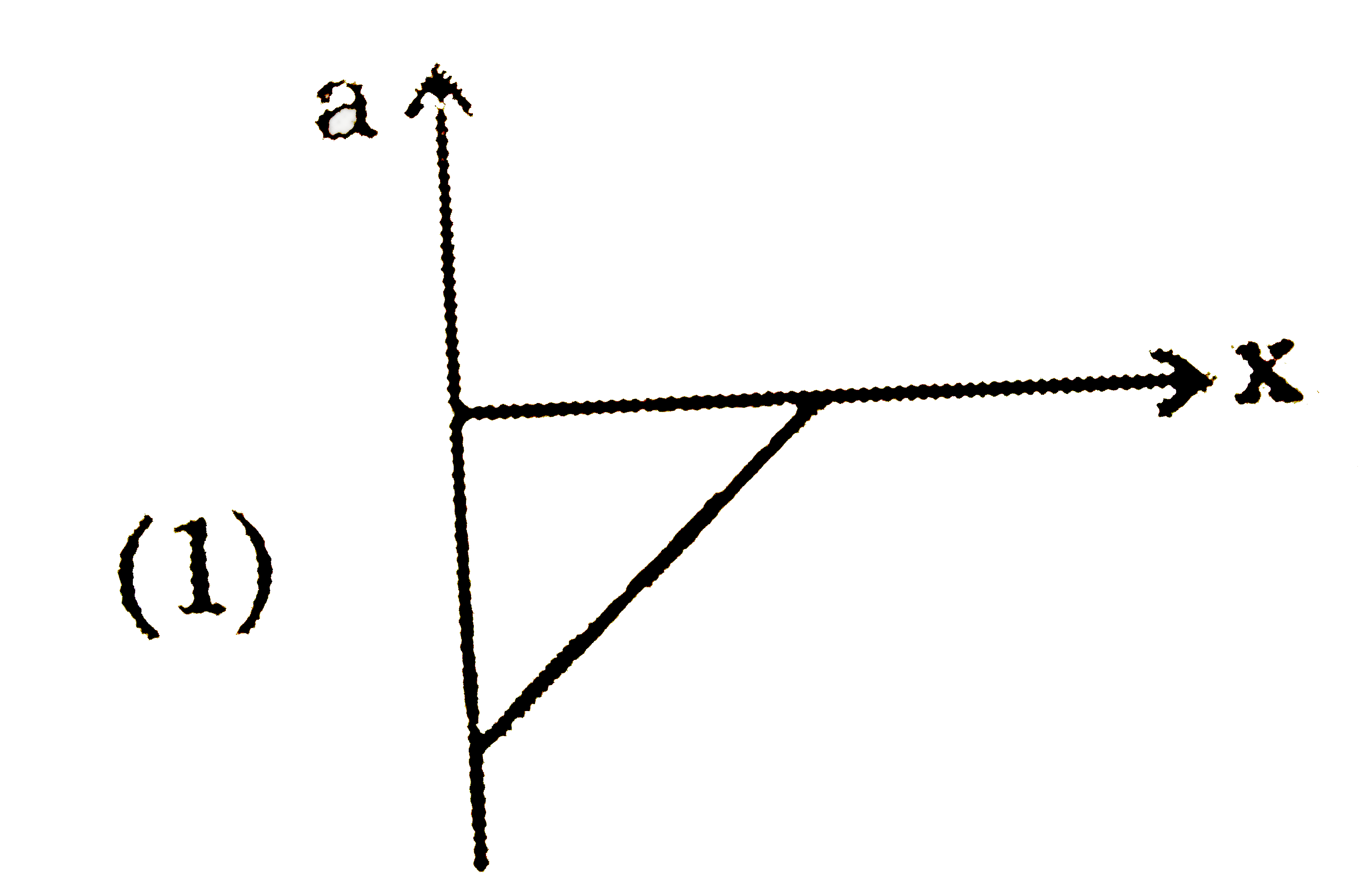
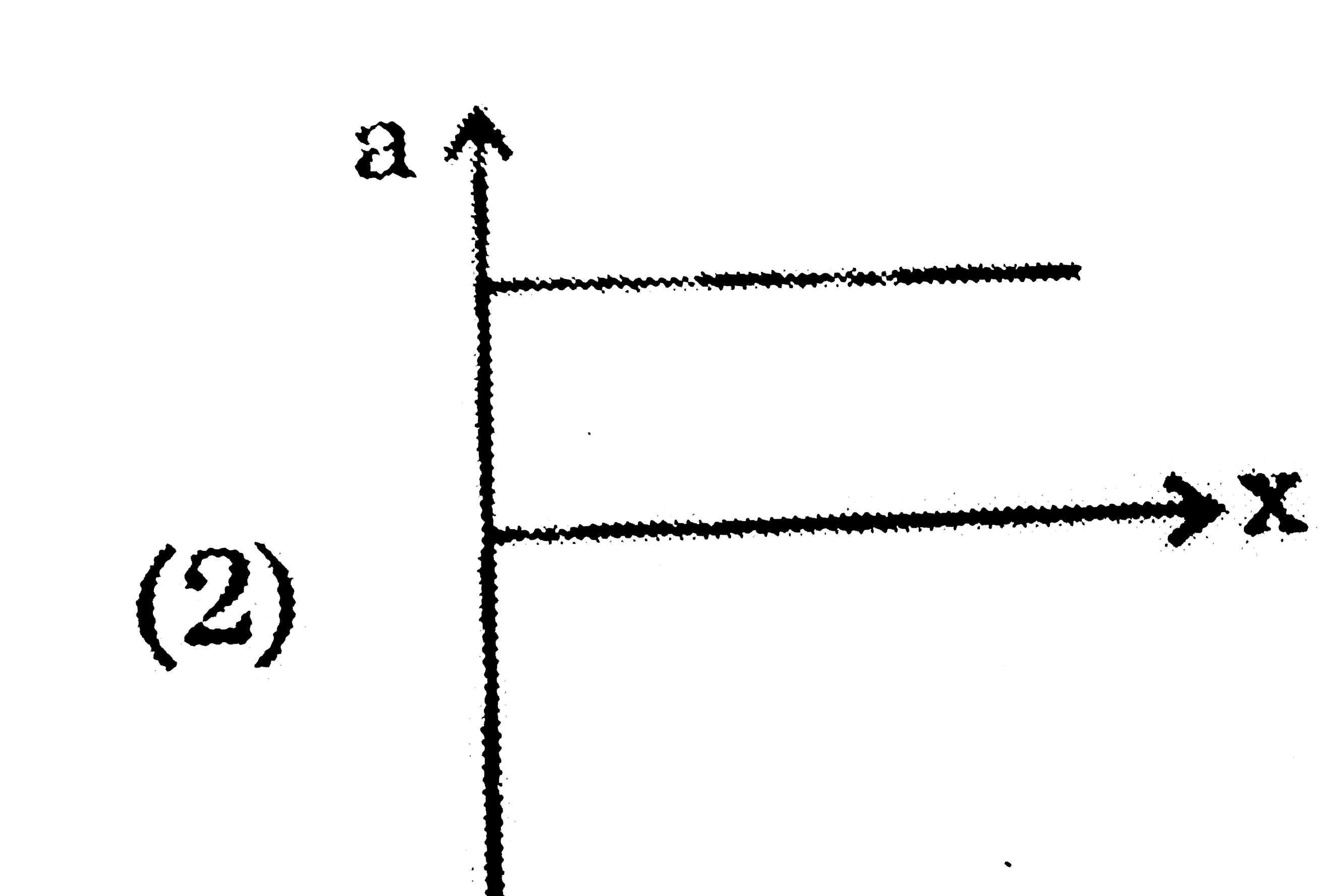
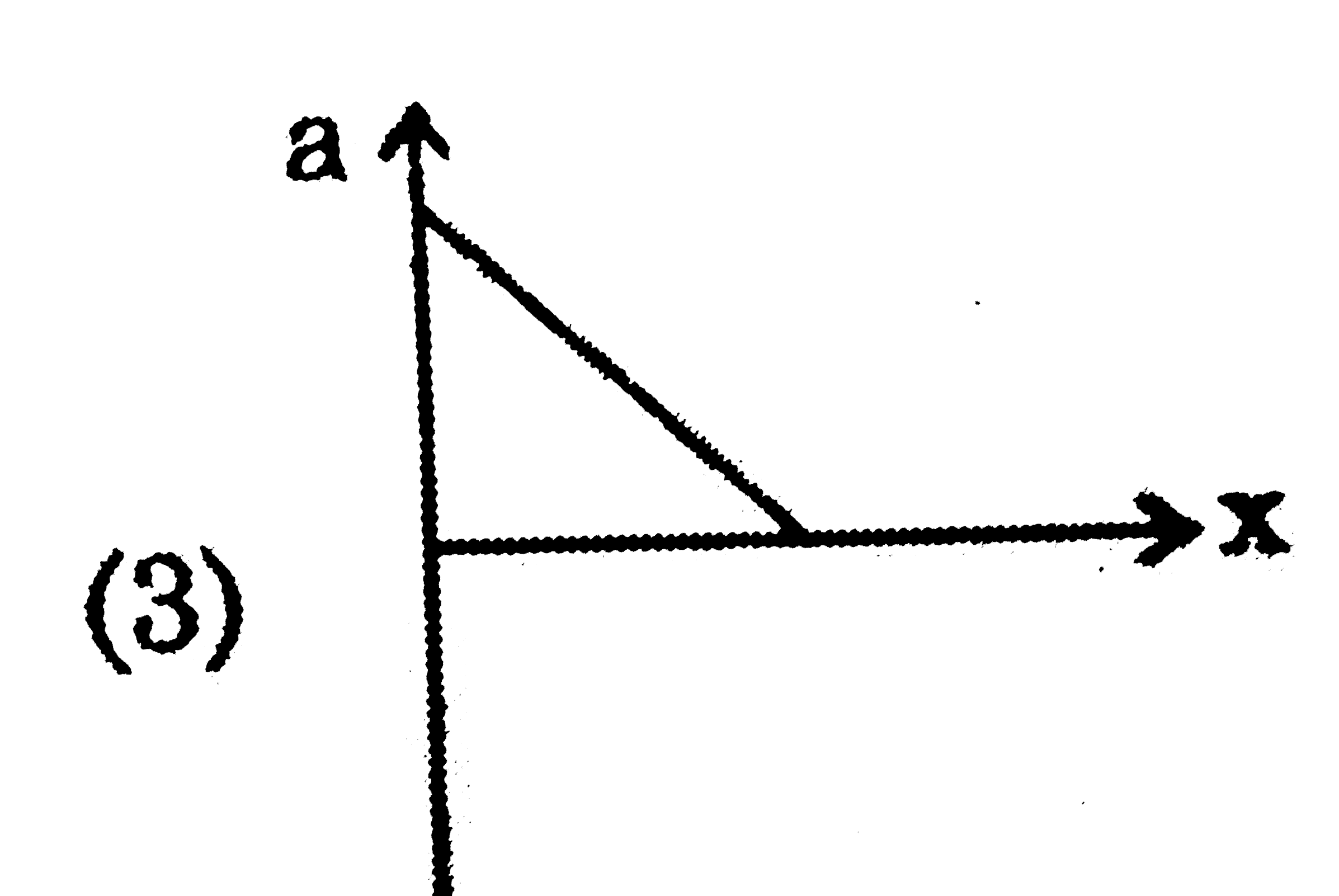
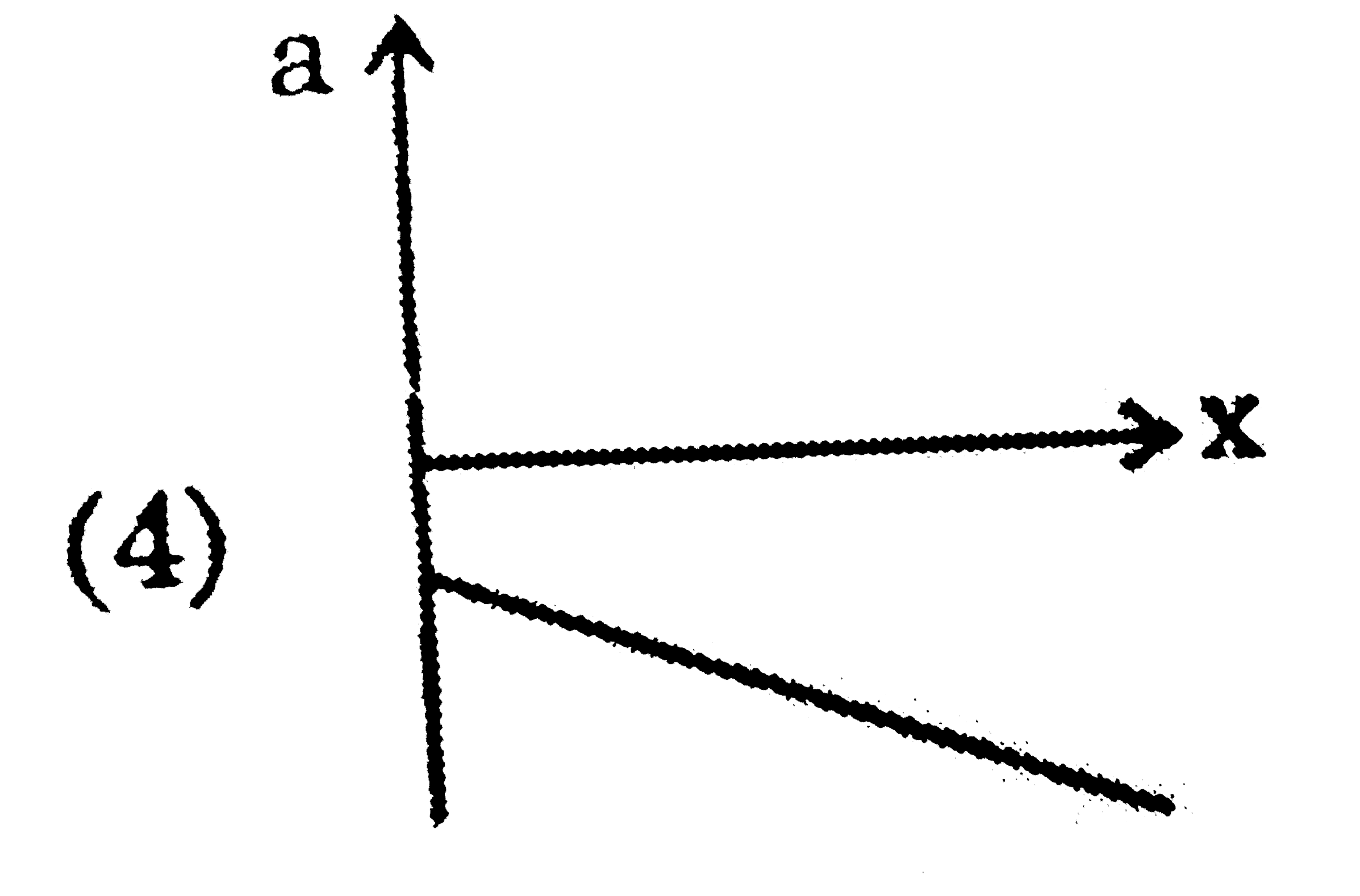
Draw a-x graph corresponding to given v-x graph . |
|
Answer»
|
|
| 36. |
The owner of a milk store finds that, he can sell 980 litres of milk each week at Rs. 14 // "litre" and 1220 litres of milk each week at Rs 16 // "litre". Assuming a linear relationship between selling price and demand, how many litres could he sell weekly at Rs 17 // "litre"? |
|
Answer» |
|
| 37. |
Ajay writes letters to his five friends and addresses the corresponding. The number of ways can the letters by placed in the envelopes so that atleast two of themare in the wrong envelopes is |
|
Answer» 120 |
|
| 38. |
If y(x) is a solution of (1+x)^((dy)/(dx)) = 1+ xy and y(0) = -1, then y(1) = |
|
Answer» Solution :`(DY)/(dx)+ (-X)/(1+x) y = 1/(1+x)` I.F. `=E^(-INT(x/(1+x))dx) = (1+x)e^(-x)` Solution y(x) is given by `y XX (1+x)e^(-x) = int e^(-x) dx = -e^(-x) +C` `y(1) = -1/2` |
|
| 40. |
Let [x] denote the greatest integer lex. The domain of definition of the function f(x)=sqrt((4-x^(2))/([x]+2)) is : |
|
Answer» `(-OO,-2)UU[-1,2]` |
|
| 41. |
A be a square matrix of order 2 with |A| ne 0 such that |A+|A|adj(A)|=0, where adj(A) is a adjoint of matrix A, then the value of |A-|A|adj(A)| is |
|
Answer» `1` Let `|A|=d=mq-np` `|A+dadjA|=|{:(m+qd,n(1-d)),(p(1-d),q+md):}|=0` `impliesmq+m^(2)d+q^(2)d+mqd^(2)-np+2npd-npd^(2)=0` `IMPLIES(mq-np)+(mq0np)d^(2)+m^(2)d+q^(2)d+2mqd-2d^(2)=0` `implies(d+d^(3)-2d^(2))+d(m^(2)+q^(2)+2mq)=0` Now, `|A- d adj|A|=-(m+q)^(2)+4(mq-np)=4d=4` |
|
| 42. |
Let f(x )= ( alphax^2 )/(x+1),x ne-1 the valueofalphafor whichf(a)=a , (a ne 0) is |
|
Answer» `1- 1/a` |
|
| 43. |
Find (dy)/(dx), If y^(x) + x^(y) + x^(x)= a^(b) |
|
Answer» |
|
| 44. |
Match the following for lists: |
|
Answer» `(m-2)x^(2)-(8-2m)x-(8-3m)=0` has roots of opposite SIGNS. The product of rootsis `-(8-3m)/(m-2)lt0` or `(3m-8)/(m-2)lt0` or `2ltmlt8//3` (b) Exactly one root of equation `x^(2)-m(2x-8)-15=0` lies in interval (0,1). `f(0)f(1)lt0` `implies(0-m(-8)-14)(1-m(-6)-15)lt0` `implies(8m-15)(6m-14)lt0` `implies15//8ltmlt7//3` (C) `x^(2)+2(m+1)x+9m-5=0` has both roots negative. Hence, sum of roots is `-2(m+1)ltormgt-1""(1)` Productof roots is `9m-5gt0impliesmgt5//9""(2)` Discriminant, `Dge0implies4(m+1)^(2)-4(9m-5)ge0` `impliesm^(2)-7m+6ge0` `impliesmle1ormge0""(3)` Hence, for (1), (2),and (3), we get `m""in((5)/(9),1]uu[6,oo)` (d) `f(x)=x^(2)+2(m-1)x+m+5=0` has one ROOTLESS than 1 and the other root greater than 1. Hence, `f(1)lt0` `implies1+2(m-1)+m+5lt0` `impliesmlt-4//3` |
|
| 45. |
A pair of dice is thrown 7 times. If getting a total of 7 is considered a success, what is the probability of atmost 6 success? |
|
Answer» |
|
| 46. |
Let A=(1,1,-1),B=(0,2,1) be two given points. Also, let P:x+y+z=0 be a plane. If A^(') and B^(') are the feet of perpendicular from A and B, respectively, on the plane 'P' then A^(')B^(') equals |
|
Answer» `SQRT(14)/3` |
|
| 47. |
If A^(2) - 3A +2I =0 then A^(-1) equals |
|
Answer» `(1)/(2) (A-3I)` |
|
| 48. |
If a body (coated black) at 600K surrounded by atmosphere at 300K has cooling rate r_(0),the same body at 900K, surrounded by the same atmosphere, will have the cooling rate close to: |
| Answer» Answer :a | |
| 49. |
Find coeff. of x^(25)in the expansion ofsum_(k=0)^(50)(-1)^(k)""^(50)C_(k)(2x-3)^(50-k)(2-x)^(k). |
|
Answer» |
|
| 50. |
The quadrilateral formed by the lines x-y+2=0, x+y=0, x-y-4=0, x+y-12=0 is |
|
Answer» PARALLELOGRAM |
|