

Saved Bookmarks
This section includes 7 InterviewSolutions, each offering curated multiple-choice questions to sharpen your Current Affairs knowledge and support exam preparation. Choose a topic below to get started.
| 1. |
Let lim_(x to) (1+(P(x))/(x^(5)))^((1)/(x^(3)-tan^(3)x)) exists and is equal to e^(9//7), where P(x) is a polynormial function. The degree of polynomial is |
|
Answer» 8 `:.P(x)` must be of degree greater than or EQUAL to 6 `i.e.P(x)=ax^(6)+bx^(7)+. . . . .. . . . . . .. ` `underset(xto0)lime^(underset(xto0)lim(1)/((x^(3)-tan^(3)x))(1+(P(x))/(x^(2))-1))=e^(9//7)` `underset(xto0)lim((x^(3))/(x-tanx))((x^(2))/(x^(2)+tan^(2)x+xtanx))(P(x))/(x^(5).x^(5))=(9)/(7)` `(-3)(2)underset(xto0)lim(P(x))/(x^(10))=(9)/(7)` `underset(xto0)lim(P(x))/(x^(10))=(-3)/(14)` Hence degree of P(x) is 10 |
|
| 2. |
If f(x)=f(pi + e - x) and int_(e)^(pi)f(x)dx=(2)/(e + pi), then int_(e)^(pi)xf(x)dx is equal to |
|
Answer» `PI - e` |
|
| 4. |
The probability distribution of x is Find the value of k |
|
Answer» 1)0.1 |
|
| 5. |
If A=[a_(ij)]_(nxxn)such that a_(ij)=0,for i nej then , A is …….. (a_(ij)nea_(jj))(ngt1) |
|
Answer» a COLUMN matrix |
|
| 6. |
Find the area bounded by the curves y= cos x and y= sin x between the ordinates x=0 and x= (3pi)/(2) |
|
Answer» |
|
| 7. |
For the reaction C_(2)H_(6)(g)hArrC_(2)H_(4)(g)+H_(2)(g),DeltaG^(@)=22.38KJ mol^(-1)" at "900K. If pure C_(2)H_(6) is passed over a suitable catalyst at a temperature of 900 K and a pressure of 1.0 atmosphere, then calculate X. Where X=100xx"mole percent of hydrogen present at equilibrium". [Antilog(1.299=0.05)] |
|
Answer» Or `K_(p)="antilog"[-(DeltaG^(@))/(2.303RT)]="antilog"[-(22.38xx10^(3)J)/((2.303)(8.314)(900))]` `K_(p)="antilog"[-1.299]` `K_(p)=0.050` `{:("Now,"""C_(2)H_(6)(g)hArrC_(2)H_(4)(g)+H_(2)(g)),("At equilibrium,"""(C-Calpha)""Calpha""Calpha):}` where 'C' is the initial concentration of `C_(2)H_(6).` Total moles at equilibrium `=C-Calpha+Calpha+Calpha=C+Calpha=C(1+alpha)` THEREFORE, the partial PRESSURE of `C_(2)H_(6)=(1-alpha)/(1+alpha).P` partial pressure of `H_(2)=(alpha)/(1+alpha).P` `K_(P)=0.050=([(alpha)/(1+alpha).P]^(2))/([(1-alpha)/(1+alpha)].P)=(alpha^(2))/((1+alpha)(1-alpha)).P=(alpha^(2))/(1-alpha^(2)).P` Then, `K_(p)=0.050=(alpha^(2))/(1+alpha^(2)).1" or "alpha=0.2182` Mole percent of `H_(2)=(alpha)/(1+alpha)xx100=(0.2182)/(1.2182)xx100=17.91` `X=17.91xx100=1791` Ans. |
|
| 8. |
Jasperwantsto measurethealtiude of hiskite. Hetiesthe kitestringto a spikedrivenintothegroundand measuresthe anglebetweenthe stringand theground. Thenhe createstwosimilartrianglesbyadjustingthedistancebetweenan-8 footpoleand thespikeuntilthe anglecreatedby apieceofstringis thesameas theanglehe measuredpreviously. thelengthof thestringto thekiteis 85feetandthelengthof thestringto thepoleis 17feet. which ofthe follpowingis closestto theheight, in feet, thatthekiteisabovethe ground? |
|
Answer» 25 |
|
| 9. |
Draw the graph of y=sin^(-1)("log"_(e)x). Also find the point of inflection. |
|
Answer» Solution :We have `y=f(X) =sin^(-1)("LOG"_(e)x)` `Heref(x) is defined if-1le" log"_(e)XLE1` `or ""e^(-1)lexle e` `f(x) = sin^(-1)("log"_(e)x)=0` `therefore"log"_(e)x=0` `therefore""x=1` So the graph meets the x-axis at (1,0). `f'(x)=1/(xsqrt(1-(log_(e)x))^(2))gt0," hence f(x) is invreasing".` `f'(x)=(sqrt(1-(log_(e)x)^(2))-(log_(e)x)/(sqrt((1-(log_(e)x)^(2)))))/(x^(2)(1-(log_(e)x)^(2)))` `f'(x)=sqrt(1-(log_(e)x)^(2))-(log_(e)x)/(sqrt((1-(log_(e)x)^(2))))=0` `therefore""(log_(e)x)^(2)+log_(e)x-1=0` `therefore""log_(e)x=(-1+sqrt5)/2` `therefore""x=e^((-1+sqrt5)/2)` Hence the graph of the FUNCTION is as shown in the FOLLOWING figure. 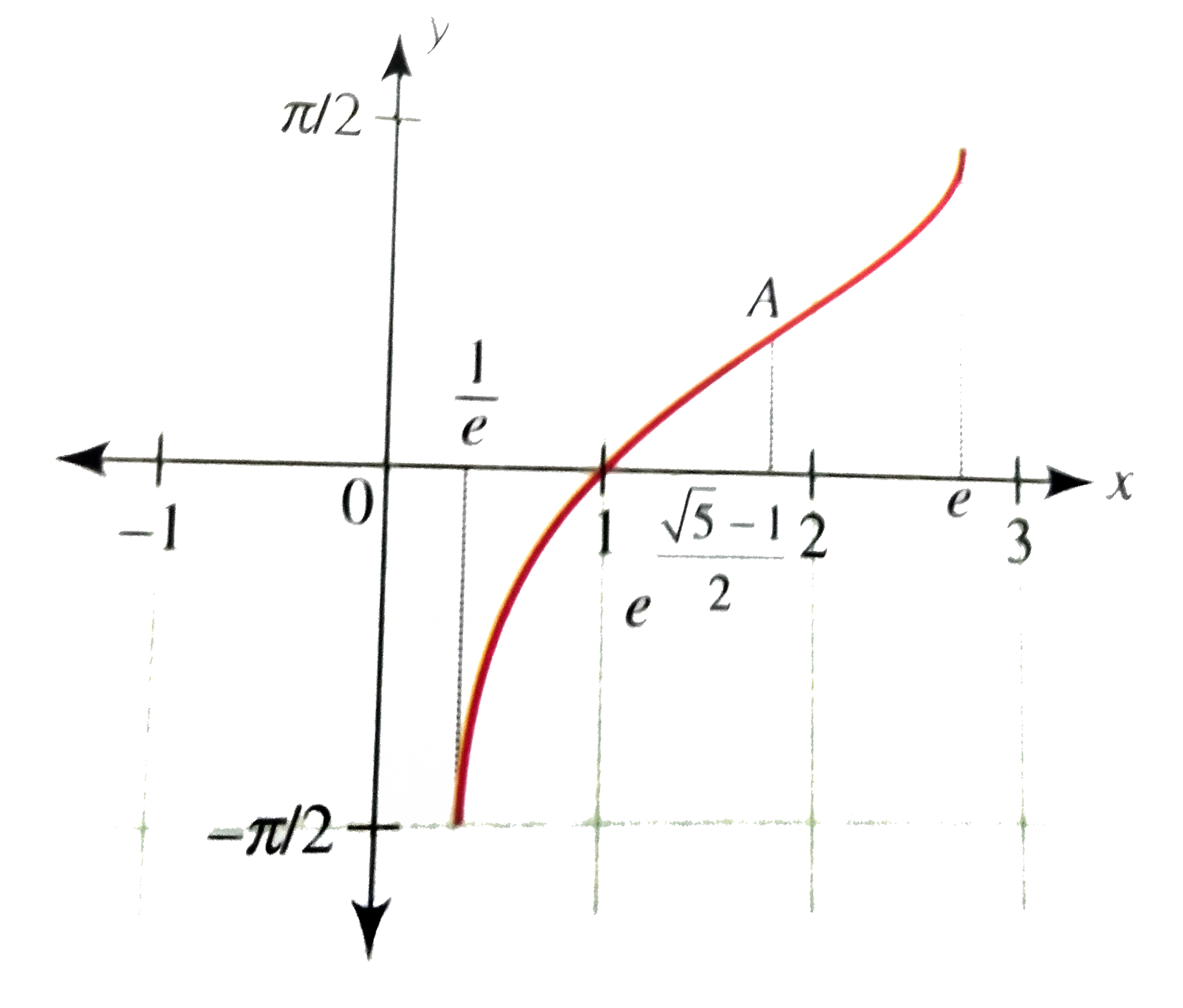 In the figure, the graph has his point of infection at point A. |
|
| 10. |
Let f(x) be twice differentiable on [1, 3], and let f(1)=f(3). Further if |f''(x)| le 2, then for all x in [1, 3] : |
|
Answer» `-1 le F'(x) le 1` |
|
| 11. |
int (("cosx")/(x) - "sinx.logx")dx = |
|
Answer» (log x) sinx + c |
|
| 12. |
If A=[{:(3,5),(1,2):}],B=adjAandC=3A, then (|adjB|)/(|C|)=....... |
| Answer» Answer :B | |
| 13. |
If I_(n) = int(sin^(n))dx, then nI_(n)-(n-1)I_(n-1) equals to |
|
Answer» `SIN^(n-1)x cosx` |
|
| 14. |
Given three identical boxes I, II and III, each containing two coins. In box I both coins are gold coins, in box II both are silver coins and in box III there is one gold and one silver coin. A person chooses a box at random and takes out a coin. If the first coin is gold, what is the probability that the other coin in the box is gold. |
|
Answer» |
|
| 15. |
Answer questions 4,5 and 6 by appropriately matching the information given in the three columns of the following table. Column l : Functions Column ll : Integration of the function with constants alpha,betaandgamma Column III : Sum of alpha,betaandgamma Which of the following options is the only CORRECT combination ? |
|
Answer» (II) (ii) (Q) |
|
| 16. |
Answer questions 4,5 and 6 by appropriately matching the information given in the three columns of the following table. Column l : Functions Column ll : Integration of the function with constants alpha,betaandgamma Column III : Sum of alpha,betaandgamma Which of the following options is the only CORRECT combination? |
|
Answer» (I) (IV) (P) |
|
| 18. |
The numberof waysinwhich6 menand4 ladiescansitarounda roundtableso thatno twoladiescome together is |
|
Answer» |
|
| 20. |
Find the number of ordered pair of real numbers (x, y) satisfying the equation: 5x(1+1/(x^(2)+y^(2)))=12 & 5y(1-1/(x^(2) + y^(2))) =4 |
|
Answer» |
|
| 21. |
Answer questions 4,5 and 6 by appropriately matching the information given in the three columns of the following table. Column l : Functions Column ll : Integration of the function with constants alpha,betaandgamma Column III : Sum of alpha,betaandgamma Which of the following options is the only INCORRECT combinations? |
|
Answer» |
|
| 22. |
Match the relation defined on set A={a,b,c} in column I with the corresponding type is columnII |
|
Answer» |
|
| 23. |
Iim_(n to oo) (1^(99) + 2^(99) + …..+ n^(99))/(n^(100)) equals : |
|
Answer» 100 |
|
| 24. |
The sum of coefficitents in the expansion of (1 + 3x -3x^(2))^(1143) is equal to |
| Answer» ANSWER :C | |
| 25. |
If n is a natural number, then |
|
Answer» `1^(2)+2^(2)+…..+n^(2)lt(n^(3))/(3)` |
|
| 26. |
A variable line is drawn through the origin O. Two points A and B same side of O are taken on the line such thatOA=1 and OB=2 unit. . Through points A and B two lines are drawn making equal angle alphawith the line AB. Then the locus of the point of intersection of the lines, is: |
|
Answer» `X^(2)+y^(2)=(9+tan^(2)ALPHA)/(4)` |
|
| 27. |
Evaluate the following lim_(xto1) (1+2x-3x^2+4x^3-5x^4) |
|
Answer» SOLUTION :`lim_(xto1)(1+2x-3x^2+4x^3-5x^4)` 1+2-3+4-5=7-8=-1 |
|
| 28. |
The probability that a student is not a swimmer is (4)/(5). The probability that out of 5 students exactly 4 are swimmers is ……….. |
|
Answer» `((1)/(5))^(3)` |
|
| 29. |
If int (x^(2)-x+1)/(x^(2)+1)e^(cot^(-1)x)dx=A(x)e^(cot^(-1)x)+c, then A(x) is equal to : |
| Answer» ANSWER :2 | |
| 30. |
Let y(x) be the solution of the differential equation . (x log x) (dy)/(dx) + y = 2x log x, (x ge 1). Then y (e) is equal to |
|
Answer» E |
|
| 31. |
The statement phArr q is not equivalent to |
|
Answer» `(pvvq)RARR (p^^q)` |
|
| 32. |
If A=[[1, 2, 3], [2, 3, 2], [1, 2, 2]], then |
|
Answer» `A_(12)+A_(22)+A_(32)=0` |
|
| 33. |
Find x and y :[[2x-y],[x+y]]=[[3],[-9]] |
|
Answer» SOLUTION :`[[2X,-y],[X,+y]]=[[3],[-9]]` `:.2x-y=3` `(x+y=-9)/(3x=-6)` `x=-2` `:. Y=-9+2=-7` |
|
| 34. |
(1 + x+x^2)^8 = a_0 + a_1x +…….+a_16 x^16 then a_0 - a_2 + a_4 - a_6 + ……..+a_16 = |
|
Answer» 1 |
|
| 36. |
Evaluate the limit . underset(n to 00)("Lt") (1+2^(4)+3^(4)+…….+n^(4))/(n^(5)) |
|
Answer» |
|
| 37. |
The tangent to the curvey=(1+x^2)^2at x=-1 has slope ______. |
|
Answer» 4 |
|
| 38. |
(Transportation Problem) A catering agency has two kitchens to prepare food at two places A and B. From these places 'Mid-day Meal' is to be supplied to threee different schools situated at P,Q,R. Themonthly requirments of the schools are respectively 40,40 and 50 food packets.A packet contains lunch for 1000 students.Preparing capacity of kitchen A and B are 60 and 70 packets per month respectively.The transpportation cost per packet for the kitchen to schools s given below: How many packets from kitechen should be transported to schools so that the cost of transportation is minimum? Also find the minimum cost. |
|
Answer» |
|
| 40. |
Compute the indicated products: (i) [(a,b),(-b,a)][(a,-b),(b,a)] (ii) [(1),(2),(3)][(2,3,4)] (iii) [(1,-2),(2,3)][(1,2,3),(2,3,1)] (iv) [(2,3,4),(3,4,5),(4,5,6)][(1,-3,5),(0,2,4),(3,0,5)] (v) [(2,1),(3,2),(-1,1)][(1,0,1),(-1,2,1)] (vi) [(3,-1,3),(-1,0,2)][(2,-3),(1,0),(3,1)] |
|
Answer» `(IV)[(14,0,42),(18,-1,56),(22,-2,70)] (V)[(1,2,3),(1,4,5),(-2,2,0)] (vi) [(14,-6),(4,5)]` |
|
| 41. |
If a=2hati+2hatj+3hatk, b=-hati+2hatj+hatk and c=3hati+hatj such that a + lambda b is perpendicular to c, then the value of lambda is |
|
Answer» 2 ` andC=3hati+ hatj` Now` (a+ lamda b) BOT c` ` implies( a + LAMDAB).c =0` `[ :' `SCALAR PRODUCTOF twoperpendicularvectorsis zero] ` implies[( 2 hati + 2 hatj+ 3 hatk )+lamda (-hati + 2 hatj + hatk ) ].(3 hati+ hatj )=0 ` `implies [(2 - lamda) hati +(2+ 2 lamda ) hatj +(3+ lamda )hatk ] .(3 hati+ hatj) =0` ` implies(2- lamda )3+(2+2lamda )1+(3+lamda )0=0` `implies6-3lamda+ 2 +2 lamda =0` `implies8-lamda =0` `implies lamda =8` hence , therequied valueof ` lamda ` is 8 . |
|
| 42. |
Discuss the relative position of the fol- lowing pair of circles. x^(2) + y^(2) + 6x + 6y + 14 = 0 x^(2) + y^(2) - 2x -4y -4 = 0. |
|
Answer» |
|
| 43. |
A vector vec( r ) has length 21 and directi9on ratio 2,-3,6. Find the direction cosines and components of vec( r ) given that vec( r ) makes an acute angle with X- axis. |
|
Answer» |
|
| 44. |
If a and b are respective coefficients of x^m and x^n in the expansion of (1+ x)^(m+n) then |
|
Answer» a + B = m+ N |
|
| 45. |
If y= log_(e)( log_(pi)x) , ( x gt 1) then ( d^2 y)/( dx^2) = ….... |
|
Answer» `- ((X .log_(e)x)^2) /( log_(e)(EX) )` |
|
| 46. |
Find the value of lambda so that the three vectors are co-planar. (2,-1,1), (1,2,-3) and (3,λ,5) |
|
Answer» Solution :Let `VECA = (2,-1,1), vecb = (1,2,-3), vecc = (3,lambda,5)` If `veca,vecb,vecc` are COPLANAR then `vecaxxvecb.vecc = 0` 
|
|
| 47. |
int tanx/sqrt(sinx) dx |
| Answer» | |
| 48. |
if f(x)={{:((8^(x)-4^(x)-2^(x)+1)/(x^(2)),xgt0),( x^(2) , x le 0):} is continuousat x=0 , thenthe valueof lamdais |
| Answer» Answer :C | |
| 49. |
Write the first three terms in the expansion of (2-(y)/(3))^(6) |
|
Answer» |
|