

Saved Bookmarks
This section includes 7 InterviewSolutions, each offering curated multiple-choice questions to sharpen your Current Affairs knowledge and support exam preparation. Choose a topic below to get started.
| 1. |
For what values of x in R, the following expressions are positive i) x^(2)- 5x + 6 ii) x^(2) - 5x + 14 iii) 4x - 5x^(2) + 1 |
|
Answer» |
|
| 2. |
Using differentials, find the approximate value of each of the up to 3 places of decimal. sqrt(0.6) |
|
Answer» |
|
| 3. |
If cosalpha+coabeta+cosgamma=0=sinalpha+sinbeta+singamma then cos(alpha+beta)+cos(beta+gamma)+cos(gamma+alpha)= |
|
Answer» 0 |
|
| 4. |
If the normals at Pand Q meet again on y^(2)=4axat R then centroid ofDelta PQRlies on |
|
Answer» Axis |
|
| 5. |
Find the direction cosines of the vector joiningthe points A(1,2,-3)and B(-1,-2,1), directed from A to B. |
|
Answer» |
|
| 6. |
To escape Quacky Turtle, Mario used a tunnel which was full of dirty water. To go out, he realized he had to drain all the water away, and immediately, he noticed that the valve box was locked by the lock shown below.15 plates numbered 1 to 15 were kept in the nearby rack, with the instruction, “The distance from plate numbered 1 to plate num- bered 2 will be less than the distance from plate numbered 2 to plate numbered 3, which is less than the distance from 3 to 4, and so on”. Placing the plates on the unshaded circles, satisfying the conditions on board, find out the value of a+b (where a and b are the numbers to be filled in the indicated circles). Note : Here Distance is calculated from centre of One Circle to centre to another Circle |
|
Answer» 10 0,4 16 1,4 17 2,4 20 3,4 25 4,4 32 0,3 09 1,3 10 2,3 13 3,3 18 0,2 04 1,2 05 2,2 08 0,1 01 1,1 02 which are 14 possibilities and that means all will be used in this puzzle as no two distancecan be equal. So there will be 4,4 difference in 14,15... 3,4 in 13 ,14 and so on... Now we start from the sides and write VARIABLE for which positions are POSSIBLE, then wesee different positions possible and continue till we reach one solution. WE GO back from ITTO fill all the remaining squares and we will get a=6 and b=10 Answer will be 16 |
|
| 7. |
Using differentials, find the approzimate value of each of the following up to 3 places of decimal :sqrt(25.3) |
|
Answer» |
|
| 9. |
Consider the sequence a _(n+1) = (1)/( 1 - a _(n)) , nge 1 Given that a _(1) = (1)/(2) find sum of first 100 terms of this sequence |
|
Answer» |
|
| 10. |
The value of sum_(r=0)^(20)(-1)^(r )(""^(50)C_(r))/(r+2) is equal to |
|
Answer» `(1)/(50xx51)` `T_(r)=(-1)^(r)(.^(50)C_(r))/(r+2)` `=(-1)^(r)(r+1)(.^(50)C_(r))/((r+1)(r+2))` `=(-1)^(r)(r+1)(.^(52)C_(r+2))/(51xx52)` `= (-1)^(r)([(r+2)-1]^(52)C_(r+2))/(51xx52)` `= (-1)^(r)([52.^(51)C_(r+1)-.^(52)C_(r+2)])/(51xx52)` `= ([-52.^(51)C_(r+1)(-1)^(r+1)-.^(52)C_(r+2)(-1)^(r+2)])/(51xx52)` `underset(r=0)overset(50)sum(-1)^(r)(.^(50)C_(r))/(r+2)` ` = -52((1-1)^(51)-.^(51)C_(0))/(51xx52)-((1-1)^(52)-.^(52)C_(0)+.^(52)C_(1))/(51xx52)` `= 1/51-1/52` `= 1/(51xx52)` Alternate solution : `(1-x)^(n)=underset(r=0)overset(n)sum.^(n)C_(r)(-1)^(r)x^(r)` or `x(1-x)^(n)=underset(r=0)overset(n)sum(-1)^(r).^(n)C_(r)x^(r+1)` Intergrating both sides WITHING the LIMITS 0 to 1, we get `underset(0)overset(1)intx(1-x)^(n)dx=underset(r=0)overset(n)sum(-1)^(r)(.^(n)C_(r))/(r+2)` or `underset(r=0)overset(n)sum(-1)^(r)(.^(n)C_(r))/(r+2) = underset(0)overset(1)intx(1-x)^(n)dx` `= underset(0)overset(1)int(1-x)x^(n)dx`(Replace x by `1-x`) `= |(x^(n+1))/(n+1)-(x^(n+2))/(n+2)|_(0)^(1)` `= (1)/(n+1)-(1)/(n+2)` `= (1)/((n+1)(n+2))` Now PUT `n = 50`. |
|
| 11. |
If A(-1, 2, -3), B(5, 0, -6) and C(0, 4, -1) are the verticesof triangle ABC, then the directionratios of the internal bisector of angleBAC are |
|
Answer» (5, 6, 7) |
|
| 12. |
The number of ways in which 11 denoted pencils can be distributed among 6 kids each receiving atleast one is |
| Answer» Answer :A | |
| 13. |
IF a linehasdirection rations2,-1,-2thendetermineitsdirection cosines . |
|
Answer» |
|
| 14. |
If f(a+b-x) = f(x), then int_a^b xf(x) dx = |
|
Answer» `(a+b)/2 int_a^b F(b-X) DX` |
|
| 16. |
Find (dy)/(dx) if x^(2)+xy+y^(2)=100 |
|
Answer» |
|
| 17. |
If ax^2+2hxy+by^2+2gx+2fy+c=0 and ax^2+2hxy+by^2-2gx-2fy+c=0 each represents a pair of lines , then prove that the area of the parallelogram enclosed by them is (2|c|)/(sqrt(h^2-ab)). |
| Answer» | |
| 18. |
The population of a city increases at a rate proportional to the number of its inhabitants present at any time t. If the population of the city was 2,00,000 in 1990 and 2,50,000 in 2000, what was the population of the city in 2010 ? |
|
Answer» |
|
| 20. |
|(x^(3)+x,x+1,x-2),(2x^(3)+3x-1,3x,3x-3),(x^(3)+2x+3,2x-1,2x-1)|=xA+B there A= |
|
Answer» `|(1,1,1),(-4,0,0),(3,-3,3)|` |
|
| 21. |
If sqrt(x) + sqrt(y) = sqrt(5), Prove that (dy)/(dx) = (-3)/(2) when x= 4" and "y=9. |
|
Answer» |
|
| 22. |
A bag contains 5 balls and it is not known how many of them are white. Two balls are drawn and these are found to be white. Find the probability that all the balls in the bag are white. |
|
Answer» |
|
| 23. |
Find the equation of all lines having slope 2 and being tangent to the curve y+(2)/(x-3)=0. |
|
Answer» |
|
| 24. |
y= sqrt(sin x + sqrt(sin x + sqrt(sin x + …….oo))) then (dy)/(dx)=……… |
| Answer» Answer :A | |
| 25. |
(1.02)^6+(0.98)^6= |
|
Answer» 2.002 |
|
| 26. |
At the foot of the mountain the elevation of its summit is 45^@, after ascending 100 m towards the mountain up a slope of 30^@ inclination, the elevation is found to be 60^@. The height of the mountain is |
|
Answer» `(sqrt3+1)/2`m |
|
| 27. |
If I_(1) = int_(0)^(1) 2^(x^(2))dx, I_(2) = int_(0)^(1) 2^(x^(3))dx, I_(3) = int_(1)^(2) 2^(x^(2))dx, I_(4)=int_(1)^(2) 2^(x^(3))dx then |
|
Answer» `I_(1) GT I_(2)` |
|
| 29. |
By giving counter examples , show that the equation x^2 -1 =0 does not have any root lying between 0 and 2 are not true: |
|
Answer» Solution :`x =1` is a root of `x^2 -1 =0` that lies between 0 and 2. `:.`The given statement is FALSE. |
|
| 30. |
Let A = {1,2,3,4,5} Define on operation v by a vee b =max {a,b} Prepare its compostion table Show that a is closed for the given operation and that the given operation is commutative |
Answer» Solution :We prepare the table as given below 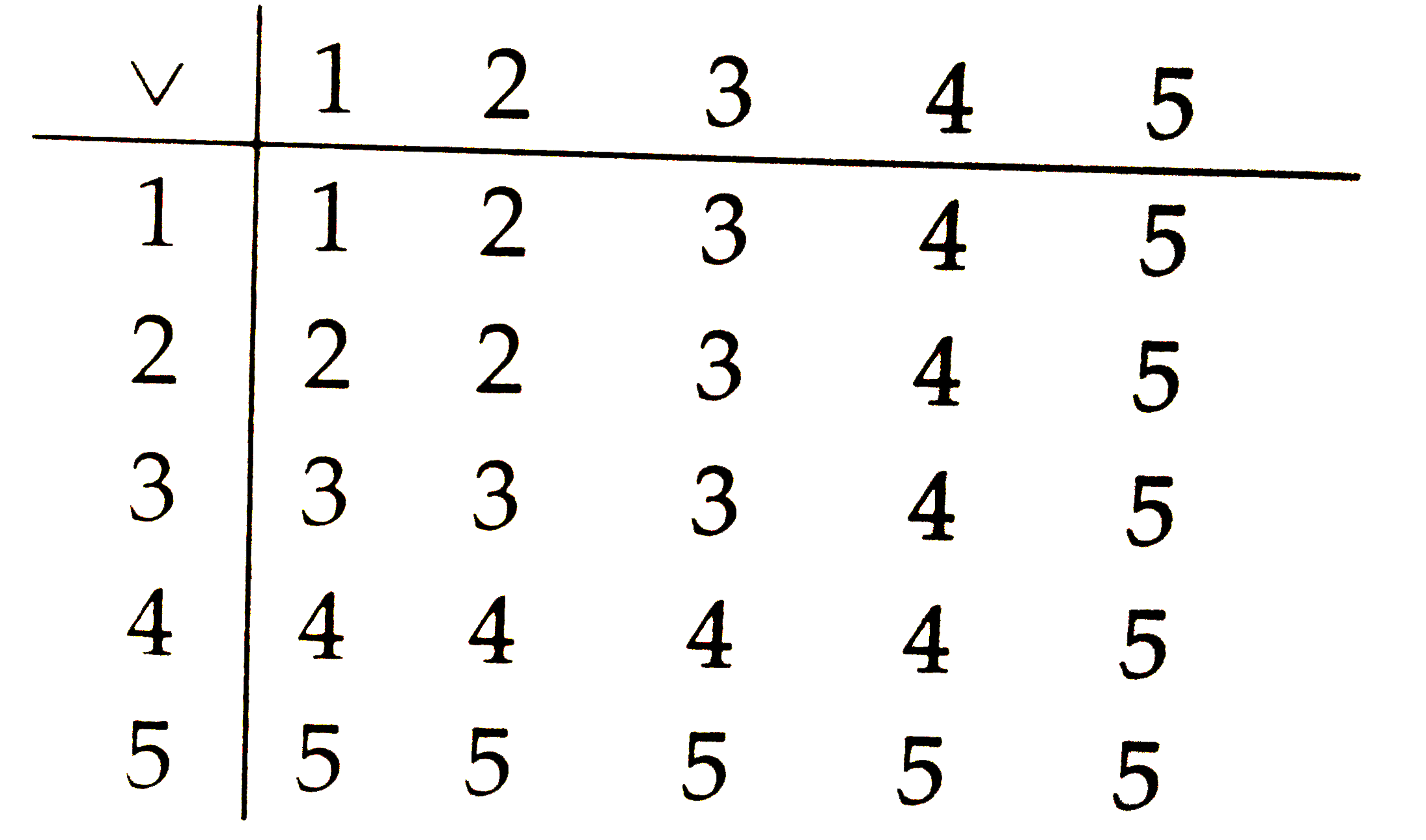 Closure property since all the entries of the composition table are FORM the given SET so closure property is satisfied Commutative law Clearly every ROW coincides with the CORRESPONDING column So commuative law is sastisfied |
|
| 31. |
A tangent to the hyperbola at P and y-axis at Q. Lines PR and QR are drawn such that OPRQ is a rectangle (where O is the origin), then R lies on |
|
Answer» `(4)/(X^(2))+(2)/(y^(2))=1` |
|
| 32. |
Let A be the area of triangle formed by any tangent to the curve xy = 4 cosec2theta, theta ne npi, n in I andthe co-ordinate axis. The minimum value of A is :- |
|
Answer» `rArr A_(min)=8` |
|
| 33. |
Fit a straight line to the following data treating y as the dependent variable |
|
Answer» |
|
| 34. |
If x cos alpha + y sin alpha = - sin alpha tan alpha be the equation of a line, then the length of the perpendiculars on the line from the points (a^(2), 2a), (ab, a+b) and (b^(2), 2b) are in |
|
Answer» A.P. |
|
| 35. |
If y=sec4x" and "t=tanx," then "(1-6t^(2)+t^(4))^(2)(dy)/(dx)= |
|
Answer» `16T(1=-t^(4))` |
|
| 36. |
If 3 le 3t - 18 le 18 , then which one of the following is true ? |
|
Answer» `15 le2t + 1 LE 20` |
|
| 37. |
A student is allowed to select atmost 'n' books from a collection of (2n + 1) books. If the total no. of ways in which he can select one or more books is 63, then n is |
|
Answer» 1 |
|
| 38. |
Let P(theta_1) and Q(theta_2) are the extremities of any focal chord of the hyperbola (x^(2))/(a^(2))-(y^(2))/(b^(2))=1 whose eccentricity is e. Let theta be the angle between its asymptotes. Tangents are drawn to the hyperbola at some arbitrary points R. These tangent meet the coordinate axes at the points A and B respectively. The rectangle OABC (O being the origin) is completedm, then Q.Locus of point C is |
|
Answer» `(B^(2))/(X^(2))-(a^(2))/(y^(2))=1` |
|
| 39. |
Find the number of ways of arranging 6 boys and 6 girls around a circular table so that all the girls sit together |
|
Answer» |
|
| 40. |
Write the interval in which the fuction f(x)=sin^-1(1-x) is differentiable. |
| Answer» SOLUTION :`sin^-1(1-x)` is DIFFERENTIABLE for `-1lt1-xlt1rArr-2lt-xlt0rArr2gtxgt0rArrx in(0,2)` | |
| 41. |
Evaluate : int ( sqrt( tan x) - sqrt( cot x)) dx |
|
Answer» |
|
| 42. |
A bag contains 10 coins of which atleast 2 are one - rupee coins. Two coins are drawn and both are found to be not one-rupee coins. What is the probability of the bag to contain exactly 2 one rupee coins. |
|
Answer» |
|
| 43. |
Let P(theta_1) and Q(theta_2) are the extremities of any focal chord of the hyperbola (x^(2))/(a^(2))-(y^(2))/(b^(2))=1 whose eccentricity is e. Let theta be the angle between its asymptotes. Tangents are drawn to the hyperbola at some arbitrary points R. These tangent meet the coordinate axes at the points A and B respectively. The rectangle OABC (O being the origin) is completedm, then Q. The value of cos((theta)/(2)) is |
|
Answer» `(1)/(2E)` |
|
| 44. |
Let P(theta_1) and Q(theta_2) are the extremities of any focal chord of the hyperbola (x^(2))/(a^(2))-(y^(2))/(b^(2))=1 whose eccentricity is e. Let theta be the angle between its asymptotes. Tangents are drawn to the hyperbola at some arbitrary points R. These tangent meet the coordinate axes at the points A and B respectively. The rectangle OABC (O being the origin) is completedm, then Q. If cos^(2)((theta_1+theta_2)/(2))=lambdacos^(2)((theta_1-theta_2)/(2)), then lambda is equal to |
|
Answer» `(a^(2)+B^(2))/(a^(2))` |
|
| 45. |
If therootsof the equation4x^3-12x^2 +11x +k=0are inarithmeticprogression thenk= |
| Answer» ANSWER :A | |
| 46. |
If alpha, beta are the roots of the equation x^(2)-px+q=0, prove that log_(e)(1+px+qx^(2))=(alpha+beta)x-(alpha^(2)+beta^(2))/(2)x^(2)+(alpha^(3)+beta^(3))/(3)x^(3)-... |
|
Answer» `LOG(X^(2)+px+q)` |
|
| 47. |
The orthocentre of the triangle formed by the lines x+y=6, 2x+y=4, x+2y=5 is |
|
Answer» (11, 10) |
|
| 48. |
If A[{:(1,-2,-5),(3,4,0):}]=[{:(-1,-8,-10),(1,-2,-5),(9,22,15):}]then ,A=……. |
|
Answer» `[{:(2,-1,1),(0,-3,4):}]` |
|
| 49. |
If f(x) = lim_(n->oo) tan^(-1) (4n^2(1-cos(x/n))) and g(x) = lim_(n->oo) n^2/2 ln cos(2x/n) then lim_(x->0) (e^(-2g(x)) -e^(f(x)))/(x^6) equals |
|
Answer» `8/3` |
|
| 50. |
int_(0)^(pi) log(1 + cos x)dx. |
|
Answer» |
|